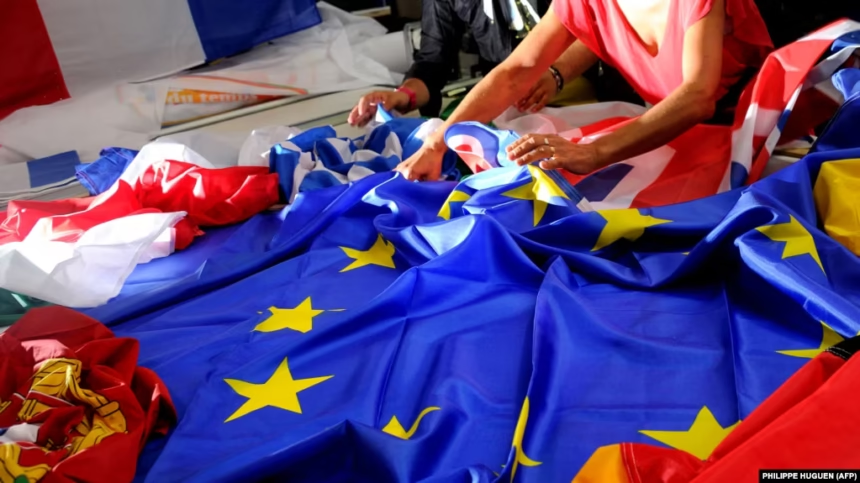
Kosovo may be on the verge of a structural breakthrough in its stagnant relationship with the European Union. A powerful new diplomatic initiative, driven by some of the EU’s heaviest institutional players, aims to gradually integrate the Western Balkans into the European Single Market—offering a realistic economic lifeline well ahead of full, formal political membership.
The proposal has gained serious geopolitical traction, backed by a strong diplomatic push from German Chancellor Friedrich Merz, signalling a major policy shift toward the region.
What is the European Single Market?
The European Single Market is a unified economic territory encompassing all 27 EU member states, alongside select non-EU partners like Norway and Iceland. It operates as a single domestic market based on the “Four Freedoms”:
   ┌────────────────────────────────────────────────────────┐
   │             THE FOUR FREEDOMS OF THE BE              │
   ├──────────────┬──────────────┬──────────────┬───────────┤
   │    MALLRAT   │   SHËRBIMET  │   KAPITALI   │  NJERËZIT │
   │  (Goods)     │  (Services)  │  (Capital)   │ (People)  │
   └──────────────┴──────────────┴──────────────┴───────────┘
     Elimination of all border regulations, tariffs, and customs.
By removing trade barriers, the framework harmonizes product standards across borders, allowing businesses to treat the entire continent as a single, frictionless marketplace.
The Secret Non-Paper and the “Merz Doctrine”
The momentum behind this shift stems from a confidential diplomatic “non-paper” distributed to member states by a coalition composed of Austria, Czechia, Italy, Slovakia, and Slovenia. The document outlines a plan to grant Western Balkan nations gradual access to the Single Market to maintain the momentum of EU expansion.
What elevates this initiative above past proposals is the explicit political backing of Germany’s new Chancellor, Friedrich Merz.
In a formal letter dispatched to EU leaders on May 21, 2026, Merz proposed granting Western Balkan nations a privileged, phased entry into the Single Market alongside observer status in core EU decision-making institutions. Under this architecture, Ukraine would be elevated to an “associated member” status without immediate voting rights, establishing a rapid-acceleration track for candidate countries.
Why Gradual Integration Fits Kosovo’s Unique Dilemma
While neighbors like Albania and Montenegro are locked in active accession negotiations, and Serbia, North Macedonia, and Bosnia hold formal candidate status, Kosovo remains isolated. Nearly four years after submitting its application, Prishtina is the only capital in the Western Balkans without candidate status.
                  [REGIONAL ACCESSION STANDING]
                                │
       ┌────────────────────────┴────────────────────────┐
       ▼                                                 ▼
   [CANDIDATE STATUS / ACTIVE]                     [NO CANDIDATE STATUS]
   • Montenegro   • Albania                        • Kosovo
   • Serbia       • North Macedonia                (Stuck in limbo 4 years post-app)
   • Bosnia & Herzegovina
Toby Vogel, a senior analyst at the Democratization Policy Council in Brussels, suggests that gradual market integration bypasses this political deadlock. Crucially, it does not legally require formal diplomatic recognition from the five EU non-recognizers (Spain, Greece, Cyprus, Slovakia, and Romania).
“The European Commission would need to explain to member states in a legally robust manner why Kosovo, despite non-recognition, can participate in specific aspects of the internal market,” Vogel told REL. “Kosovo has friends in the EU, but it lacks friends willing to spend political capital to push its full membership forward right now. Gradual integration is the only realistic path forward.”
Economic Impacts: Short-Term Pain, Long-Term Gains
The transition into a highly competitive trade zone carries both opportunities and risks for Kosovo’s consumption-driven economy.
According to Kosovar trade expert Sytrime Dervisholli, the structural impact will follow a distinct timeline:
- The Initial Risk: Small, domestic manufacturing sectors may face immediate pressure when exposed to direct competition from high-efficiency European industrial giants.
- The Long-Term Win: Lower consumer prices, superior quality control, and the complete elimination of customs friction for exporting firms.
Top Export Sectors Poised to Benefit:
- Information Technology (IT) & Digital Services
- Prefabricated Construction Materials
- Wood Processing & Furniture Manufacturing
- Beverage and Agro-Processing Industries
The Economic Context: 2026
The structural push comes at a critical time for Kosovo’s domestic economy. According to recent data from the International Monetary Fund (IMF), real GDP growth slowed to 3.6% in 2025, down from 4.6% in 2024.
Concurrently, driven by global supply disruptions, headline inflation rose to 5.75% in January 2026, disproportionately affecting food prices and highlighting the urgent need to integrate Kosovo’s small economy into larger, more stable European supply lines.