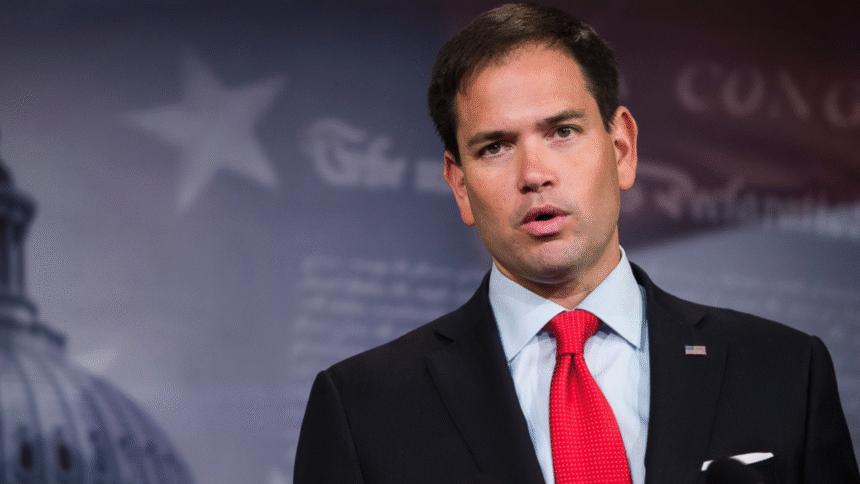
.S. Secretary of State Marco Rubio issued a stern ultimatum to Tehran on Thursday, declaring that any prospective diplomatic accord to end the ongoing U.S.-Israeli conflict with Iran would become completely “unfeasible” if the Islamic Republic moves forward with plans to levy maritime tolls on commercial shipping in the Strait of Hormuz.
Speaking to reporters at Homestead Air Reserve Base in Florida before boarding his plane for a high-stakes NATO summit in Sweden, Rubio slammed the proposed tolling mechanism as an unlawful extortion scheme against global commerce.
The statement comes amid breaking reports that Iran and Oman are actively negotiating a permanent maritime tariff structure to formalize joint oversight over the heavily disrupted chokepoint.
   [THE STRAIT OF HORMUZ STANDOFF]
   • Iranian Directive:    Proposing a maritime toll system for all transit vessels.
   • U.S. Legal Position:  Labeling the toll regime completely illegal under international law.
   • Diplomatic Impact:    Rubio warns the implementation acts as an absolute dealbreaker.
The Pakistani Mediation Channel
Despite the escalating rhetoric surrounding global energy lanes, Rubio revealed that behind-the-scenes diplomatic backchannels are still showing fragile signs of operational progress.
The top U.S. diplomat expressed cautious optimism regarding the high-profile mediation mission of Pakistan’s Army Chief, General Asim Munir, who arrived in Tehran on Thursday following extensive preliminary groundwork by Pakistani Interior Minister Mohsin Naqvi.
              [THE TEHRAN-WASHINGTON BACKCHANNEL]
                               │
       Pakistani Interior Minister Finalizes Groundwork in Tehran
                               │
                               ▼
       Army Chief Asim Munir Lands in Iran to Deliver Mediation Framework
                               │
                               ▼
       Rubio Cautiously Observes "Good Signs" While Holding "Other Options"
“We are dealing with an Iranian system that itself is a little fractured,” Rubio noted, carefully balancing his expectations. “There are some good signs, but I don’t want to be overly optimistic. Let’s see what happens over the next few days. President Trump’s preference is always to secure a good deal, but if we cannot, the president has been entirely clear that he has other options.”
Pre-Summit Broadside: Rubio Bashes NATO’s “Refusal to Act”
The urgent briefing served as an aggressive prelude to Rubio’s arrival at the NATO Foreign Ministers’ meeting in Helsingborg, Sweden. The Secretary of State used his final press appearance on American soil to launch a scathing critique against European allies, accusing them of abandoning Washington on the Iranian security front.
The political fallout follows the unilateral U.S.-Israeli military strikes against Iranian facilities on February 28, a campaign launched without prior consultation with Brussels.
   [THE TRANSATLANTIC BURDEN-SHARING DISPUTE]
   • U.S. Grievance:    NATO allies refuse to offer logistical or political backing for the Iran conflict.
   • White House Claim: Trump is not asking for fighter jets, but expects baseline structural support.
   • Allied Hesitation: European states fear deep regional escalation and economic blowback.
“There are many countries in NATO that openly agree Iran is a global threat and must never obtain a nuclear weapon, but they refuse to back our policy responses,” a visibly frustrated Rubio stated. “President Trump is not asking them to send their own fighter jets or commit combat troops. But they refuse to do even the bare minimum, and we are very upset about that.”
Rubio further warned that while NATO provides critical regional basing that allows the U.S. to project power into the Middle East, the strategic utility of the alliance is heavily undermined when European members restrict American access to those exact facilities during active conflicts.