Even after Russia’s invasion of Ukraine and the Kremlin’s growing international isolation, Serbia continues to be Russia’s most important ally in the Balkans. Belgrade’s refusal to impose sanctions on Moscow, along with its political, energy, and strategic ties with Russia, has kept Serbia at the center of Russian influence in the region.
According to Paolla Petrić of the Heinrich Böll Stiftung office in Sarajevo, the Balkans remain one of Moscow’s geopolitical pressure points for destabilizing the European Union and slowing down Euro-Atlantic integration in the region.
Although Serbia is officially a candidate for European Union membership, it remains one of the few European countries that has refused to join sanctions against Russia. This has reinforced perceptions that Belgrade is still the Kremlin’s closest regional partner.
At the same time, relations between Serbia and Russia have not been without tensions. Last year, Russian intelligence accused Serbia of indirectly supplying weapons that eventually reached Ukrainian forces through third countries such as the Czech Republic and Bulgaria.
Dalliborka Uljarević, director of the Center for Civic Education in Podgorica, said Russia continues to tolerate Serbia because of its strategic importance in the Balkans.
“Serbia relies on Russia because of the Kosovo issue, while Russia needs a major regional state through which it can project influence across the Balkans,” she told Radio Free Europe.
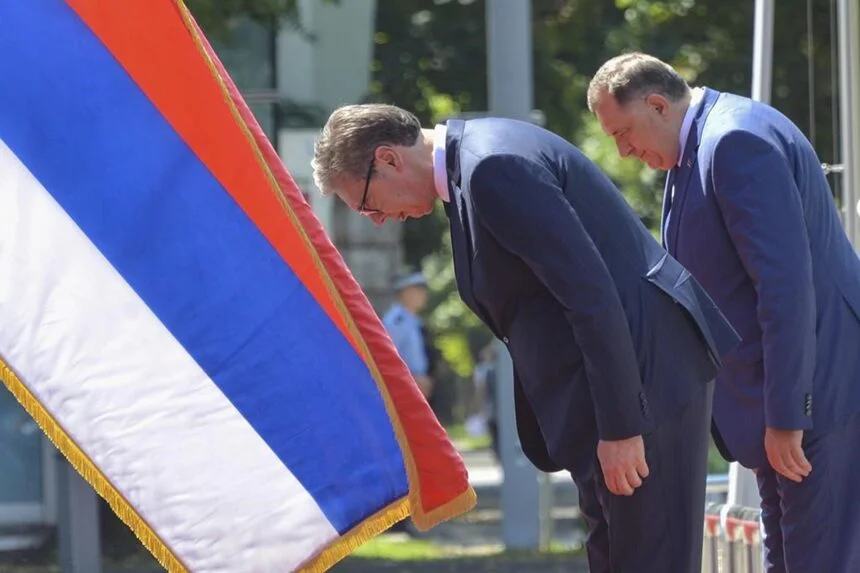
In Bosnia and Herzegovina, Republika Srpska leader Milorad Dodik remains one of the Kremlin’s closest political allies. Since the start of the war in Ukraine, Dodik has met Russian President Vladimir Putin nine times, following a balancing strategy similar to that of Serbian President Aleksandar Vučić.
Analysts believe Russian influence in the Balkans is primarily sustained through its alliance with Serbia and pro-Serbian political structures in the region, especially in Republika Srpska.
Meanwhile, after Viktor Orbán’s departure from power in Hungary, Russia lost one of its strongest allies inside the European Union, making Serbia even more strategically important for Moscow’s geopolitical interests in Southeast Europe.
Experts also warn that the rise of populism and anti-Western narratives in the Balkans continues to create fertile ground for Russian influence, while weak democratic institutions in the region make that influence even more dangerous.