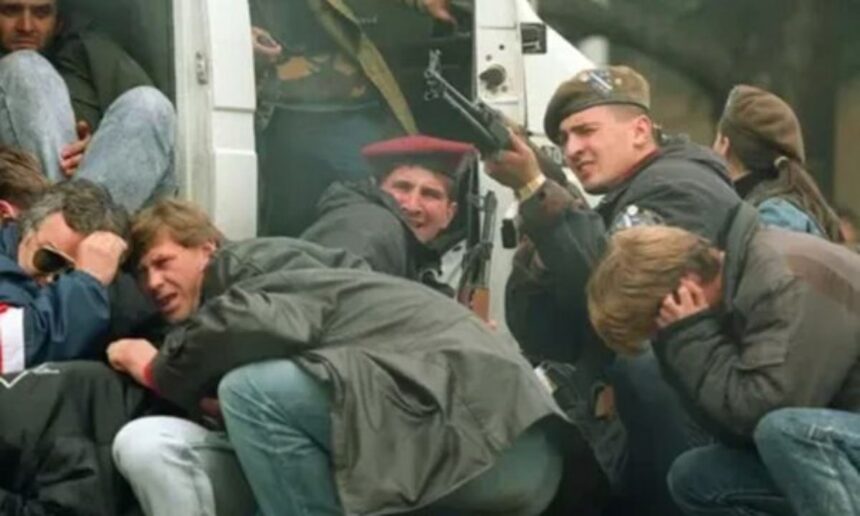
The Milan Public Prosecutor’s Office has launched a landmark international war crimes investigation into a sinister network that allegedly organized “death safaris” for wealthy Westerners during the Bosnian War.
According to an exposé by the German magazine Der Spiegel, the probe is targeting affluent individuals—collectively dubbed “weekend snipers”—who paid thousands of dollars to be embedded with Serb paramilitary units surrounding the besieged city of Sarajevo in the 1990s, explicitly to hunt and murder innocent civilians for sport.
The Prosecutors: Two Heavyweights of the Italian Judiciary
The highly sensitive investigation is being orchestrated from the Milan Palace of Justice by two of Italy’s most seasoned and formidable legal minds:
- Marcello Viola (Chief Public Prosecutor of Milan): A legendary magistrate in Italy, Viola is coordinating the legal framework of the case. He spent decades on the frontlines of Italy’s brutal war against organized crime, famously prosecuting top-tier bosses of the Sicilian Mafia (Cosa Nostra).
- Alessandro Gobbis (Lead Investigating Prosecutor): Directing the case on the ground alongside the Carabinieri’s elite ROS (Special Operations) unit, Gobbis has built an unshakeable reputation within the Italian judiciary for his clinical, high-stakes prosecutions of international terrorism and espionage networks.
The criminal proceedings, spearheaded by Viola and executed by Gobbis, are investigating several European citizens under the charge of “multiple counts of premeditated murder aggravated by cruelty and abject motives.” Under Italian law, these charges carry a mandatory sentence of life imprisonment.
Unmasking the “Sarajevo Safari” Infrastructure
The active judicial inquiry is attempting to reconstruct the logistics of a highly organized, underground pipeline that catered to affluent Western men—predominantly over the age of 50—from Italy, France, Germany, Austria, and Switzerland.
          [THE "SARAJEVO SAFARI" INDUSTRIAL PIPELINE]
                              │
                              ▼
 ┌────────────────────────────────────────────────────────┐
 │ 1. INDUCTION & PAYMENTS                                │
 │    Clients paid €50,000–€100,000 to shadowy networks  │
 ├────────────────────────────────────────────────────────┤
 │ 2. REGIONAL TRANSIT                                    │
 │    Assembled in Trieste, Italy -> Routed via Belgrade   │
 ├────────────────────────────────────────────────────────┤
 │ 3. EMBEDDING & EXECUTION                               │
 │    Escorted to VRS sniper nests in the Sarajevo hills  │
 └────────────────────────────────────────────────────────┘
According to evidence compiled in the case file, these “tourists” paid astronomical fees—estimated between 50,000 and 100,000 Deutsche Marks at the time—to be transported to positions controlled by the Army of Republika Srpska (VRS) in the hills surrounding Sarajevo, such as the Jewish Cemetery. Witnesses allege that price tiers escalated significantly if the “hunter” requested to target young children.
Intelligence Disclosures and Key Testimonies
The Milan prosecutors have made significant headway by incorporating testimonies from high-ranking diplomatic and intelligence sources. A pivotal element of the file includes a damning deposition by Michael Giffoni, a prominent former Italian diplomat who served in Bosnia during the 1990s and later became Italy’s Ambassador to Kosovo.
Giffoni’s testimony reveals that Italy’s former Military Intelligence and Security Service (SISMI) had full, contemporaneous knowledge of these operations. Intelligence agents regularly documented the movements of these wealthy clients and intercepted reports detailing how the foreign mercenaries celebrated their kills.
Furthermore, Italian investigators have already subpoenaed records from the International Criminal Tribunal for the former Yugoslavia (ICTY) in The Hague and have begun interrogating specific suspects—including a retired 80-year-old logistics worker and a Milanese industrialist.
Expanding European Scope and Balkan Resistance
While the investigation gains momentum in Milan, the shockwaves have triggered parallel legal actions across Western Europe:
- Austria: Federal prosecutors in Vienna have opened their own formal inquiry into Austrian nationals linked to the transit ring.
- Germany & Switzerland: Lawmakers and civil rights organizations are aggressively petitioning their respective ministries of justice to open matching criminal files.
However, investigators face a starkly contrasting reality in the Balkans. Der Spiegel notes that while civil groups and survivors in Sarajevo are cooperating fully, there remains a deep, institutional reluctance and systemic foot-dragging within Bosnia and Herzegovina’s fragmented state judicial institutions, where profound ethnic divisions continue to paralyze the prosecution of war-era atrocities.