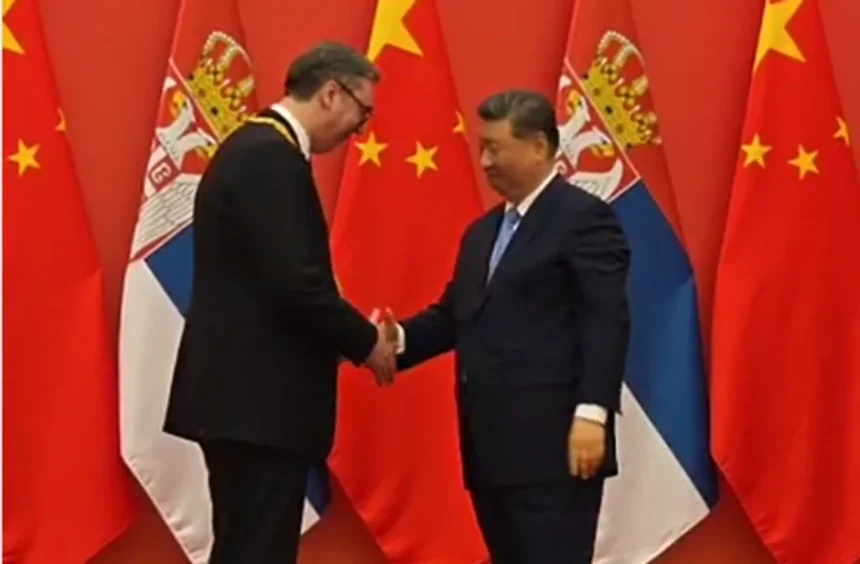
State and mainstream media outlets across the People’s Republic of China have given saturated, high-profile coverage to Serbian President Aleksandar Vučić’s official state visit to Beijing.
Following a high-stakes bilateral summit at the Great Hall of the People where President Xi Jinping personally decorated Vučić with China’s highest foreign honor, state commentators are framing the Belgrade-Peking axis as a groundbreaking blueprint for China’s broader diplomatic strategy on the European continent.
The “Demonstration Effect” and Global Geopolitics
The state-run Global Times explicitly noted that the rock-solid, friction-free relationship between Belgrade and Beijing carries a heavy “demonstration effect” tailored for other European nations.
            [THE SINO-SERBIAN "DEMONSTRATION EFFECT"]
                                │
                                ▼
  ┌──────────────────────────────────────────────────────────┐
  │ TARGET AUDIENCE: EU Member States divided on China trade │
  ├──────────────────────────────────────────────────────────┤
  │ THE KREMLIN MODEL: Balanced diplomacy avoids bloc coding  │
  ├──────────────────────────────────────────────────────────┤
  │ THE REWARD: High-tech tech transfers & market access     │
  └──────────────────────────────────────────────────────────┘
According to Cui Hongjian, a professor at Beijing Foreign Studies University interviewed by the outlet, this blueprint serves as a living template at a time when Beijing’s relations with several Western European capitals are heavily bogged down by trade wars and political friction.
Chinese analysts argue that Serbia’s ability to maintain an autonomous, “balanced diplomacy” between China, the EU, the United States, and Russia proves that European nations can harvest immense economic gains without subscribing to Washington-led decoupling strategies.
Expanding Beyond Steel: The Next Era of the Silk Road
While traditional infrastructure projects under the Belt and Road Initiative (BRI)—such as the Smederevo Steelworks, the Belgrade-Budapest high-speed railway, and the Fruška Gora Corridor—were heavily praised by state broadcaster CGTN, Chinese media stressed that the relationship is entering a highly sophisticated phase.
According to data compiled by the Chinese Ministry of Foreign Affairs, bilateral trade has surged by 13% year-on-year, hitting a record $6.49 billion. Fuelled by the Free Trade Agreement that entered into force on July 1, 2024, the next strategic phase of cooperation will pivot hard toward:
- Artificial Intelligence (AI) and Next-Gen Digital Infrastructure
- Green Energy Transition and Advanced Green Manufacturing
- Systemic Security Cooperation: The South China Morning Post highlighted joints agreements expanding combined police patrols, joint special forces counter-terrorism drills, and the physical security management of critical BRI logistical hubs inside Serbia.
A Shared Future: The Order of Friendship
The emotional and symbolic peak of the state visit occurred when President Xi Jinping presented Vučić with the Order of Friendship, the highest state decoration the People’s Republic of China can bestow upon a foreign national.
The ceremony was widely shared across Chinese digital spaces, including the official “Xi’s Moments” account on X.
President Xi Jinping on Serbia’s Alignment: “Our friendship possesses deep historical logic and an unshakeable practical foundation. President Vučić has consistently provided the firmest, clearest, and most unambiguous support to China on matters involving our core national interests, earning him the deep respect of the Chinese people.”
Vučić accepted the medal, calling it “one of the most monumental moments of my life” and a supreme validation of Serbia’s sovereign, independent foreign policy. Following the ceremony, the two leaders oversaw the signing of over 20 distinct bilateral agreements spanning science, commerce, judiciary affairs, and culture, formally cementing the transition of their alliance into a comprehensive “Community with a Shared Future in the New Era.”