The traditional foreign policy framework that has sustained Serbian President Aleksandar Vučić for over a decade is undergoing a chaotic and high-stakes transformation. As domestic instability deepens and international patience wears thin, Belgrade is attempting a highly volatile strategic pivot: replacing its historical balancing act between the European Union and Russia with an arguably more dangerous balancing act between the United States and the People’s Republic of China.
In an exhaustive analytical report published in the May 29, 2026 edition of the investigative weekly Radar (Issue 115), Bojana Selaković, Coordinator of the National Convention on the European Union (NCEU), breaks down how a perfect storm of domestic criminal scandals and structural shifts in global power have pushed the Serbian regime into a state of geopolitical hyperactivity.
1. The Collapse of the Post-2022 Balancing Doctrine
For years, Vučić’s survival strategy mirrored a lesson Slobodan Milošević failed to grasp but Josip Broz Tito mastered during the Cold War: staying close enough to all global powers to be perceived as an indispensable guarantor of Balkan stability, while remaining distant enough to preserve a facade of domestic autonomy.
Until recently, this multi-vector strategy relied on distinct pillars of systemic dependency:
- Energy Dependency: Relied entirely on the Russian Federation.
- Economic Dependency: Anchored directly to European Union markets and developmental investments.
- Financial & Infrastructure Dependency: Bankrolled primarily by the People’s Republic of China.
However, the prolonged war in Ukraine fundamentally erased the geopolitical “grey zone” between East and West. While Brussels initially tolerated institutional corruption, controlled media environments, and flawed election cycles in exchange for localized regional stability, European leaders now view Western Balkan integration as a strict, non-negotiable national security interest.
The regime attempted to bypass Brussels’ mounting demands for structural democratic reforms by offering alternative geopolitical currency—granting access to Serbia’s lithium reserves, purchasing French Rafale fighter jets, and funneling domestic ammunition to Ukraine. Simultaneously, Vučić offered symbolic tokens of loyalty to Moscow, underscored by his high-profile attendance at the military parade in Moscow celebrating the 80th anniversary of the end of World War II. Despite these maneuvers, international interlocutors across the board have lost patience with Belgrade’s selective compliance.
2. The Clash of Dual European Realities
Selaković highlights a growing, internal contradiction within the European Union’s institutional approach toward Serbia, creating a diplomatic friction point that is rapidly coming to a head:
                      [THE PARALLEL LOGICS OF EU-SERBIA RELATIONS]

  The Institutional Bureaucracy (EP / Marta Kos) ─────► The Geopolitical Executive (von der Leyen)

  • Focus: Rule of law, judicial independence,        • Focus: Short-term regional containment,
    and electoral integrity.                           migration control, and energy security.
  • Action: Proposing freezing Growth Plan funds      • Action: Maintaining direct lines with Vučić
    over "Mrdić's laws" and police brutality.           to insulate the Balkans from Russia.
These two opposing philosophies are colliding in an increasingly unstable security environment. While the executive branch continues to protect Vučić to prevent immediate regional fragmentation, the legislative and institutional arms of the EU realize that prolonged “stabilocracy” inevitably breeds the exact domestic volatility Europe fears most.
This friction explains Belgrade’s aggressive rejection of the gradual EU accession model proposed by German Chancellor Friedrich Merz. The “Merz Model” actively bars candidate states from treating the EU as an à la carte buffet (enjoying access to the single market and Schengen privileges) without permanently adopting the bloc’s rigid political, legal, and democratic criteria.
3. Domestic Fractures: Cracking the Illusion of Invincibility
The frantic nature of Vučić’s current diplomatic offensive is directly tied to a deteriorating domestic landscape. The regime’s carefully cultivated aura of political invincibility is cracking along two distinct fault lines:
- High-Level Police Corruption Scandals: The explosive criminal fallout surrounding the “Senjak Case” and the subsequent arrest of high-ranking law enforcement officials—including former Belgrade Police Chief Veselin Milić—has exposed deep rot within the state apparatus. Selaković notes that global superpower networks are entirely comfortable dealing with authoritarian figures, but will swiftly abandon them the moment they are perceived as politically spent and structurally unpredictable partners (citing the historical precedent of Milo Đukanović in Montenegro).
- The Student-Led Protest Wave: Months of continuous, highly organized civic demonstrations led by student movements have effectively broken the ruling Serbian Progressive Party’s (SNS) absolute monopoly over societal energy and narratives of the future. Autocratic structures do not merely fear standard opposition parties; they fear the psychological turning point where the general public, domestic elites, and foreign investors realize the ruling order is no longer permanent.
4. A Dangerous Gamble: Caught Between Washington and Beijing
Faced with shifting ground at home, Vučić is launching a frantic diplomatic offensive, attempting to navigate the highly polarized fissure separating Washington and Beijing.
| Foreign Policy Vector | Concurrent Diplomatic Maneuvers (May 2026) | Long-Term Strategic Risk |
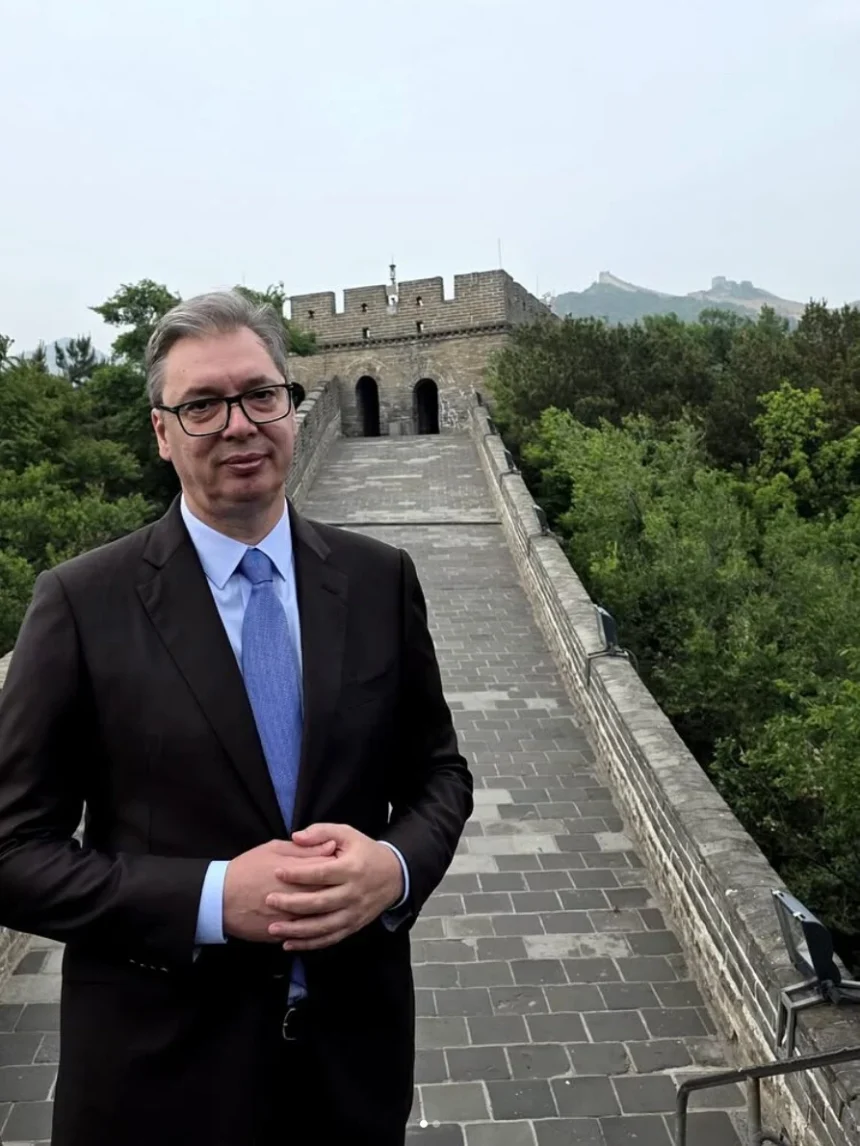
| The Beijing Anchor | Deepening comprehensive political, technological, and infrastructure agreements directly with Xi Jinping in Beijing. | Reassigns Serbia a quasi-colonial status, granting unchecked access to domestic resources in exchange for regime survival. |
| The Washington Anchor | Attempting to initiate an expansive Strategic Dialogue with the Donald Trump administration. | A calculated bid to bypass traditional EU channels by positioning Belgrade as Trump’s primary illiberal partner in the Balkans, effectively seeking to replace Viktor Orbán’s regional relevance. |
The systemic rivalry between the United States and China is no longer confined to trade disputes; it encompasses the fundamental architecture of the future global order—spanning artificial intelligence, semiconductor supply chains, energy infrastructure, and defense networks. In a conflict of this magnitude, small nations cannot maintain prolonged, opportunistic neutrality.
Conclusion: Colonial Status as a Unifying Catalyst
In an attempt to appease both superpowers simultaneously, the Serbian presidency has taken to writing synchronized public panegyrics to both Washington and Beijing, offering up the country’s infrastructure, legal exemptions, and natural resources.
Paradoksalno, Selaković concludes that this desperate overreach is inadvertently curing the deep political polarization that has historically fragmented the Serbian opposition. By reducing the sovereign status of the country to a transactional asset for foreign powers, the regime has erased the artificial divisions between domestic “Westernizers” and “Russophiles.”
As the lines harden, the diverse factions of Serbia’s protest movement are finding a singular, unified rallying cry: resisting a foreign policy that reduces the nation to a colonial outpost, regardless of whether that administration is directed from Washington or Beijing.