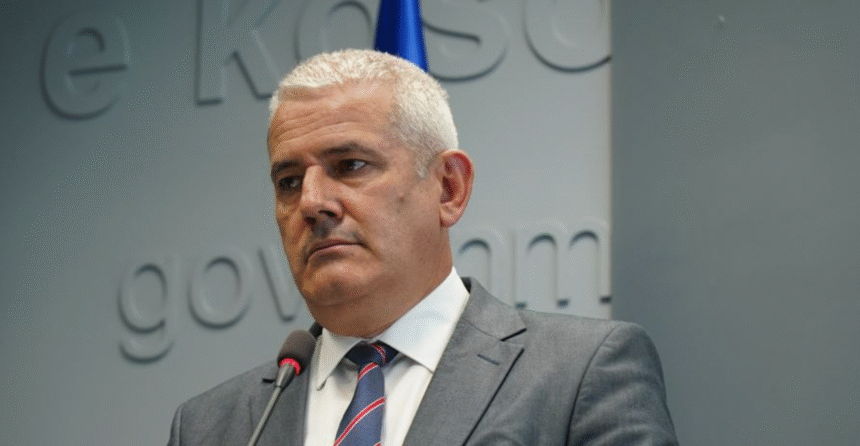
Kosovo’s Minister of Internal Affairs, Xhelal Sveçla, has delivered a scathing response to the highly controversial remarks made by Serbian Minister Snežana Paunović, asserting that her comments are not an isolated personal opinion but a reflection of Serbia’s historic state policy toward ethnic Albanians.
In an interview with Euronews Albania, Sveçla reacted to Paunović’s declaration that she would have “ethnically cleansed” Kosovo in 1998 had she been in Slobodan Milošević’s shoes. The interior minister labeled the current Serbian leadership—specifically President Aleksandar Vučić and Interior Minister Ivica Dačić—as direct ideological successors to the Milošević regime, warning that Belgrade remains a fundamental source of regional instability.
“Not a Personal Statement”: A Historic Pattern of Repression
Sveçla firmly rejected any attempts by Belgrade to downplay Paunović’s remarks as an individual lapse of judgment. He pointed out that her position as the Minister of State Administration and Local Self-Government gives her words official, institutional weight.
“This is absolutely not the personal statement of an individual. First of all, she is a minister in the government of Serbia. Secondly, it reflects a historical Serbian stance against Albanians throughout history.”
— Xhelal Sveçla, Kosovo Minister of Internal Affairs
                    [ Sveçla's Historical Timeline ]
                                   |
         +-------------------------+-------------------------+
         |                                                   |
         v                                                   v
  [ Pre/Post-WWII Expulsions ]                       [ Late 1980s Repression ]
  • Systemic campaigns forcing Albanians             • Belgrade-driven displacement waves
    out of their ancestral lands.                      preceding the open warfare of the 90s.
         |                                                   |
         +-------------------------+-------------------------+
                                   |
                                   v
                      [ The Modern Diaspora ]
                      • Millions of Kosovar Albanians forced to
                        live abroad due to decades of state-sponsored terror.
The Lineage of Belgrade’s Ruling “Cabal”
Sveçla reserved his sharpest criticism for Ivica Dačić, who defended Paunović by suggesting that Serbs who do not feel at home in Serbia should “go to Albania or Kosovo,” and President Aleksandar Vučić. He argued that neither has ever truly distanced themselves from the genocidal legacy of the 1990s.
- Ivica Dačić (The Legacy of Milošević): Sveçla reminded viewers that Dačić—the current Serbian Interior Minister and head of the Socialist Party of Serbia (SPS)—was Milošević’s official spokesperson and political “number two” during the height of the wars.
- Aleksandar Vučić (The Legacy of Šešelj): The Kosovo minister noted that Vučić served as the close lieutenant to Vojislav Šešelj, the ultranationalist leader convicted of war crimes by the International Criminal Tribunal for the former Yugoslavia (ICTY).
- Aleksandar Vulin: Sveçla pointed out that Vulin, another high-ranking Serbian official, was historically the right-hand man to Mirjana Marković, Milošević’s wife and political partner.
“It is the exact same clique. They were the ‘number twos’ back then, and they hold the power now. It is the exact same policy—only the global circumstances have changed.”
— Xhelal Sveçla, Kosovo Minister of Internal Affairs
“We Are No Longer Victims”
Despite the threatening rhetoric coming from Belgrade, Sveçla concluded his interview with a message of institutional strength and deterrence. He emphasized that the geopolitical reality of 2026 is vastly different from that of 1998, and that the Republic of Kosovo is fully prepared to defend its sovereignty.
While Belgrade’s threats may reflect their “innermost wishes,” Sveçla declared that the continuous consolidation of Kosovo’s rule of law and security apparatus ensures that Albanians will never again be passive victims of state-sponsored ethnic cleansing.