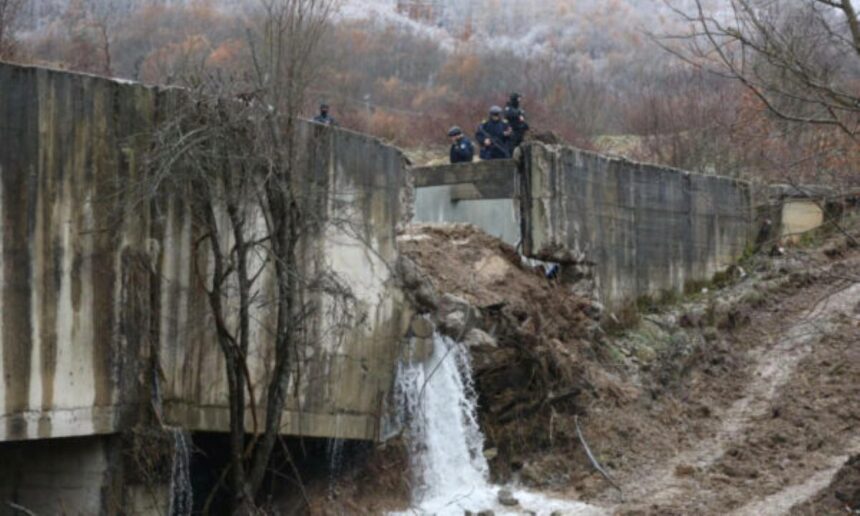
The Basic Court of Prishtina has officially confirmed the indictment filed by the Special Prosecution Office regarding the terrorist attack on the Ibër-Lepenc water canal, which occurred on November 29, 2024.
The first-instance court ruled that the indictment and presented evidence establish a well-founded suspicion that brothers Jovan and Dragisha Viqentijeviq committed the criminal offenses of “Endangering the constitutional order by destroying or damaging public installations and equipment” in connection with “Committing a terrorist act,” alongside unauthorized weapons possession.
Additionally, the court found well-founded suspicion that Jovan Viqentijeviq committed espionage, while another defendant, Igor Dimoviqi, is charged with unauthorized weapons possession.
“From the evidence highlighted above, at this stage of the procedure, the court is convinced there is a well-founded suspicion that the defendants committed the criminal offenses brought against them,” the court’s decision states. “In order to fully and correctly verify the factual situation… the court will administer all proposed evidence during the main trial, where the criminal liability of the defendants will ultimately be determined.”
Key Evidence: DNA and Soil Samples
The November 2024 attack caused a massive disruption in water supply for Mitrovica, Skenderaj, and northern municipalities, while also severely threatening electricity production across Kosovo.
Among the prosecution’s key forensic components are the defendants’ DNA profiles discovered on the fuse used to detonate the explosives, alongside specific soil samples collected from the defendants’ boots.
The defense team has fiercely contested these findings. Milos Delevic, the defense attorney for Dragisha Viqentijeviq, argued that the DNA expertise conducted by the Forensic Science Police Service in Rome was based on mixed profiles and should be dismissed. Delevic also challenged a geological report provided by the U.S. Federal Bureau of Investigation (FBI), claiming the soil in that regional zone has a highly similar composition, making the timeline of the traces impossible to pinpoint cleanly.
However, the Basic Court ruled that these arguments must be thoroughly debated during the trial rather than throwing out the case prematurely.
“Regarding the DNA analysis, the court notes that although it initially involved mixed profiles, subsequent testing at a specialized international laboratory succeeded in individualizing the profile,” the ruling stated. Addressing the FBI’s geological data, the court noted that comparative analyses linking the soil on the boots to the crime scene hold sufficient weight to be evaluated during judicial review.
Defense Challenges Dismissed
The path to confirming the indictment saw several procedural hurdles. At the start of the initial review, defense attorneys made a rare request to dismiss the case prosecutor, Bekim Kodraliu, claiming biased investigative practices. This request was rejected by both the Chief Prosecutor of the Special Prosecution Office, Blerim Isufaj, and the Court of Appeals.
Presiding Judge Vesel Ismaili ultimately ruled that the prosecution’s decision not to accept certain defense proposals during the investigation phase—such as specific alibi claims—does not constitute grounds to throw out the indictment, as the defense retains the right to present additional evidence during the main trial.
The defense further questioned the legality of the evidence seized during house searches, citing the absence of independent witnesses. The court countered that while a lack of witnesses during a raid can affect how the credibility of the evidence is evaluated later, it does not automatically render the search illegal, particularly under urgent circumstances permitted by law.
With the indictment officially sustained, the high-profile case is now set to proceed to a full trial in Prishtina.