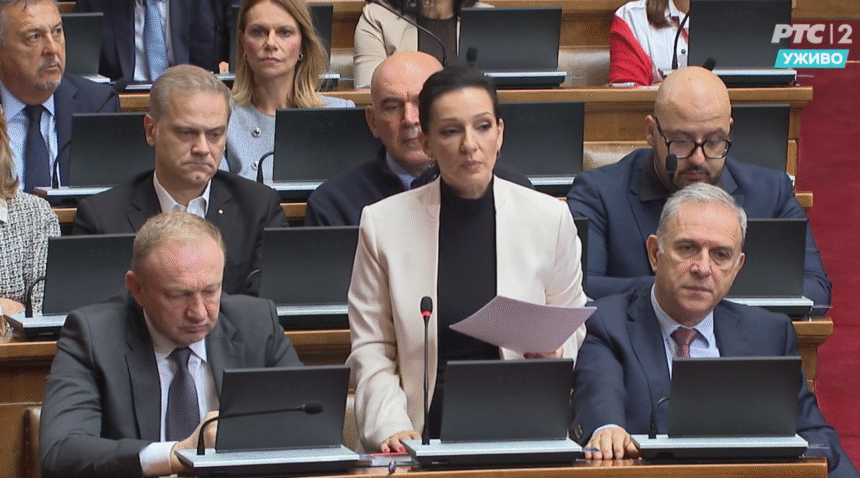
The Vice President of the opposition Party of Freedom and Justice (SSP), Marinika Tepić, issued a blistering critique of Serbia’s law enforcement on Sunday, stating that the national police force has never been as disgraced or criminalized in the country’s recent history as it is under the administration of President Aleksandar Vučić.
In an official statement released by the SSP, Tepić alleged that the primary and sole qualification for advancement within the Ministry of Internal Affairs (MUP) has become absolute loyalty to what she characterized as “the Vučić brothers’ cartel.”
“Former Car Dealers and Red Berets” at the Helm
Tepić raised serious concerns regarding the leadership of critical police departments, claiming that key units are currently being directed by individuals with highly problematic backgrounds.
“Today, the most important police units are managed by former car dealers and officers from the ‘Red Berets,'” Tepić stated, referring to the notorious Special Operations Unit (JSO) whose former members were convicted of the 2003 assassination of Serbian Prime Minister Zoran Đinđić.
According to Tepić, while questionable figures are elevated to top positions, true career professionals within the force are systematically degraded, marginalized, and subjected to intense administrative pressure, forcing many to leave the Ministry altogether.
Weaponizing the Security Apparatus
The opposition leader argued that the erosion of the internal affairs system has compounded aggressively with each successive minister appointed by Vučić. She singled out former Interior Minister Aleksandar Vulin, noting he left an “indelible mark” on the institution while prioritizing personal aesthetics and political loyalty over structural integrity.
“The entire MUP has been deformed into a tool to instrumentalize the security apparatus for personal, party, and mafia purposes,” Tepić remarked. She added that this shift has effectively criminalized the police force itself, transforming it into “a baton used to settle scores with political dissidents.”
Demands for Radical Reform
Looking forward, Tepić emphasized that a complete overhaul of the state’s security architecture is the only viable path to restoring public trust. She reiterated the SSP’s official stance that the country’s main intelligence agency, the Security Intelligence Agency (BIA), must be entirely disbanded.
“The police must once again become a service for the citizens, not a parapolice for the ruling regime,” Tepić concluded, adding that the deep professionalization of the police force and all adjacent security services remains the sole model for curing Serbia’s deeply compromised security sector.