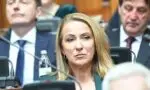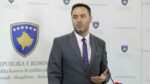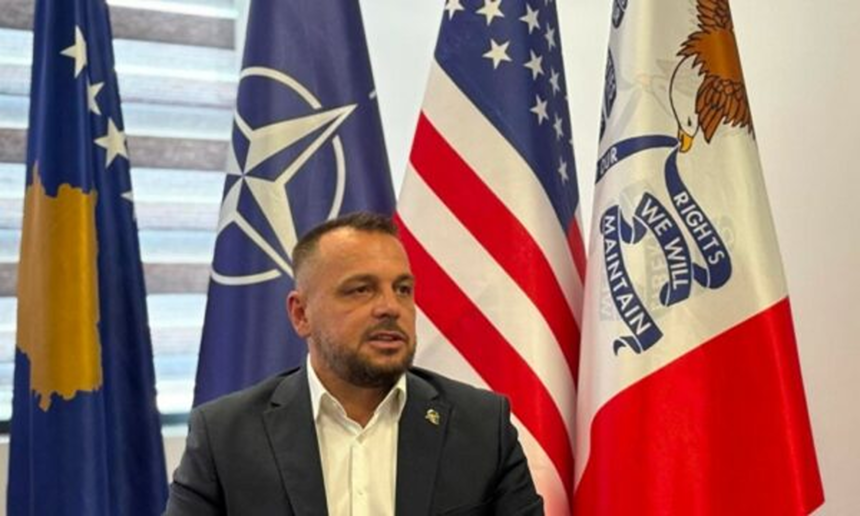
Kosovo’s Acting Minister of Defense, Ejup Maqedonci, has strongly condemned the recent remarks made by Serbian Minister Snežana Paunović, describing them as evidence of an “ultra-nationalist” and “genocidal mindset” that, according to him, continues to influence Serbia’s political establishment.
In an interview with Ekonomia Online, Maqedonci argued that Paunović’s statement was not an isolated incident, but rather part of a long-standing political approach in Serbia.
“The Serbian minister’s position is an ultra-nationalist one that reveals a genocidal mindset which, unfortunately, still exists within Serbia’s policymaking. It is a mentality that has existed for many years and predates the current government. Her remarks reflect an attitude that continues to be present in Serbian politics,” Maqedonci said.
He warned that such rhetoric is harmful not only to relations between Kosovo and Serbia but also to the stability of the entire Western Balkans.
“These statements revive the aggressive policies and attitudes of Serbia from the 1990s. When such comments come from a government minister, they seriously undermine efforts to establish long-term peace and security in the Western Balkans,” he stated.
Maqedonci also argued that, despite Serbian President Aleksandar Vučić’s attempt to distance himself from the minister’s remarks, Serbia’s Constitution still claims Kosovo as part of its territory, which he said reflects hegemonic ambitions that continue to encourage such rhetoric.
Asked whether statements like Paunović’s could signal renewed security threats following attacks such as Banjska and the Ibër-Lepenc incident, Maqedonci said Kosovo’s security situation has fundamentally improved.
He emphasized that the rule of law now extends across Kosovo’s entire territory, including the four northern municipalities, and that state institutions exercise effective authority throughout the country.
According to Maqedonci, armed groups that previously operated in northern Kosovo have been defeated and driven out, although he warned that the threat has not disappeared completely because, he claimed, these groups continue to receive shelter and protection in Serbia.
“As long as Serbia continues to shelter those involved in terrorist acts against Kosovo and fails to hold them accountable, the risk remains,” he said.
The acting defense minister added that Kosovo’s security institutions—including the Kosovo Police, the Kosovo Intelligence Agency (AKI), and the Kosovo Security Force (KSF)—have significantly strengthened their capabilities.
“Today we live in a much safer Kosovo, and every day we continue building stronger capacities to defend our territorial integrity, sovereignty, and the lives of all our citizens,” Maqedonci concluded.
Paunović later claimed that her remarks had been taken out of context, apologizing to President Aleksandar Vučić and the Serbian government while insisting that her comments did not represent official Serbian state policy.
The controversy began after Paunović stated on 12 July that if she had been in Slobodan Milošević’s position, she would have ethnically cleansed Kosovo in 1998.