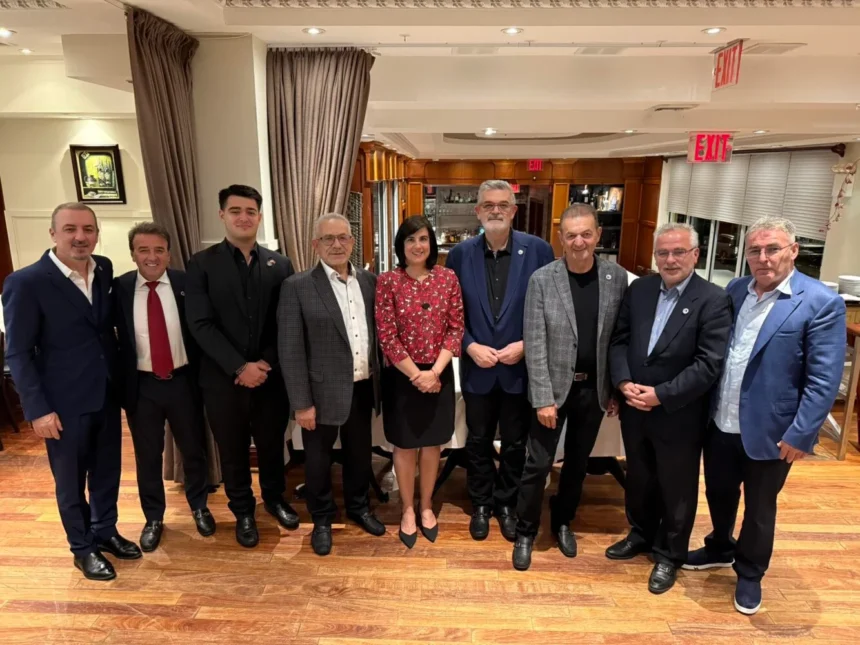
The Albanian-American Relations Council (AARC) initiated a strategic diplomatic push on Capitol Hill on Monday, June 1, 2026, aimed at shifting Athens’ long-standing foreign policy stance toward Kosovo. Led by AARC President Martin Vulaj and Chairman Eli Rusi, a high-level diaspora delegation met with influential U.S. Congresswoman Nicole Malliotakis (R-NY)—a prominent lawmaker of Greek descent—to deliberate on Western Balkan security and formal state recognition.
The meeting underscores a broader transatlantic effort to leverage influential Greek-American lawmakers to act as diplomatic bridges between Prishtina and Athens. Greece remains one of the five European Union member states that has yet to formally recognize Kosovo’s 2008 declaration of independence, despite maintaining robust economic and low-level diplomatic liaisons.
The Diplomatic Objective: Upgrading Athens-Prishtina Relations
According to an official briefing released by the AARC, the primary focus of the Washington meeting centered on creating a roadmap for comprehensive institutional cooperation between Greece and Kosovo.
“One of the main topics of discussion was the strengthening of relations between Greece and Kosovo and encouraging closer cooperation that in the future could lead toward the official recognition of Kosovo by Greece,” the AARC statement noted.
Diaspora representatives argued that formal Greek recognition would effectively unlock Kosovo’s frozen Euro-Atlantic integration path, stabilizing the southern flank of the Western Balkans against foreign interference.
[Strategic Goals of AARC Washington Lobbying]
   ├── Greece-Kosovo: Shift economic ties into formal diplomatic recognition.
   ├── North Macedonia: Monitor Ohrid Framework Agreement & ethnic Albanian rights.
   └── Regional Security: Counterbalance Russian, Chinese, and Serbian expansionism.
Countering Non-Western Malign Influence
Congresswoman Malliotakis, who serves on key congressional committees focused on foreign affairs, reportedly expressed intense interest in the geopolitical shifts altering the Balkan peninsula. She questioned the delegation regarding regional alliances, the depth of local pro-American sentiment, and the logistical footprint of non-NATO actors like Moscow and Beijing.
The AARC delegation provided a detailed overview of the regional security architecture:
- The Pro-American Baseline: Representatives reconfirmed that Kosovo remains statistically one of the most pro-American societies in the world, with mirroring, deep-rooted support for the transatlantic alliance sustained by ethnic Albanian communities in Albania, North Macedonia, and Montenegro.
- The Serbian Influence Network: The council briefed Malliotakis on Belgrade’s ongoing strategy to exert asymmetrical political, economic, media, and security leverage across its borders—specifically targeting structural vulnerabilities in Bosnia & Herzegovina, Montenegro, North Macedonia, and northern Kosovo.
- Sino-Russian Footprints: The delegation outlined how Russian disinformation and Chinese state-backed infrastructure loans are being weaponized to undermine democratic institutions in peripheral Balkan states.
Monitoring Human Rights in North Macedonia
Beyond the recognition framework, the AARC raised urgent alerts regarding the domestic status of ethnic Albanians in North Macedonia. The delegation emphasized the necessity of continued, active U.S. congressional monitoring to ensure the strict preservation of the Ohrid Framework Agreement (2001). They noted that any legislative or administrative erosion of the treaty’s power sharing mechanisms could trigger renewed ethnic polarization.
Additionally, the delegation briefed Malliotakis on recent grassroots student movements within the region, framing their demands for systemic institutional accountability as a positive development for Western Balkan democratization.
The AARC delegation featured prominent figures within the Albanian-American business and political network, including Vice President Tony Marke, Secretary Burim Rexhaj, and board members Agim Jusufi and Vehbi Bajrami. The council plans to follow up on the session by coordinating a broader briefing with the Congressional Hellenic Caucus to further explore mutual security interests between democratic actors in Prishtina and Athens.