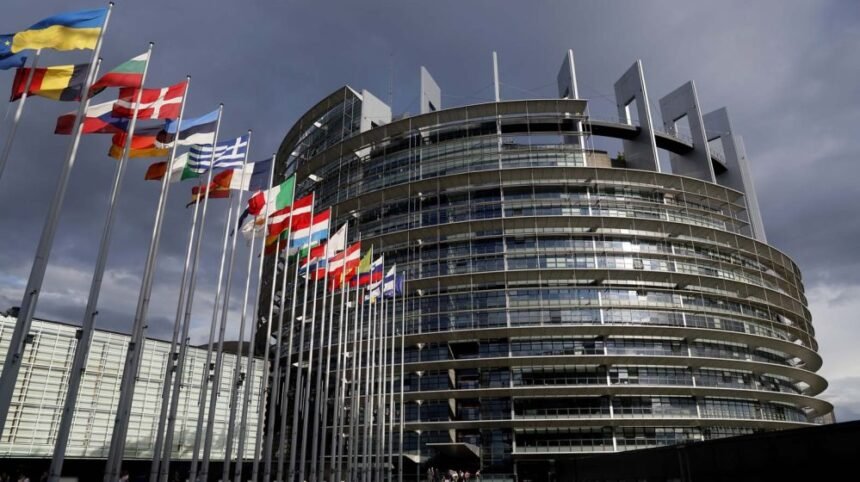
The European Parliament’s Committee on Foreign Affairs (AFET) is scheduled to debate and vote on a crucial draft report regarding Kosovo on Wednesday, June 3, 2026.
The comprehensive document, authored by Estonian MEP and rapporteur Riho Teras, solidifies a stable parliamentary majority in Brussels supporting Kosovo’s statehood and Euro-Atlantic integration. However, it simultaneously delivers an unvarnished warning to Prishtina’s political elite regarding prolonged domestic polarization and the immediate risk of losing millions in European financial aid.
Key Takeaways from the Draft Kosovo Report
The aligned compromise amendments, hammered out between the European Parliament’s major political factions, outline explicit directives for EU member states and institutions:
- Greenlighting the EU Membership Application: The report firmly endorses Kosovo’s official application for EU membership, which was originally submitted in December 2022. It explicitly demands that the European Council instruct the European Commission to submit the mandatory evaluation questionnaire without further delay and produce a merit-based opinion on the country’s readiness.
- Accelerating Candidate Status: The document strongly recommends that the European Council act swiftly to grant Kosovo official EU candidate country status as soon as the baseline technical and political criteria are verified.
- Pressure on the Non-Recognizers: The text renews a direct, urgent appeal to the five EU member states that have not yet recognized Kosovo’s independence—Spain, Greece, Cyprus, Slovakia, and Romania—to do so immediately to unblock the region’s overall stability.
Severe Backlash: 2025 Labeled a “Lost Year” Amid Financial Risks
While the report heavily backs Kosovo’s foreign policy objectives, it pulls no punches regarding the country’s domestic political fractures. The document explicitly expresses profound regret over a protracted legislative stalemate, officially labeling 2025 as a “lost year” due to crippling political deadlock and partisan polarization.
   [Political Paralysis in Prishtina & Financial Consequences]
 Failed Presidential Compromise ──> Total Institutional Deadlock (2025) ──> Snap Elections (June 2026)
                                                                                  │
                                                                                  ▼
                                                                  [RISK OF SEVERE FINANCIAL LOSS]
                                                                                  │
                                                                                  ▼
                                                                    Forfeiture of Millions from the
                                                                    EU Western Balkans Growth Plan
Kosovo was forced into yet another snap parliamentary election cycle (scheduled for June 7, 2026) after lawmakers fundamentally failed to secure a cross-party compromise to elect a new President of the Republic. Brussels explicitly warns that this prolonged institutional paralysis heavily threatens Prishtina’s economy. If the incoming government is unable to pass mandatory judicial and anti-corruption reforms within strict compliance windows, Kosovo will be legally disqualified from drawing down vital funding from the EU’s €6 Billion Growth Plan for the Western Balkans.
Bilateral Relations with Belgrade and the Banjska Attack
In tandem with the Kosovo file, the AFET Committee will simultaneously vote on the 2026 Report on Serbia. Both documents treat the normalization of relations between Belgrade and Prishtina as an essential prerequisite for any future EU expansion.
The European Parliament explicitly demands that Serbia immediately halt all efforts to obstruct Kosovo’s admission into the Council of Europe and other international organizations, underscoring that such blocking maneuvers directly violate the binding obligations agreed upon in the Brussels and Ohrid normalization pacts.
Furthermore, the draft report expresses sharp condemnation over the ongoing impunity enjoyed by Milan Radoičić, the mastermind and commander behind the deadly paramilitary ambush in the northern Kosovo village of Banjska in September 2023. The text calls out the Serbian judiciary, noting with concern that Radoičić remains free in Serbia and has yet to be brought to justice for the armed assault.