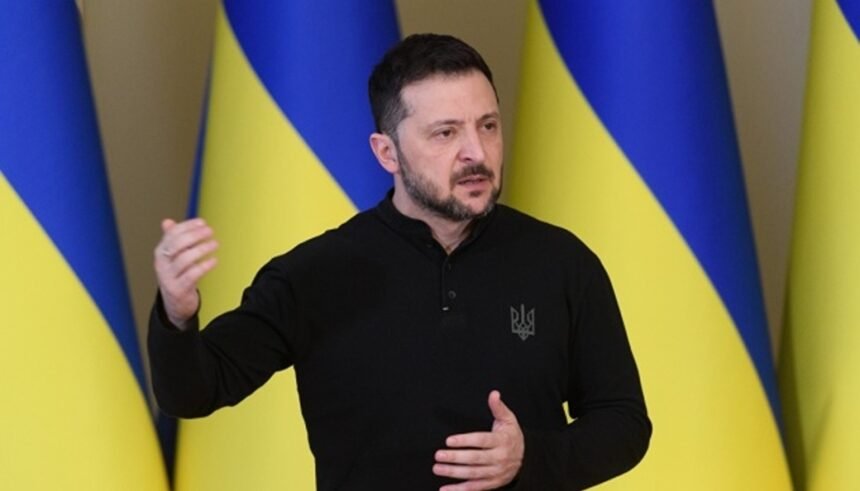
Ukrainian President Volodymyr Zelensky revealed that his proposal to manufacture American-designed anti-aircraft missiles on Ukrainian soil received a “positive” response from U.S. President Donald Trump.
Speaking at the Group of Seven (G7) summit in France on Tuesday afternoon, Zelensky emphasized that expanding air defense capabilities remains Kyiv’s ultimate strategic priority. The push comes amid a critical, chronic shortage of interceptor missiles, a vulnerability severely worsened by recent Western arms diversions to the Middle East.
1. Shifting the Strategy: From Weapon Requests to Production Licenses
With Western defense assembly lines struggling to keep pace with the high-intensity attrition warfare in Eastern Europe, Zelensky altered his approach, moving from requests for direct stockpiles to a long-term defense industry partnership.
The Strategic Pitch for Domestic Missile Production

 [ THE BOTTLENECK ] ──► SUPPLY LINES CANNOT MATCH NEED
 • Production in the United States cannot match Ukraine's massive defense burn rate,
   leaving the frontline dangerously exposed.

 [ THE SOLUTION ] ──► TRANSFERRING PRODUCTION LICENSES
 • Zelensky bypassed standard requests, appealing directly to Trump for critical
   industrial licenses to manufacture the advanced interceptors locally.

 [ THE TRUMP REACTION ] ──► A POSITIVE PRELIMINARY SIGNAL
 • While Washington has kept quiet, Zelensky told Reuters the pitch went well:
   "I hope that when President Trump is positive, it means yes."
2. The Patriot Missile Crisis and the Middle East Diversion
The urgency behind the production request is driven by Russia’s tactical shift to massive, multi-vector saturation strikes. Moscow routinely fires hundreds of kamikaze drones alongside dozens of ballistic and cruise missiles simultaneously to intentionally deplete Ukraine’s limited interceptor stockpiles.
The Anatomy of Ukraine's Air Defense Vulnerability
┌────────────────────────────────────────────────────────────────────────┐
│                                                                        │
│  [ THE PATRIOT DEPLETION PROBLEM ] ────────────────────────────────┐   │
│  • Ukraine operates highly advanced U.S. Patriot missile batteries,   │   │
│    the gold standard for shooting down Russia's supersonic targets.    │   │
│    However, it faces a chronic, severe shortage of reload missiles.│   │
│                                                                        │   │
│  [ THE MIDDLE EAST COMPONENT ] ────────────────────────────────────┤   │
│  • The supply bottleneck spiked drastically following the outbreak of │   │
│    war in the Middle East, as U.S. stockpiles originally earmarked     │   │
│    for Kyiv were diverted to protect assets in the Persian Gulf.   │
│                                                                        │   │
│  [ INTELLECTUAL PROPERTY GOAL ] ───────────────────────────────────┘   │
│  • Securing domestic manufacturing rights for Patriot missiles would   │
│    decouple Ukraine's immediate air defense from shifting Western     │
│    political currents and foreign military diversions.          │
└────────────────────────────────────────────────────────────────────────┘
“This is a major challenge, in fact, because production is not as large as our needs. Production is in the United States. I raised the issue of licenses. I presented it to President Trump. We need licenses to produce missiles.”
— Volodymyr Zelensky to Reuters at the G7 Summit
3. G7 Consensus on Securing Ukraine’s Skies
Despite the industrial backlog, Zelensky expressed optimism about his broader diplomatic meetings on Tuesday, reporting that “everyone” present at the G7 summit agreed on the absolute necessity of reinforcing Ukraine’s fractured air defense framework.
| Alliance Status | Operational Challenge | Technical Reality |
| G7 Commitment | Unanimous political consensus to help Ukraine safeguard its airspace and cities. | Turning political solidarity into immediate, physical industrial output remains the primary diplomatic hurdle. |
| Ukrainian Ingenuity | Massive domestic advancements in drone warfare and localized battle tracking. | Despite tech breakthroughs, Ukraine remains entirely dependent on Western systems to shoot down Russia’s most advanced ballistic missiles. |
| U.S. Administration | The White House and the Pentagon have declined to issue an official comment. | Securing technology transfer licenses for weapons as highly classified as the Patriot system involves strict, lengthy regulatory oversight in Washington. |
As Russia continues to mount pressure across the frontlines, securing the rights to build these advanced systems at home could prove to be the most critical industrial breakthrough for Ukraine’s long-term survival.