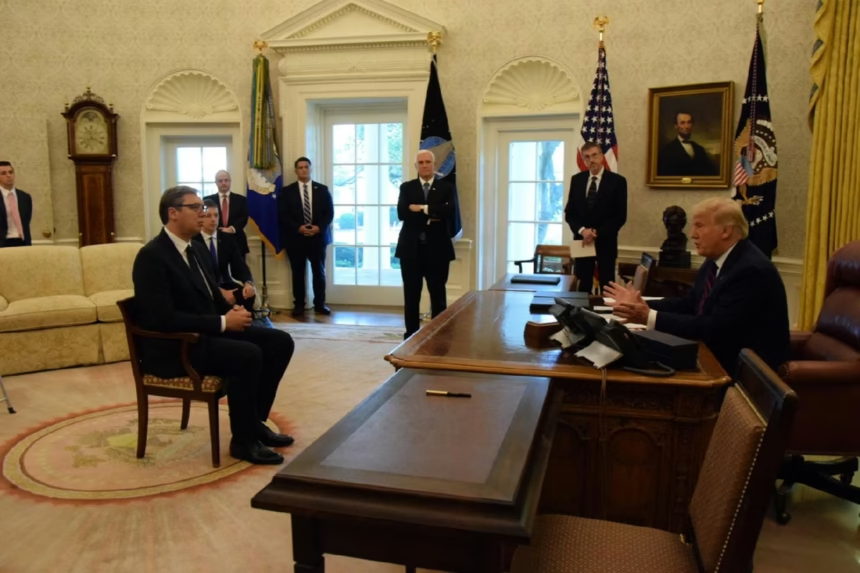
Despite an intensive, multi-week media blitz by the Serbian government designed to showcase an unprecedented alignment with US President Donald Trump, veteran diplomats and economic indicators suggest the reality of US-Serbian relations is far more fractured than Belgrade admits.
In an analysis for Nova.rs, former diplomat Srećko Đukić characterized Belgrade’s recent charm offensive as a calculated propaganda campaign designed purely for domestic consumption ahead of the upcoming elections. Led by President Aleksandar Vučić, the government has engaged high-profile US media outlets and American lobbyists to simulate a warm relationship with Washington. However, this narrative has been fundamentally disrupted by tangible diplomatic snubbing and a severe trade enforcement action over human rights violations.
The Flattery Campaign: Odes to Trump
Belgrade’s aggressive public relations pivot began in late May, seeking to repair bilateral ties that were severely damaged throughout 2025. Vučić took his message directly to conservative American media outlets:
- Fox News (May 22): In an op-ed, Vučić pitched Serbia as a highly dependable partner, offering Washington “strategic depth, political stability, and a government focused on execution rather than ideology.”
- Breitbart News: Vučić boasted that Trump’s popularity in Serbia has reached astronomical levels, claiming that three-quarters of the population supports him—the highest level of pro-Trump sentiment anywhere in Europe.
- Fox News Digital (June 11): Vučić declared that the US President would be welcomed as a literal hero on the streets of Belgrade.
To bolster this effort domestically, the administration enlisted former Illinois Governor Rod Blagojevich, who stated during a Balkan Watch interview that modern US-Serbian ties are vastly superior to those under the Clinton administration.
The Fractured Reality: Forced Labor and Diplomatic Freezes
The carefully engineered image of a blooming alliance completely unraveled just five days after Vučić’s latest US interview. On June 16, 2026, the U.S. Customs and Border Protection (CBP) delivered a massive economic blow to Belgrade by issuing a Withhold Release Order (WRO) against copper and copper products manufactured in eastern Serbia by Serbia Zijin Copper D.O.O.
                    BELGRADE'S LOBBYING VS. WASHINGTON'S ACTIONS

   THE STATE NARRATIVE (PINK/INFORMER)           THE REQUISITE POLICY FACT
 ──────────────────────────────────────        ──────────────────────────────────────
 • "Relations with the Trump administration    • U.S. CBP blocks Zijin copper imports
   have reached an all-time historic high."      due to systemic forced labor practices.
 • "Serbian diplomacy is highly respected      • Foreign Minister Marko Đurić is denied
   and deeply integrated in Washington."         official entry into the State Department.
 • "The White House views Serbia as its primary • Belgrade left without an official US
   strategic anchor in the Western Balkans."     ambassador for nearly two full years.
The federal agency directed personnel at all US ports of entry to immediately detain shipments from the Chinese-owned mining giant following a extensive probe revealing that vulnerable foreign workers were subjected to severe exploitation, including the withholding of wages, passport confiscation, and illegal restrictions on movement.
Beyond the economic fallout, Đukić points out several structural indicators proving that Serbia is not even on Washington’s radar:
“The Western Balkans are simply not in Trump’s field of vision. This is easily proven by the basic grammar of diplomacy. When Foreign Minister Marko Đurić visits the United States, he is not even received inside the State Department building. Furthermore, Serbia has faced a glaring diplomatic vacuum, operating without a sitting US ambassador for nearly two full years.”
— Srećko Đukić, Former Diplomat
While the White House recently put forward Michael Young, a prominent legal expert and diplomat from California, to finally fill the long-vacant ambassadorial post in Belgrade, it represents a secondary attempt by the administration to push a nominee through a hesitant Senate.
The Blueprint of 2025’s Diplomatic Collapses
According to analysts, the sudden halt of major joint initiatives dates back to the massive failures of 2025. In May of last year, Vučić’s highly anticipated, state-advertised trip to the US imploded overnight amid reports that he attempted to use a false identity to gain entry into a private Republican National Committee donor dinner. The administration abruptly aborted the visit, claiming the president had to return to Belgrade due to sudden hospitalization for an urgent health condition.
By December 2025, Washington’s institutional dissatisfaction became explicit when the US House of Representatives passed the Western Balkans Democracy and Prosperity Act, formally designating the state of Serbian democracy as “deeply concerning” and labeling its electoral conditions “unfair.” Concurrently, Trump’s son-in-law, Jared Kushner, quietly pulled his investment firm out of the high-profile, highly controversial luxury hotel development project on the historic site of the bombed Generalštab (Yugoslav Army Headquarters) in downtown Belgrade, signaling a broader Western retrenchment from the current regime.