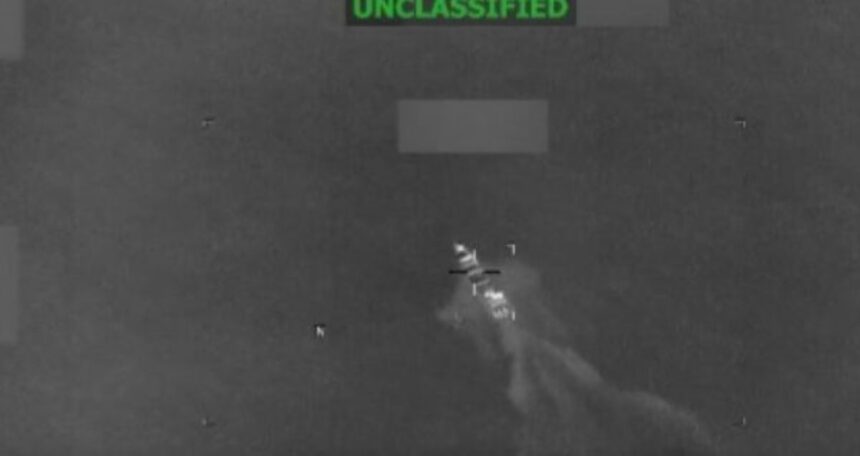
The United States military has executed another kinetic strike against a vessel suspected of drug trafficking in the eastern Pacific Ocean, leaving two people dead and six survivors.
The operation marks the latest escalation in President Donald Trump’s multi-month maritime campaign targeting Latin American cartels, which the White House has formally designated as “narcoterrorist” organizations. According to updated defense data, the total number of lethal strikes conducted under this initiative has now surpassed 60, resulting in over 210 deaths since the offensive was launched in September 2025.
The Strike on Open Waters: Operation Southern Spear Continues
The high-speed interception was coordinated by U.S. Southern Command (SOUTHCOM) and carried out by Joint Task Force Southern Spear. According to military officials, intelligence assets tracked the vessel as it traveled along a well-documented maritime smuggling corridor.
                  OPERATION SOUTHERN SPEAR: LETHAL CAMPAIGN METRICS

   OPERATIONAL RUNTIME           TOTAL KINETIC STRIKES          CONFIRMED FATALITIES
 ───────────────────────       ────────────────────────       ────────────────────────
 • Commenced: Sept 2025        • Over 60 verified missile     • 210+ suspected cartel
 • Ongoing active phase          or aerial strikes on           operators and crew
   through June 2026.            smuggling vessels.             members killed at sea.
A short, declassified video sequence released on social media platform X depicts the boat traveling at high speed across open waters before being obliterated by a precision projectile, which instantly engulfed the craft in a massive fireball.
SOUTHCOM officials confirmed they immediately transferred spatial coordinates to the U.S. Coast Guard to trigger the Search and Rescue (SAR) system for the six individuals who survived the blast. However, authorities have not yet confirmed if the survivors have been successfully pulled from the water or taken into federal custody.
Legal Scrutiny and the “Armed Conflict” Precedent
Despite the definitive nature of the tactical strikes, the Pentagon has not released public evidence confirming that the targeted vessel was actively carrying illicit narcotics at the exact moment of its destruction.
This lack of transparency has sparked intense pushback from legal scholars and human rights monitoring organizations, who argue that the actions resemble extrajudicial executions. President Trump has continuously pushed back against these domestic and international critics, declaring that the US is engaged in an “armed conflict” against international cartels and that aggressive military interdiction is the only way to halt fatal overdose spikes in American cities.
“If you are transporting drugs that can kill Americans, we are hunting you! We are in an armed conflict to protect our borders, and we will continue to eliminate these narcoterrorist threats at sea.”
— President Donald Trump
Strategic Pushback: Fentanyl’s Real Route
Beyond the immediate legal questions, geopolitical and narcotics policy experts have voiced skepticism regarding the strategic efficacy of targeting small maritime vessels in the Pacific and Caribbean.
Independent supply chain data confirms that fentanyl—the synthetic opioid responsible for the vast majority of fatal drug overdoses inside the United States—is overwhelmingly smuggled across land borders through official ports of entry from Mexico, where it is mass-produced using precursor chemical components legally and illegally imported from industrial labs in China and India.
Furthermore, Capitol Hill lawmakers recently demanded that the Pentagon release unedited, raw video feeds of all maritime strikes following a controversial incident where US forces executed a secondary, fatal strike on wounded survivors who were clinging to floating wreckage in open water. While the White House defended that engagement as an act of “self-defense” to ensure the total destruction of hostile assets, the Pentagon’s Inspector General launched an official review in May to investigate whether targeting personnel complied with standard military frameworks.