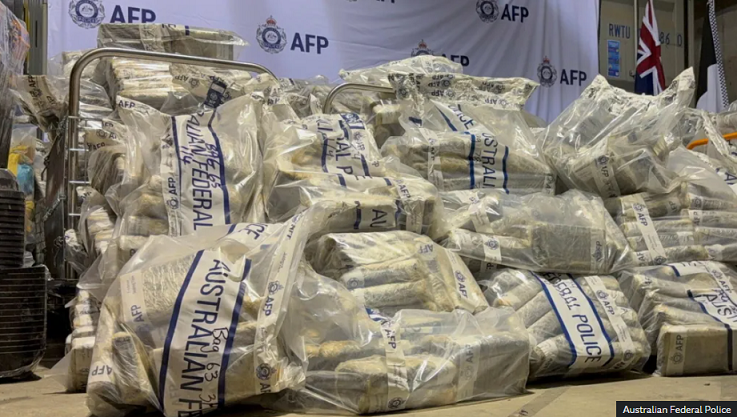
In what has been confirmed as the largest single cocaine interception in Australian history, law enforcement authorities have seized 2.7 tons of cocaine hidden inside an elaborate underground bunker network west of Sydney.
The massive haul, carrying an estimated street market value of 816 million Australian dollars ($571 million USD), was uncovered during a high-stakes tactical raid at a semi-rural property in Londonderry on Friday, June 19, 2026. The multi-agency operation, code-named “Operation Minjiang,” effectively dismantles a highly sophisticated transnational syndicate capable of trafficking commercial-scale narcotics across international waters.
The Underground Fortress: How the Haul Was Found
According to official briefings from the Australian Federal Police (AFP), tactical officers targeted three large shipping containers located toward the rear of the Londonderry estate. A meticulous search revealed that the syndicate had engineered false flooring inside the containers, which served as hidden access hatches.
Beneath the metal sheets lay a structurally reinforced underground bunker system. Inside the subterranean chambers, detectives discovered dozens of industrial-sized plastic tubs packed tightly with brick-sized blocks of high-purity cocaine. Forensic experts noted that the seizure equates to roughly three million individual street-level deals that have been successfully kept out of the Australian domestic market.
Bust Breakdown: The Scale of Operation Minjiang
Operation Minjiang was originally triggered in May 2026 following a bizarre incident at a boat ramp near Midge Point in North Queensland. Frontline officers responding to a burnt-out flatbed truck spotted a floating parcel containing 40 kilograms of cocaine drifting in the adjacent waters.
That local discovery sparked a massive cascading investigation involving the Queensland Joint Organised Crime Taskforce (QJOCTF), culminating in the historic Sydney bunker raid.
| Metric | Details & Statistical Impact |
| Total Cocaine Weight | 2.7 Tons (Largest single cocaine seizure in Australian history) |
| Estimated Market Value | $816 Million AUD (~$571 Million USD) |
| Equivalent Street Deals | Approximately 3 Million individual doses |
| Total Drugs Seized | Over 3.3 Tons (Including previous seizures of 178kg cocaine & 142kg meth) |
| Primary Transit Vessel | MV Wealth (Detained and boarded by authorities in the Solomon Islands) |
Tactical Arrests and International Supply Chains
During the initial breach of the Londonderry compound, two suspects—a 21-year-old man from Plumpton and a 25-year-old man from Liverpool—attempted to evade the police perimeter by fleeing on foot through nearby fields. Both were quickly apprehended by canine and tactical units.
The suspects have been formally charged with possessing a commercial quantity of an unlawfully imported border-controlled drug. Under federal Australian statutes, this charge carries a maximum statutory penalty of life imprisonment. Both individuals were officially refused bail and are scheduled to stand trial at the Penrith Local Court on August 13, 2026.
“This alleged plot to distribute nearly three tonnes of cocaine—by arranging for an international vessel to offload the drugs in Northern Queensland before moving them into Sydney—demonstrates how highly organised and determined these criminal networks are, and the extreme lengths they are willing to go to for profit.”
— Stephen Jay, AFP Commander
Intelligence gathered throughout the month-long investigation indicates that the syndicate utilized a classic “mother-ship” smuggling methodology. A foreign commercial cargo vessel, identified as the MV Wealth, allegedly transported the multi-ton payload across the Pacific Ocean before offloading it onto smaller, high-speed regional vessels off the coast of Queensland. The MV Wealth has since been intercepted and remains detained by law enforcement authorities in the Solomon Islands as international multi-agency investigations continue.
Data published by the University of New South Wales alongside global trafficking briefs from the United Nations Office on Drugs and Crime (UNODC) highlight Australia as an incredibly lucrative target for transnational syndicates. Due to its strict geographical isolation and strong domestic demand, Australia maintains some of the highest black-market street prices and per-capita consumption rates for cocaine globally, ensuring that cartels will continue attempting highly complex maritime penetrations.