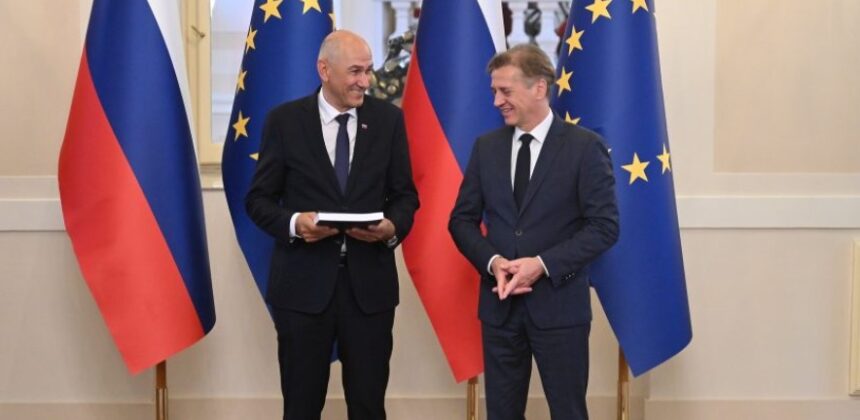
Slovenia’s Parliament has formally approved a new right-wing coalition government led by veteran politician Janez Janša, ending four years of center-left governance under outgoing Prime Minister Robert Golob and causing political ripples across the European Union.
Janša secured his fourth term as prime minister after assembling a fragile five-party coalition that commands 43 out of 90 seats in parliament. To pass key legislative packages, his government will rely on the external voting support of Resni.ca, a controversial, pro-Russian populist party—a political marriage of convenience that has already raised eyebrows among Western diplomats.
The Shadow of Illiberalism and Media Crackdowns
Janša’s previous tenure (2020–2022) was marked by fierce clashes with civil society, leading international watchdogs to sound the alarm over democratic backsliding. Critics frequently drew parallels between his governance style and the illiberal models seen in neighboring Central European states.
The newly formed coalition has already signaled a sweeping, contentious domestic agenda that includes:
- Public Broadcasting Overhaul: Planned structural changes to the national public broadcaster, raising fears of political interference.
- NGO Funding Cuts: Restrictions aimed at capping financial resources for independent non-governmental organizations.
- Labor Restrictions: Legislative adjustments that could significantly curtail the constitutional right to strike.
“There should be no room in the European democratic family for political forces that actively challenge the fundamental values of the European Union,” stated representatives from the Social Democrats in the European Parliament, who are aggressively lobbying to expel Janša’s Slovenian Democratic Party (SDS) from the mainstream European People’s Party (EPP).
                      THE JANŠA PARADOX (JUNE 2026)

   DOMESTIC & REGIONAL ANXIETIES                 FOREIGN & SECURITY ALIGNMENT
 ──────────────────────────────────           ───────────────────────────────────
 • Pushing media reforms and curbs            • Unwavering, hawkish support for
   on NGO civil society groups.                 Ukraine against Russian aggression.
 • Deep polarization over rollbacks           • Strong advocacy for upgrading
   on climate and LGBTQ+ policies.              NATO and joint EU defense limits.
 • Lingering distrust over past               • Vocal champion of fast-tracking
   "non-paper" Balkan border edits.             Western Balkan EU integration.
The Geopolitical Paradox: Hawkish on Russia, Vocal on Expansion
Despite severe Western anxieties regarding his domestic policies, geopolitical analysts emphasize that Janša cannot be easily lumped together with figures like Hungary’s Viktor Orbán or Slovakia’s Robert Fico.
Politologiast Tomaž Deželan notes that Janša intends to position Slovenia as a core security actor on the continent. Janša remains a fierce critic of Moscow; he famously became one of the first Western leaders to brave an active war zone to visit Kyiv in March 2022 alongside his Polish and Czech counterparts.
Furthermore, his comeback carries massive implications for the Western Balkans. Janša is a staunch advocate for EU enlargement, pushing for a model of gradual integration that allows candidate countries to access European institutional structures well before achieving full, formal membership.
However, his regional legacy remains deeply entangled with the infamous 2021 “Non-Paper”—a leaked diplomatic memo proposing the radical redrawing of Balkan borders along strict ethnic lines. Though Janša categorically denied authoring the document, the specter of that proposal continues to fuel deep distrust among Bosnia and Herzegovina, Kosovo, and North Macedonia, where any talk of shifting borders is viewed as an existential threat to peace.