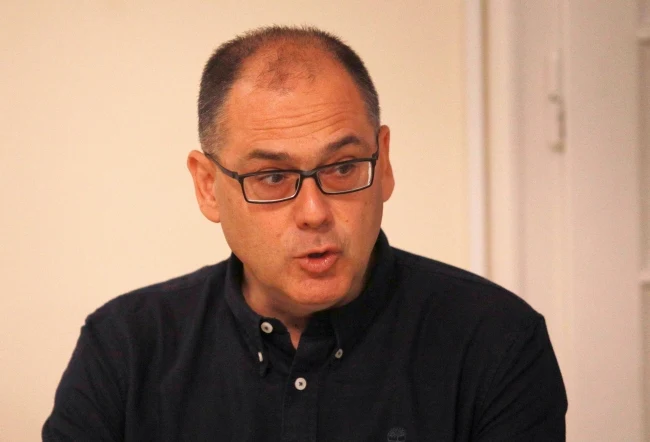
Military analyst Aleksandar Radić stated today that the definitive truth regarding the alleged deployment of a sonic weapon against student protesters on March 15, 2025, in Belgrade will only be uncovered following a change of government in Serbia.
Speaking to the Beta news agency, Radić argued that the current administration is utilizing state propaganda for damage control due to escalating legal pressure from the United Nations (UN) and the European Court of Human Rights (ECHR) in Strasbourg.
Strasbourg’s Interim Prohibition vs. Belgrade’s Propaganda Response
According to Radić, international legal bodies are actively demanding answers from Serbian authorities, which has cornered the ruling coalition into creating a domestic counter-narrative.
                    THE SONIC CANNON IMPASSE (JUNE 2026)

   INTERNATIONAL LEGAL ACTIONS                  DOMESTIC PRESS REACTION
 ────────────────────────────────               ────────────────────────────────
 • UN Commission & ECHR demand rigorous          • Higher Public Prosecutor's Office
   and detailed technical telemetry.              launches criminal fake narrative probe.
 • Strasbourg issues an interim measure         • Pro-regime outlets claim "FBI & FSB"
   banning MUP acoustic cannon use.               disproved any acoustic deployment.
Radić detailed the geopolitical deadlock and the government’s internal strategies to deflect blame:
- International Accountability Demands: The UN Commission and the Strasbourg Court have formally requested precise operational logs regarding the deployment of specialized acoustic technology. The ECHR has went as far as enforcing an interim injunction legally prohibiting the Serbian government from using the sonic cannon device until further notice.
- The State Counter-Investigation: Rather than providing data to international courts, Radić explains that authorities are using propaganda to convince their base that students orchestrated a fake simulation of a sonic cannon. He notes the state is investigating a select group of students solely to buy time and tell foreign institutions that an “investigation is ongoing.”
“Our judicial system could easily establish the facts if it weren’t under total political pressure. As it stands, the truth will only surface when power shifts and cooperating witnesses (svedoci-saradnici) step forward to testify about exactly who authorized the order on that critical day.”
— Aleksandar Radić, Military Analyst
The Technical Reality: LRAD Model 450
The core of the controversy stems back to the original March 15, 2025 protest, where an aggressive acoustic burst shattered a planned 15-minute period of silent tribute held by students, inducing widespread public panic.
                                  TECHNICAL FILE

          DEVICE TYPE: Acoustic Cannon / Long Range Acoustic Device (LRAD)
          MANUFACTURER: Genasys Inc. (United States)
          MODEL: LRAD 450
          OPERATIONAL RANGE: Up to 3,000 meters in clear conditions
          CAPABILITY: High-decibel targeted tones (jet engine / rocket frequencies)
Radić previously identified the hardware captured on camera atop a Gendarmery (Žandarmerija) vehicle as an American-made LRAD Model 450, a non-lethal weapon designed to disable targets via extreme acoustic pressure. While importing the device is not legally banned, the Ministry of Internal Affairs (MUP) never secured the necessary domestic legal framework or statutory police guidelines required to authorize its use against civil populations.
The Prosecution Matrix and the Student Defense
The Higher Public Prosecutor’s Office (VJT) in Belgrade issued a stern warning today, confirming it will criminally prosecute anyone found to have prepared, organized, or systematically disseminated the narrative of a “sonic cannon” deployment across media and social platforms.
                       THE CONFLICTING NARRATIVES

   PROSECUTION CLAIM (VJT)                      STUDENTS IN BLOC RESPONSE
 ─────────────────────────────                 ───────────────────────────────────
 • Raids on the Faculty of Philosophy          • The seized logbook is a safety risk
   uncovered a premeditated logbook.             assessment from an older rally.
 • Asserts students completely faked           • Over 3,500 citizens have formally
   acoustic impact to cause public panic.        testified to experiencing injuries.
Students currently leading the active university blocks heavily rejected the VJT’s claims, calling them an outright fabrication meant to distract from institutional violence.
The student leadership clarified that the document seized by police at the Faculty of Philosophy was a standard safety assessment drafted two months prior to the March 15 incident. The document was mapped out for an entirely separate, prolonged 24-hour blockade at the Autokomanda intersection to evaluate standard police escalation risks—such as tear gas, water cannons, and acoustic devices—and had no operational connection to the events that unfolded at Slavija Square.