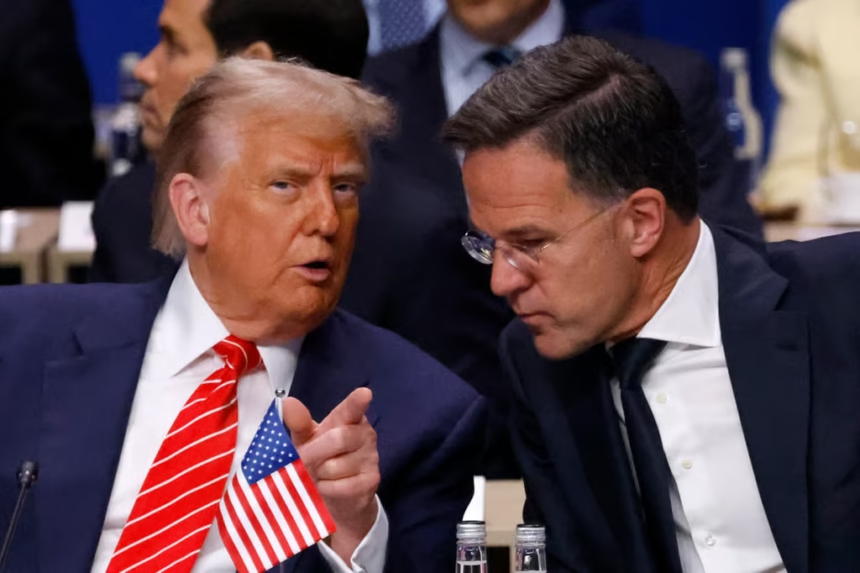
The heads of state of Europe’s most powerful economies have pledged to drastically reinforce the continent’s defense footprint within NATO. The announcement comes directly ahead of a crucial meeting between NATO Secretary-General Mark Rutte and U.S. President Donald Trump.
Meeting in Berlin under the “E5” group framework, the leaders of Germany, France, Italy, the United Kingdom, and Poland met to establish a unified transatlantic defense strategy. A major goal of the summit was coordinating agendas for the alliance’s highly anticipated summit next month in Ankara, Turkey.
Key Agenda Items for the Ankara Summit
With NATO chief Mark Rutte joining the Berlin deliberations via a secure video uplink before traveling to meet President Trump, European officials outlined two non-negotiable pillars for the future of the alliance:
- Escalating Pressure on Russia: Outgoing British Prime Minister Keir Starmer emphasized that Ukraine military support and stricter economic sanctions must top the itinerary in Ankara, citing recent Russian battlefield vulnerabilities.
- Building a “European NATO”: The E5 issued a joint commitment to step up continental defense spending and enhance local procurement, specifically prioritizing the joint development of deep precision strike capabilities.
E5 Alliance Coordination Dashboard (June 2026)
========================================================================
Core Group Members   --> Germany, France, United Kingdom, Italy, Poland.
Upcoming Milestone   --> NATO Leaders Summit in Ankara, Turkey.
U.S. Policy Shift    --> Trump pivots back to Ukraine aid after focusing on Iran.
Geopolitical Conflict--> Strategic alignment amid ongoing U.S.-Israeli 'Operation Epic Fury'.
========================================================================
Transatlantic Realignment and Peace Talk Friction
The defense huddle marks a distinct shift in optimism across European capitals. For months, European allies faced friction with Washington due to President Trump’s heavy focus on Middle Eastern theaters—specifically the joint U.S.-Israeli military campaign against Iran, known as Operation Epic Fury. However, following Trump’s sudden commitment to bolster Ukrainian aid at last week’s G7 summit in France, continental leaders believe a window for alignment has reopened.
French President Emmanuel Macron: ““We are at a point in time when Europeans and Americans are growing closer again.””
Despite the unified front on defense spending, internal divisions remain regarding potential peace negotiations with Moscow. While the U.K., France, and Germany previously held an exclusive meeting in London to sketch out a baseline negotiation framework, Poland and Italy have loudly protested their exclusion from the inner circle.
Polish Prime Minister Donald Tusk warned that any security arrangement architecture formulated without input from Warsaw, the Baltic states, Romania, and Scandinavia would fail to protect the alliance’s vulnerable eastern flank.