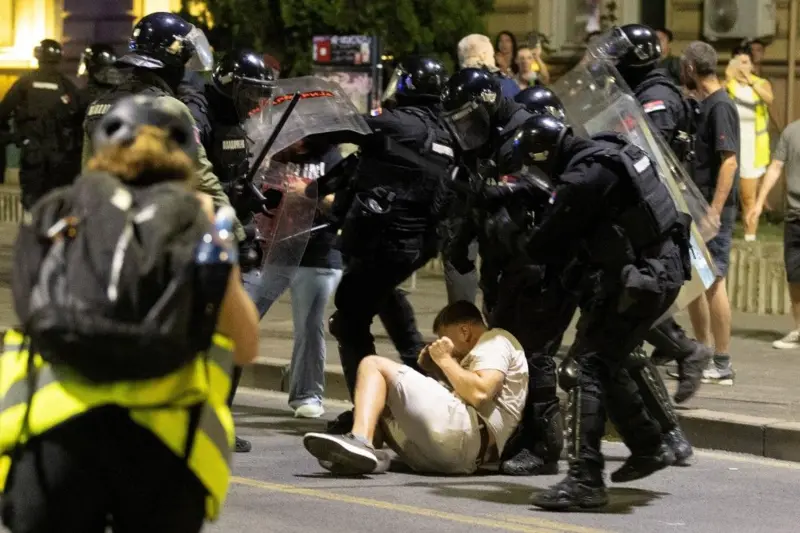
The adoption of the Resolution on the functioning of democratic institutions in Serbia by the Parliamentary Assembly of the Council of Europe (PACE) on June 23 has brought the testimonies of those who have directly faced state violence to the international forefront. The document details a grim reality: retaliation, intimidation, physical assaults, and smear campaigns against critical voices.
For activists, students, and independent journalists in Serbia, this resolution serves as vital international recognition of the daily repression they face under the regime of Aleksandar Vučić.
Testimonies from the Frontlines of Repression
The PACE document was largely informed by the violent events that followed the tragic canopy collapse at the Novi Sad Railway Station, which killed 16 people, and the massive anti-government protests that ensued:
- Violence Against Students: Vukašin Đinović, a mathematics student in Novi Sad, was struck in the head with a shield by a police officer during protests. He has filed a criminal complaint, with the trial scheduled for October. According to him: “The government is doing everything it can to make us feel as threatened and unsafe as possible in every sense.”
- Assaults on Journalists: N1 television journalist Lea Apro was physically assaulted four times by riot police while covering the blockade of the Novi Sad court, despite being clearly marked as a member of the press. She testifies that media safety in Serbia has deteriorated to critical levels, and attacks routinely end without a judicial epilogue.
- Pressure on Civil Society: Naim Leo Beširi from the Institute for European Affairs emphasizes that members of the civil society sector are constantly labeled as “traitors and foreign mercenaries” by pro-government media, translating targeted media headlines into dangerous, real-life threats.
The Massive Contradiction: The “Sonic Cannon” Investigation
One of the most specific clauses in the Resolution demands that Serbia conduct a thorough investigation into the alleged use of sonic weapons to disperse crowds during mass demonstrations in Belgrade on March 15, 2025. While thousands of citizens testified to hearing unusual high-pitched noises and feeling strange vibrations that caused panic, the government has denied using them.
In a bizarre reversal, the Higher Public Prosecutor’s Office in Belgrade initiated an investigation targeting the student movement and military analyst Aleksandar Radić, accusing them of “simulating” a sonic cannon during a meeting in January 2025 to fabricate public panic and falsely blame the police. A joint statement signed by 14 non-governmental organizations expressed deep concern over this move, labeling the prosecutor’s investigation a transparent attempt at state intimidation.
The Regime’s Reaction and Political Consequences
Within PACE, the Resolution passed with 89 votes in favor, 13 against, and 4 abstentions. Members of the ruling Serbian Progressive Party (SNS) voted against it, dismissing the document as “non-objective” and “criticism for the sake of criticism.”
Serbia's Integration and Monitoring Status (June 2026)
========================================================================
Monitoring Procedure --> Active since Serbia's accession to the CoE in 2003.
Weight of Resolution --> The first deeply critical comprehensive report in 14 years (since 2012).
EU Negotiations      --> Only 2 out of 35 chapters closed; no new chapters opened since 2021.
Political Fallout    --> Severely damages Belgrade's narrative as a "factor of stability."
========================================================================
Although Council of Europe resolutions are not legally binding, Beširi points out that their political weight is immense. It acts as an official international diagnosis proving that state institutions in Serbia are manufacturing fear instead of delivering justice, driving the country further away from European integration.