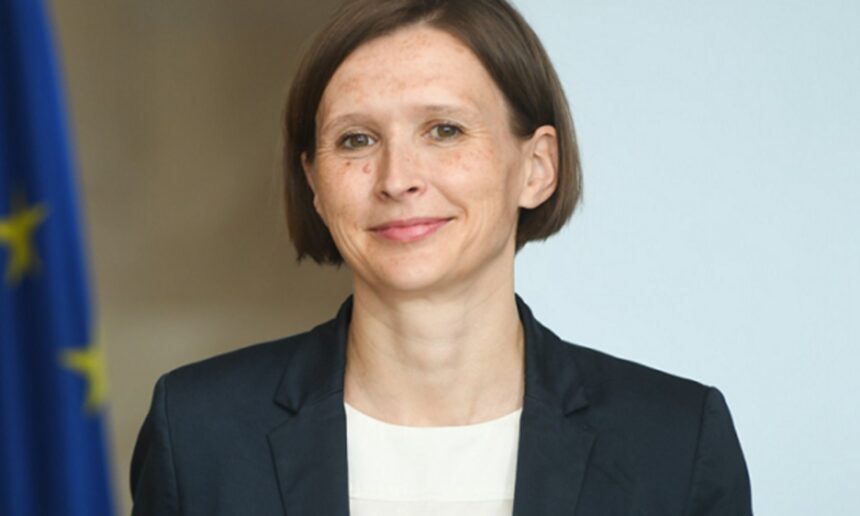
In an opinion piece, Eva Palatová, Acting Head of the European Union Office in Kosovo, emphasized that Kosovo’s citizens have fulfilled their democratic duty by voting repeatedly, and that political leaders must now focus on forming functional institutions and governing.
Palatová noted that during the past 18 months, citizens of Kosovo went to the polls three times in February 2025, December 2025, and June 7 of this year describing the elections as peaceful, competitive, and well-administered. According to her, these elections demonstrated the resilience of Kosovo’s democracy and citizens’ commitment to shaping the country’s future through democratic means.
However, she stressed that democracy does not end on election day. The purpose of elections, she said, is to create institutions capable of governing and delivering results for citizens.
The EU official highlighted that Kosovo has experienced a prolonged political and institutional deadlock, with previous elections failing to produce a government or the parliamentary majority needed for key institutional processes. She warned that repeated elections without clear political outcomes risk creating frustration and voter fatigue.
Palatová also emphasized that while the Constitutional Court of Kosovo has played an important role in resolving disputes and protecting the constitutional order, courts cannot replace political leadership. According to her, democratic systems depend on elected representatives’ ability to find solutions through dialogue, compromise, and shared responsibility.
She underlined that compromise is not a sign of weakness but a fundamental democratic skill, particularly for countries aspiring to join the European Union. She called on Kosovo’s political actors to place European integration above party divisions and work together to build stable institutions.
The EU official also highlighted the opportunities available for Kosovo through European support mechanisms, including the Western Balkans Growth Plan and other investment instruments, which can support infrastructure, energy security, businesses, public services, and opportunities for young people.
However, she stressed that these opportunities require capable institutions. “The European Union can support Kosovo, but it cannot do Kosovo’s homework,” she said, emphasizing that responsibility for advancing Kosovo’s European future ultimately belongs to Kosovo’s political leaders and institutions.
Following the certification of election results, Palatová said priorities are clear: the winning party has a special responsibility to engage with other political forces to build the necessary compromises for forming the Assembly, establishing a government, and addressing other constitutional obligations.
She concluded that Kosovo’s citizens have done their part by participating in free and democratic elections, and now they deserve institutions capable of delivering results.
“Kosovo has voted. Now it is time to govern — and to move forward decisively on the path toward European integration.”