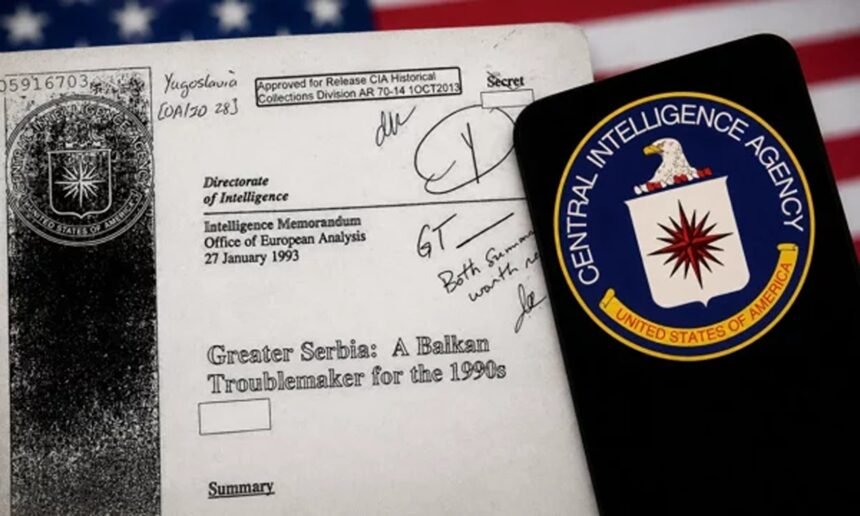
A formerly classified Central Intelligence Agency (CIA) memorandum, dated January 27, 1993, warned that the project of creating a “Greater Serbia” posed the most serious threat to the Balkans and Europe throughout the 1990s.
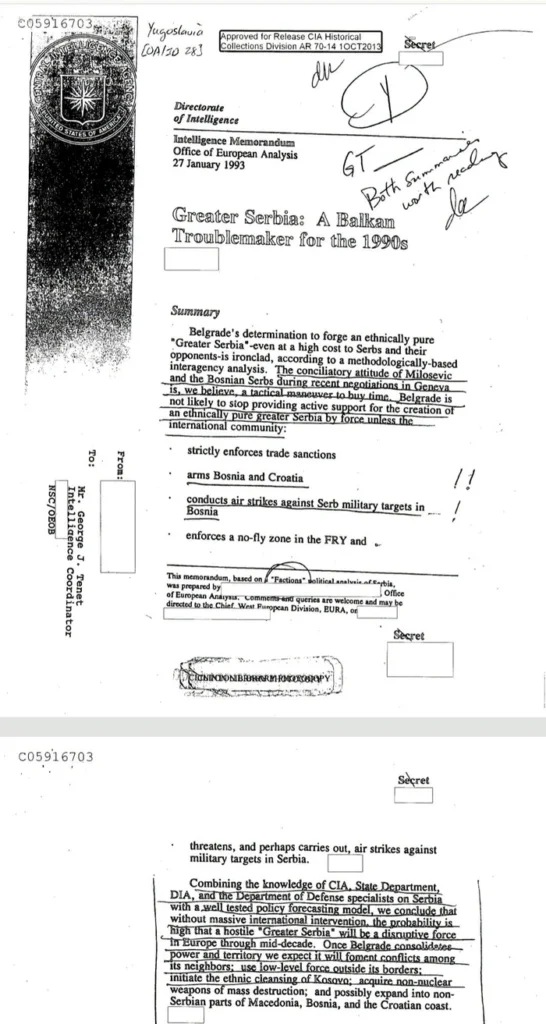
The 13-page document, titled “Greater Serbia: A Balkan Troublemaker for the 1990s,” was prepared by the CIA’s Directorate of Intelligence, Office of European Analysis, and reflected a joint assessment by the CIA, the U.S. Department of State, the Defense Intelligence Agency (DIA), and the U.S. Department of Defense.
According to the report’s executive summary, Belgrade remained firmly committed to establishing an ethnically homogeneous Greater Serbia, while any conciliatory stance shown by Serbian President Slobodan Milošević or Bosnian Serb leaders during international negotiations was viewed merely as a tactical effort to buy time.
The assessment concluded that Serbia would not abandon its expansionist ambitions unless the international community imposed significantly stronger measures, including strict enforcement of economic sanctions, political isolation, military assistance to Bosnia and Croatia, enforcement of a no-fly zone, and targeted airstrikes against Serbian military positions.
The report warned that, without decisive international intervention, there was a high probability that a Greater Serbia would become a major destabilizing force in Europe by the middle of the decade. Once Belgrade consolidated territorial control, the analysis predicted it would provoke conflicts with neighboring states, use military force beyond its borders, initiate the ethnic cleansing of Kosovo, seek weapons of mass destruction, and pursue territorial expansion into parts of North Macedonia, Bosnia and Herzegovina, and Croatia.
The memorandum further assessed that the situation of Kosovo Albanians would deteriorate within a year, as Serbia’s political landscape was increasingly shifting toward nationalist factions advocating the ethnic cleansing of Kosovo.
According to the analysis, Slobodan Milošević, Serbian nationalist movements, and the Yugoslav military were the principal drivers of Serbia’s expansionist agenda. The report argued that even Milošević’s removal from power would not necessarily alter Belgrade’s strategic objectives, as the military establishment and nationalist groups shared the same long-term goals.
In the chapter titled “A Greater Serbia at Any Price?”, U.S. intelligence analysts concluded that Serbia’s democratic opposition and independent media exercised only limited influence, while Milošević, the Socialist Party of Serbia, Serbian nationalist organizations in Serbia, Bosnia, Croatia, and Kosovo, together with the tacit support of the military, were spearheading efforts to establish an ethnically pure Greater Serbia.
The report stated that these actors were prepared to bear significant political and economic costs rather than abandon their objectives.
The CIA also predicted that a Greater Serbia would follow an increasingly aggressive regional strategy comparable to that of Iraq at the time, generating continuous instability throughout the Balkans. It warned that Belgrade would provoke neighboring countries, initiate ethnic cleansing in Kosovo, seek chemical weapons capabilities and delivery systems, conduct military operations beyond its borders, and potentially attempt to dominate North Macedonia or seize additional territory in Bosnia and Croatia.
A separate section of the memorandum focused specifically on Kosovo, noting that nationalist groups advocating the concentration of Albanians into designated areas and their administrative separation from territories reserved for Serbs were gaining influence in Belgrade.
The CIA warned that such policies would likely provoke violent resistance while simultaneously empowering Serbian extremists seeking an even more radical campaign of ethnic cleansing against Kosovo Albanians.
In its conclusion, the report emphasized that even if Milošević were removed from office, the Serbian military and nationalist establishment would remain the dominant political forces. According to the CIA, a Greater Serbia without Milošević would likely continue destabilizing the region and pursuing the creation of an ethnically homogeneous Serbian state. The report suggested that Kosovo Albanians might avoid expulsion or ethnic cleansing only if Milošević’s successor proved to be politically much weaker than him.
The contents of the memorandum have gained renewed attention following remarks made by Snežana Paunović, Serbia’s Minister of Public Administration and Local Self-Government.
Speaking to Serbian television Kurir on Saturday, Paunović stated that, had she been in Milošević’s position in 1998, she “would have ethnically cleansed Kosovo.” The statement prompted widespread condemnation in Kosovo and drew criticism from European officials.
Milošević served as President of the Federal Republic of Yugoslavia and was indicted by the International Criminal Tribunal for the Former Yugoslavia (ICTY) on charges of war crimes, crimes against humanity, and genocide-related offenses.
Describing her remarks, Paunović stated:
“This is the strongest statement I have ever made in my life.”
She later claimed she would not have “liquidated Albanians,” but instead would have forced anyone who did not consider themselves loyal citizens of the Federal Republic of Yugoslavia to leave for what she referred to as their “mother state.”
In a statement published on July 14, Paunović reaffirmed her loyalty to the Socialist Party of Serbia (SPS), of which she has been a member since 1992.
“We are the party that led Serbia through extraordinarily difficult historical circumstances, the party that made great sacrifices—the party whose name was mentioned most often before The Hague Tribunal,” she wrote on social media.
Paunović has served as Vice President of the Socialist Party of Serbia since 2024.
The party’s leader, Ivica Dačić, who also serves as Serbia’s Deputy Prime Minister, defended Paunović, describing the criticism directed at her as “shameful and hypocritical.” He argued that those accusing her of advocating ethnic cleansing had remained silent, in his view, regarding the displacement of Serbs from Kosovo.