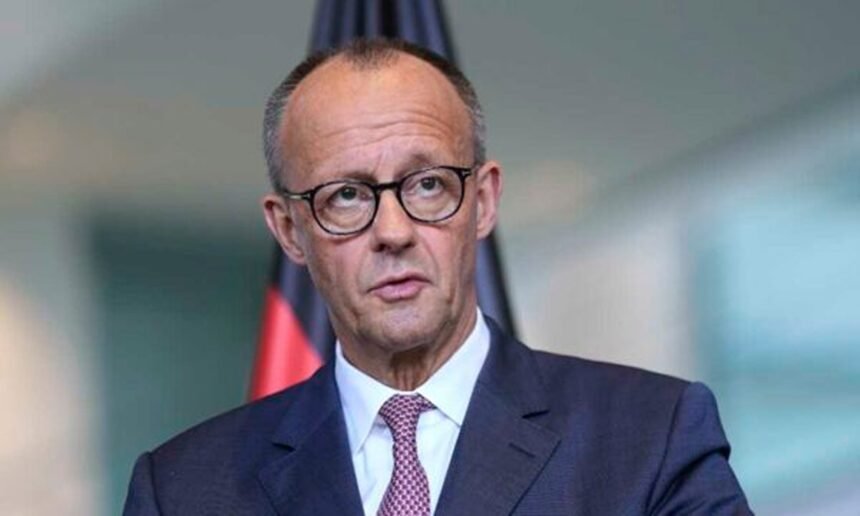
Despite weak polling results, German Chancellor Friedrich Merz believes that the governing coalition has “found its balance.” Ahead of the summer recess, he warned against voting for the Alternative for Germany (AfD) and delivered a message regarding the future of the Western Balkans.
The German chancellor’s annual summer press conference is one of his final engagements before heading on vacation. The conference hall in Berlin was packed with journalists.
Observers noted that Merz appeared confident and satisfied with his government’s performance, despite opinion polls showing approval ratings between 13 and 20 percent for both his work and that of his coalition government, made up of the Christian Democrats (CDU/CSU) and the Social Democrats (SPD).
“The coalition has found its balance,” Merz said, adding: “The results are positive. The federal government has found its rhythm despite some criticism. We have met expectations.”
Merz was referring specifically to reforms related to pensions, healthcare, and taxation — measures approved by the government but not yet ratified by parliament.
He praised the planned pension reform, which for the first time introduces a limited investment component. “We should have done this 30 years ago, like the Swedes, Danes, Dutch and many others around the world who introduced such systems long ago. But at least we are starting now,” he said.
However, despite discussions about government reforms, many journalists focused their questions on the Alternative for Germany (AfD), a party partly classified as far-right that is leading in opinion polls ahead of September elections in two eastern German states.
Asked how he intends to prevent the far right from governing Germany for the first time, Merz initially avoided a direct response. But when pressed, he addressed voters in Saxony-Anhalt and Mecklenburg-Vorpommern:
“Look carefully. Do not rely solely on activity on social media — wherever it happens. Instead, look at what the federal government is actually trying to achieve.”
Responding to a question from a Dutch journalist, Merz said that, given Germany’s Nazi past, it would be “something completely different” if far-right extremists were to regain political power.
Despite unfavorable polls, Merz remains confident ahead of the September elections.
“The campaigns have only just begun. I remain convinced that we will prevent the AfD from gaining a parliamentary majority in any of the three states — especially in Saxony-Anhalt and Mecklenburg-Vorpommern.”
Elections will also take place in September in Berlin, which functions both as Germany’s capital city and a federal state.
In response to a question from DW, Merz also elaborated on his controversial proposal to offer Ukraine — currently under pressure from the war — an initial path toward European Union membership without voting rights.
The chancellor said Ukrainians should be told honestly that the road toward EU membership is more difficult than initially expected, but argued that smaller, sustainable steps should begin now.
“At the moment, we essentially have five Western Balkan countries, Moldova, and Ukraine as potential new members of the European Union — these are the countries waiting for the EU to take the next steps,” Merz said.
The EU has not admitted a new member for 13 years, despite numerous promises to expand. According to Merz, if the bloc wants to preserve its credibility, it must take realistic but meaningful steps:
“If we lose that credibility, we lose those countries.”