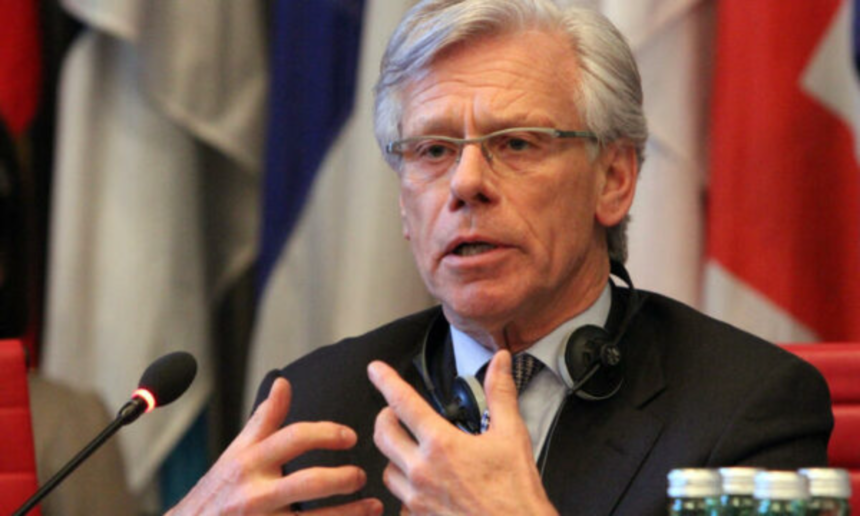
Former Norwegian Foreign Minister and Chair of the International Commission on Missing Persons (ICMP), Knut Vollebaek, addressed the unresolved issue of persons missing from the Kosovo war during the “Bridges of Memory” conference held in Pristina in June, emphasizing the importance of continuing efforts to establish the fate of those who remain unaccounted for.
Vollebaek noted that nearly three decades after the conflict, approximately 1,600 people are still missing, and for their families, the passage of time has neither eased the pain of uncertainty nor diminished the need for answers.
According to him, every unresolved case matters and requires sustained institutional, political, and scientific commitment.
He praised the work of the International Commission on Missing Persons (ICMP) in Kosovo, highlighting that modern identification methods—particularly DNA analysis—have helped determine the fate of more than 2,600 missing persons.
Vollebaek called for all remaining unresolved cases to be re-examined using the most advanced forensic and scientific techniques. He stressed the importance of reviewing earlier identifications that were based primarily on clothing and personal belongings, as well as conducting further analysis of unidentified human remains held by relevant institutions.
He also underlined that strengthening Kosovo’s domestic institutions, including the Kosovo Institute of Forensic Medicine and the Government Commission on Missing Persons, together with continued regional cooperation, remains essential to completing this process.
“Reconciliation is not about forgetting the past. It is about confronting it honestly, humanely, and in accordance with the rule of law,” Vollebaek said.
He concluded that resolving the remaining missing persons cases would not only fulfill an obligation to the families still awaiting answers, but would also represent a significant step toward advancing transitional justice and reconciliation in Kosovo.