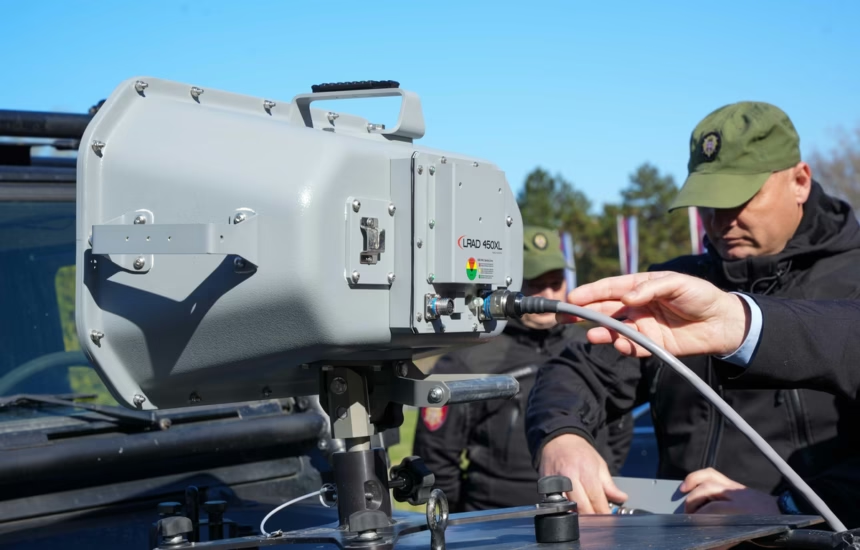
Serbia’s government is facing renewed scrutiny over its possession of Long Range Acoustic Devices (LRADs) after Interior Minister Ivica Dačić suggested that the police may sell the equipment because its use is not authorized under Serbian law.
The announcement comes more than a year after allegations that an acoustic device was used during the March 15 protest in Belgrade, accusations the government has consistently denied.
Speaking about the devices, Dačić explained that LRAD systems have different operating modes, including one for broadcasting warnings over long distances and another capable of emitting high-pitched, pulsating sounds intended to disperse crowds. He maintained that Serbian police have never used either function and argued that the devices remain unused because existing legislation does not permit their deployment.
“If the law has not changed and does not allow their use, we are ready to sell the devices,” Dačić said.
The minister’s remarks have prompted fresh questions about why the equipment was purchased in the first place if its use was never legally authorized.
Former Criminal Police Directorate inspector Milan Dumanović argued that the procurement itself raises legal concerns. According to him, purchasing equipment that cannot legally be deployed suggests that multiple officials may have violated regulations. He also questioned why the devices had reportedly been mounted on Interior Ministry vehicles despite lacking a lawful operational purpose.
Journalist Filip Švarm, editor of the weekly Vreme, said the proposal to sell the LRAD systems appears suspicious.
“At first glance, it looks like the removal of evidence,” Švarm said, suggesting that disposing of the devices could make it more difficult to investigate allegations regarding their possible use during the March 15 demonstration.
Critics also linked the controversy to the ongoing legal case against military analyst Aleksandar Radić, who has been targeted by Serbian authorities after publicly claiming that an acoustic weapon was used against protesters. Dumanović argued that removing the devices could undermine the defense’s ability to request forensic examinations that might determine whether they had ever been activated.
Švarm warned that the government’s actions risk creating a climate of intimidation.
“When authorities act this way toward people like Radić, they are sending a message to intimidate citizens,” he said, comparing the atmosphere to systems in which people fear speaking openly.
Adding to the controversy, attorney Aleksandar Olenik, who has also been questioned in connection with the investigation, claimed that Serbia’s Interior Ministry possesses not only LRAD devices but also several Russian-made acoustic systems. According to Olenik, it remains possible that a different acoustic device—unknown to the public—could have been used during the March 15 protest.
The debate over the LRAD systems continues as opposition figures, legal experts and independent observers call for greater transparency regarding the procurement, storage and potential use of acoustic crowd-control equipment by Serbian authorities.