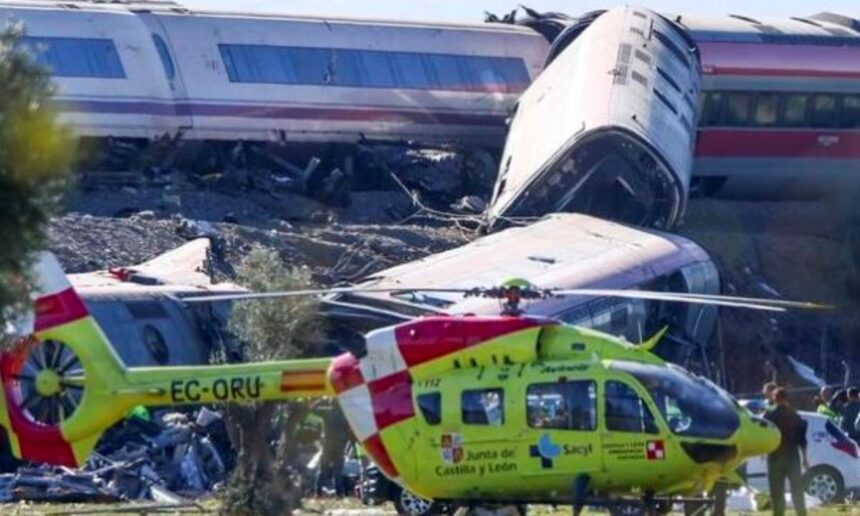
Spain has begun three days of national mourning following a major railway accident that killed at least 68 people and injured more than 100, prompting authorities to launch a wide-ranging investigation into the circumstances surrounding the disaster.
The crash occurred near the town of Urda, in the province of Toledo in central Spain, when two passenger trains operated by state-owned Renfe and private company Iryo collided. According to preliminary information, the Iryo train was stationary on the tracks when it was struck by the other train. The impact caused several carriages to derail and fall from the railway embankment.
Both trains were traveling from Madrid toward Andalusia, carrying more than 540 passengers combined.
Regional authorities in Castilla-La Mancha reported that at least 68 people had died. More than 100 others were injured, with 53 still hospitalized. Several remained in critical condition, according to German news agency dpa.
Questions over railway traffic management
The disaster has renewed concerns about the safety of Spain’s railway infrastructure and the procedures used to manage train movements during technical failures.
Transport Minister Óscar Puente said the accident may have been linked to unclear decisions made during the management of railway traffic.
According to his explanation, the automatic control system had been disabled because of a technical fault, forcing trains operating along the affected section to stop. Railway operators subsequently took manual control and made separate decisions about when to resume the movement of the halted trains.
Minutes later, a Renfe train was reportedly authorized to continue its journey while an Iryo train remained on the tracks.
Investigators have yet to establish the exact speed of the Renfe train immediately before the collision. Preliminary estimates suggest it may have been traveling at more than 200 kilometers per hour.
Authorities are expected to examine the sequence of operational decisions, the technical failure and the procedures used to authorize trains to resume their journeys.
Concerns over railway safety
The crash has intensified debate over the condition and safety of Spain’s railway network, particularly its high-speed lines.
The tragedy comes after another deadly collision on a high-speed railway line near Adamuz, in the province of Córdoba, on January 18 this year. That accident killed 46 people and injured 123 others, according to the report.
The recurrence of fatal incidents has raised questions about whether existing safety procedures and infrastructure are sufficient to prevent similar disasters.
Spanish railway unions have repeatedly warned about problems affecting the country’s rail network.
Despite the latest tragedy, train drivers’ union Semaf is continuing with a previously scheduled strike intended to pressure authorities to improve safety standards and prevent future accidents.
The investigation into the latest collision is expected to focus on the technical and operational circumstances that allowed the trains to occupy the same section of track, as authorities seek to establish responsibility and determine what measures may be necessary to improve railway safety.