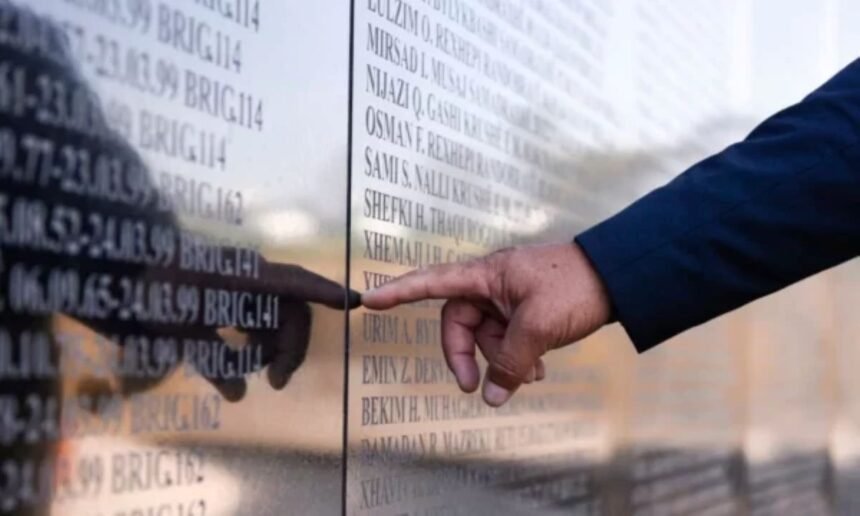
The discovery of a suspected mass grave site in northern Kosovo has renewed calls for Serbia to grant full access to its state and military archives related to the 1998–1999 Kosovo war.
For the families of approximately 1,600 people who remain missing from the conflict, access to these records could provide critical information about the fate of their loved ones and help locate undiscovered burial sites.
Although the issue of missing persons is regarded as a humanitarian matter, Serbia has not provided full access to documents held by institutions that operated during the war, despite commitments to cooperate and exchange information.
Experts on war crimes documentation and missing persons say unrestricted access to the archives could help identify mass grave locations, establish chains of command and responsibility, and clarify the circumstances surrounding those who remain unaccounted for.
Key archives remain inaccessible
According to Sonja Biserko, president of the Helsinki Committee for Human Rights in Serbia, the most significant records are held in Serbia’s state archives, as well as by the Serbian Armed Forces and the Serbian Ministry of Internal Affairs (MUP).
“The military archives and police structures contain wartime reports, operational records of military units, and documentation on troop movements that could help identify secondary mass graves and cases of missing persons in areas where combat operations took place,” Biserko told Radio Free Europe/Radio Liberty.
She added that archives of Serbia’s state security services contain intelligence reports from operations in Kosovo, including information on detentions and coordination between the MUP and the Yugoslav Army.
Bekim Blakaj of the Humanitarian Law Center Kosovo said that while the Ministry of Internal Affairs and the military hold crucial records, archives of other institutions should also be opened.
He pointed to records held by entities responsible for transporting and burying bodies, including public utility companies and similar organizations, which could provide additional evidence.
Archives could help solve many missing persons cases
Experts caution that opening Serbia’s archives would not automatically resolve every missing persons case, as many wartime killings were never officially documented.
“Many executions carried out in the field were not accompanied by official documentation,” Biserko said.
She stressed that during and after the conflict, Serbian state structures were involved in the systematic transfer of the bodies of murdered Kosovo Albanian civilians from Kosovo to mass graves in Serbia in an effort to conceal evidence of war crimes.
“This demonstrates there was an organized effort to cover up these crimes. Whether additional documentation exists that could help clarify the fate of the missing can only be determined through full and unrestricted access to the relevant archives,” she said.
Blakaj believes that opening all relevant archives and case files could significantly reduce the number of unresolved missing persons cases.
“A large percentage of the missing could be identified,” he said.
Kosovo seeks access to classified military records
Biserko argues that Serbia’s reluctance to open its archives is primarily driven by concerns that they would directly reveal the responsibility of the military and security services that operated in Kosovo throughout the 1990s.
Nearly three decades after the war—which claimed more than 12,000 lives, displaced hundreds of thousands of people, and devastated Kosovo—Belgrade continues to reject responsibility for wartime crimes and has made limited progress in resolving issues related to the conflict, including enforced disappearances.
Kosovo is specifically seeking access to the archives of the 37th Motorized Brigade of the Yugoslav Army, which were classified for 30 years under a decision issued by Serbia’s Ministry of Defense in 2014.
That same year, the Humanitarian Law Center in Belgrade requested access to the brigade’s archives and, in 2015, filed a lawsuit against then-Defense Minister Bratislav Gašić, arguing that the classification decision was unlawful.
According to Blakaj, the documents concern the brigade’s activities in Kosovo during 1999, including the killing of Albanian civilians and the transfer and concealment of their bodies in the Rudnica mass grave in Serbia.
At the time, the brigade was commanded by Ljubiša Diković, who later became Chief of the General Staff of the Serbian Armed Forces.
Limited progress despite dialogue commitments
Kosovo and Serbia previously adopted a Joint Declaration on Missing Persons as part of the EU-facilitated Brussels Dialogue, committing to provide full access to reliable information, including confidential records, to help determine the fate of missing persons.
Earlier this year, the two sides held the first meeting of the Joint Commission on Missing Persons, but no concrete progress was achieved.
Blakaj noted that Serbia has previously submitted a considerable number of wartime documents to the International Criminal Tribunal for the former Yugoslavia (ICTY). However, he said those records have not been sufficient to establish the fate of the 1,577 people who remain missing from the Kosovo war.