Acting Kosovo Prime Minister Albin Kurti has warned that any attempt to constitute the new parliament without a prior political agreement on the election of the country’s president could lead to another dissolution of the Assembly and a new political crisis.
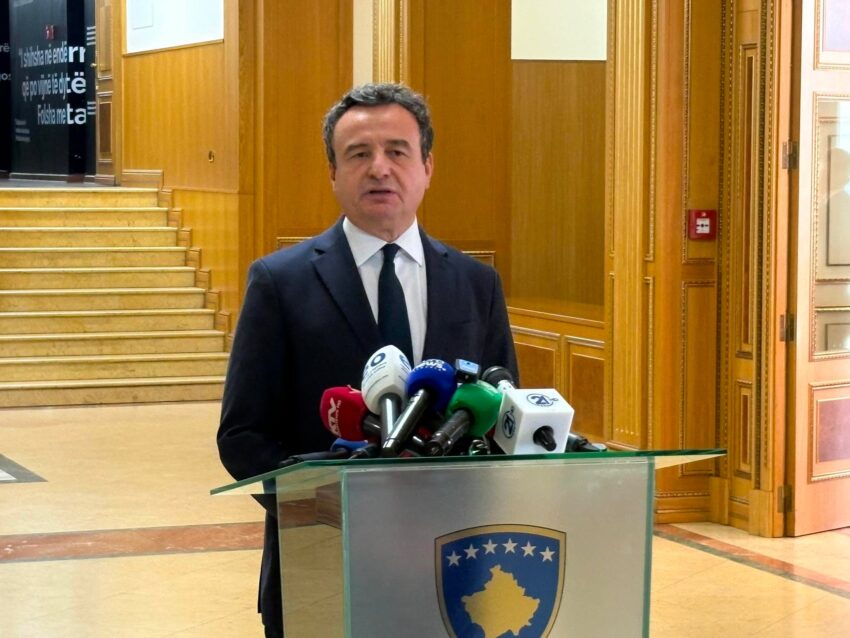
Speaking to reporters after the constitutive session of Kosovo’s 11th legislature was suspended on Thursday, Kurti said political parties should use additional time to reach an agreement on the presidency before proceeding with the formation of state institutions.
“Any constitution of the Assembly without a prior agreement on the issue of the president would be a preparation for the dissolution of the Assembly,” Kurti said.
He argued that political dialogue is the only viable path toward establishing Kosovo’s institutions and called for additional time for negotiations among the parties.
“We need to take additional time for discussions, and only once we have reached an agreement on the issue of the president should the institutions be constituted. Last time, we saw that there were difficulties when a solution for the president had not been found,” Kurti said.
The constitutive session of the Assembly was suspended earlier Thursday after no candidate was proposed for speaker, preventing lawmakers from moving forward with the next stage of the process.
Kurti said he remained ready to continue discussions with the Democratic League of Kosovo (LDK) and called on the leaders of other political parties to join negotiations.
“I call on the chairman of the Alliance for the Future of Kosovo, Ardian Gjini, as well as the chairman of the Democratic Party of Kosovo, Bedri Hamza, to meet and discuss,” Kurti said.
He maintained that while the speaker of parliament and the government are responsibilities of the parliamentary majority, the presidency should be treated as a broader political responsibility.
“The president is a responsibility of both the AAK and the LDK,” Kurti said.
His comments come as Kosovo’s newly elected lawmakers face renewed political uncertainty over the formation of institutions, with the failure to agree on key leadership positions raising the prospect of another prolonged institutional deadlock.