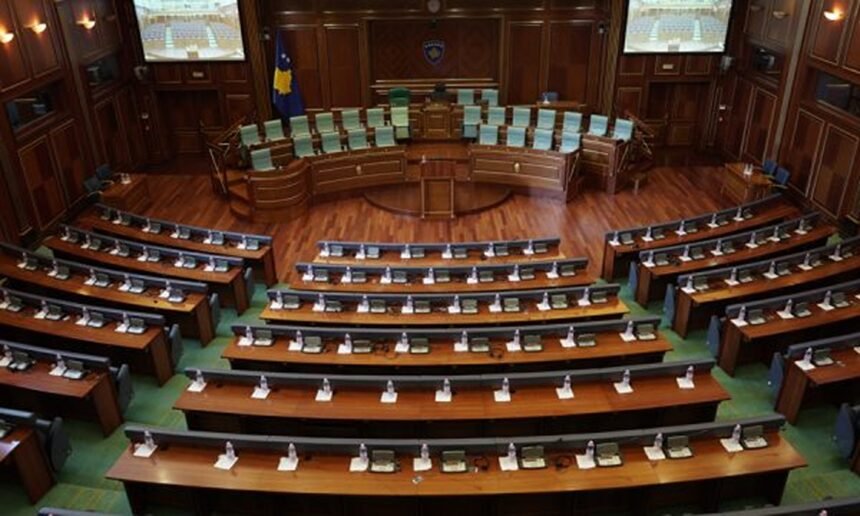
Kosovo’s newly elected lawmakers have only a few hours left to convene on Friday, the final day of a 30-day deadline set by the Constitutional Court to complete the constitution of the country’s new legislature.
Legal experts Eugen Cakolli and Naim Jakaj agree that failing to constitute the Assembly within the deadline would amount to a constitutional violation, but they differ over what should happen after the deadline expires.
Cakolli, from the Kosovo Democratic Institute (KDI), considers the August 7 deadline absolute and argues that it cannot be extended, even though Kosovo’s Constitution does not explicitly specify the legal consequences of failing to constitute the Assembly.
He said the lack of a clearly defined sanction appears to stem from the fact that the Constitution did not anticipate a situation in which lawmakers would fail to constitute the institution itself.
The political deadlock intensified on August 6, when Vetëvendosje leader Albin Kurti called for additional time for political discussions over the presidency. Kurti did not propose a candidate for Assembly speaker and the constitutive session was suspended.
According to Cakolli, if the Assembly is not constituted by midnight, there would no longer be a constitutional basis for the presiding officer, Avni Dehari, to call another continuation of the session.
He also argues that lawmakers would not be entitled to reconvene on their own initiative after the deadline expires.
Cakolli warned that the consequences could extend beyond the Assembly itself. He argued that, after taking their oaths as MPs, ministers and deputy ministers who have also been elected to the new legislature cannot simultaneously continue exercising executive functions.
As a result, he described the caretaker government as lacking both legal and political legitimacy and warned that its decisions could potentially be challenged before the courts.
In his view, the first legal step following a failure to constitute the Assembly would be to refer the matter to the Constitutional Court. Politically, however, he believes the eventual outcome could be another election.
“Elections are inevitable; it is simply a matter of finding the path toward them,” Cakolli said.
Naim Jakaj of the Kosovo Law Institute (KLI) agrees that missing the deadline would constitute a constitutional violation, but takes a different view of what can happen afterward.
Because the Constitution does not establish a specific legal sanction for failing to constitute the Assembly within the 30-day period, Jakaj believes that the constitutive session could still be called after August 7.
He argues that Dehari should continue to convene the session even if the deadline passes, because there is no explicit legal provision preventing him from doing so.
Jakaj is also skeptical that referring the matter back to the Constitutional Court would necessarily resolve the political crisis. In his view, the court could essentially reiterate that MPs are obliged to act in the country’s best interests and that the Assembly should have been constituted within the prescribed 30-day period.
Nevertheless, Jakaj warned of potentially serious consequences if the political deadlock continues.
A particularly sensitive issue is the presidency. Under Kosovo’s constitutional framework, the acting president can remain in office for no more than six months.
Albulena Haxhiu, who headed the previous legislature, took the oath as an MP of the new Assembly on August 6 and has been serving as acting president since April 2026, when Vjosa Osmani’s five-year presidential mandate ended.
Jakaj warned that Kosovo could enter an unprecedented institutional crisis if new institutions are not established before the acting president’s mandate expires.
He said the situation could potentially leave the country without an authority capable of calling new elections or assigning a mandate to a candidate for prime minister to form a government.
“We will enter a situation that we have never experienced before,” Jakaj said, warning that the consequences could amount to what he described as the “collapse of democracy” and lead to “institutional anarchy.”
He urged political parties to reach an agreement as quickly as possible to enable the constitution of the Assembly, the formation of a new government and the election of a president.
Civil society organizations have also called for the Assembly to be constituted within the constitutional deadline.
The Group for Legal and Political Studies (GLPS) said that party interests had taken precedence over the public interest, blocking the functioning of state institutions and undermining public confidence.
“There is no longer room for excuses, broad political interpretations or further postponements,” GLPS said, arguing that the only clear obligation is to constitute the Assembly within the constitutional deadline.
According to the organization, any failure to fulfill that obligation would constitute a constitutional violation and an irresponsible political and institutional act.
With the deadline expiring at midnight, Kosovo’s political parties face a critical few hours to reach an agreement and prevent the country from entering an even deeper institutional crisis.