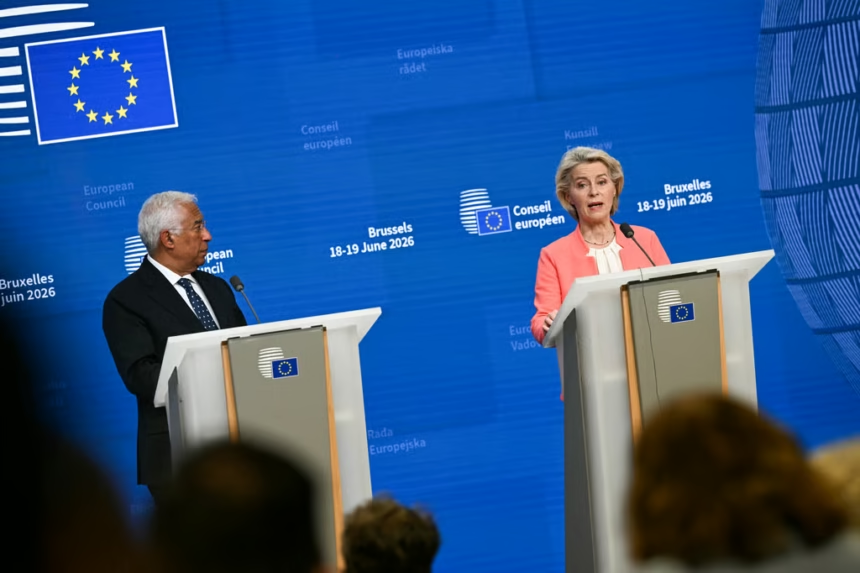
European Commission President Ursula von der Leyen and European Council President António Costa have voiced strong support for the International Criminal Court after the United States imposed sanctions on its president, Tomoko Akane, and a senior court official.
In a joint statement on Wednesday, von der Leyen and Costa said they “stand firmly with the ICC, President Tomoko Akane and the officials who uphold its mission,” emphasizing that the court plays a crucial role in delivering justice to victims of some of the world’s gravest crimes.
The EU leaders stressed that ICC judges and officials must be able to carry out their duties “independently and without external pressure.”
The statement came a day after U.S. Secretary of State Marco Rubio imposed sanctions on Akane and ICC senior trial lawyer Abdoulaye Seye. Washington has accused the court of targeting officials from countries that do not accept its jurisdiction, particularly in connection with its investigations involving Israeli officials over alleged crimes in Gaza.
Neither the United States nor Israel is a member of the ICC, although the court maintains that it has jurisdiction over alleged crimes committed in the Palestinian territories.
European Commission Executive Vice-President Teresa Ribera also criticized the U.S. measures, describing the sanctions as “profoundly sad and unfair” and reaffirming the EU’s support for the court and its officials.
Germany separately backed Akane and the ICC, with a foreign ministry spokesperson saying the court was fulfilling its mandate by holding perpetrators of the most serious crimes accountable.
The Netherlands has also rejected the sanctions. Dutch Foreign Minister Tom Berendsen said international courts must be able to carry out their mandates freely and invited Akane to The Hague for discussions on continued Dutch support.
The latest statements come as Washington steps up pressure on the ICC. Rubio has vowed to “systematically dismantle” the court’s ability to pursue Americans and nationals of other countries that are not members of the tribunal.
The ICC itself condemned the sanctions as a “flagrant attack” on its independence, warning that targeting judges and prosecutors for carrying out their legal duties threatens the broader international legal order.
The confrontation marks a widening dispute between the United States and its European allies over the role and independence of international judicial institutions, with European governments increasingly positioning themselves in defense of the ICC.