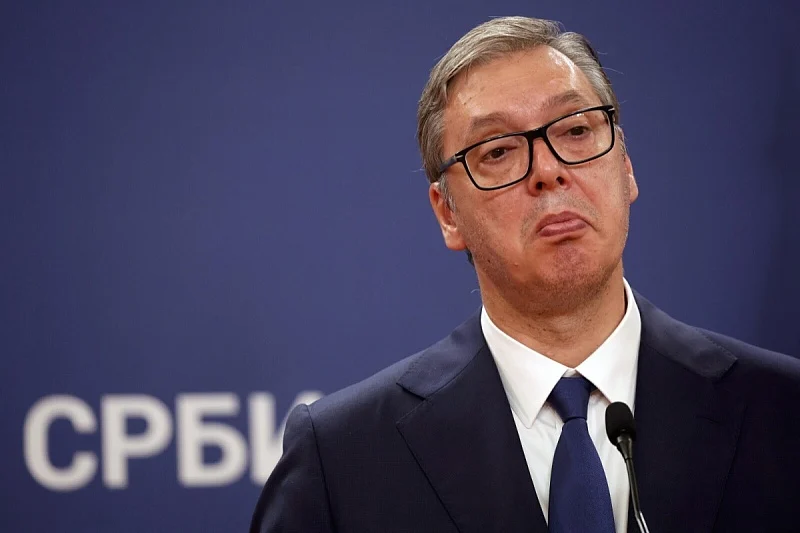
Serbian President Aleksandar Vučić has questioned why convicted war criminal Ratko Mladić has not been granted release from prison on humanitarian grounds, saying the former Bosnian Serb military commander is reportedly in critical health.
Speaking about the possibility of Mladić being released from custody, Vučić framed the issue as one of basic humanitarian treatment rather than the merits of the verdict against him.
“There is such a thing as humane treatment of people. General Mladić is effectively on his deathbed,” Vučić said, adding that authorities could have considered releasing him shortly before his death so that he could die where he had lived.
He referred to the earlier release of former Yugoslav Army General Nebojša Pavković, who was granted temporary release shortly before his death, arguing that a similar approach could have been applied to Mladić.
Vučić said he did not understand the position of the International Residual Mechanism for Criminal Tribunals, which is responsible for handling cases stemming from the tribunals for the former Yugoslavia and Rwanda.
“I do not understand these principles. This has nothing to do with the verdicts or with what anyone thinks. It is only about humane treatment of a human being. Why are they doing this and why are they behaving this way? I honestly do not understand,” Vučić said.
Mladić, who commanded the Bosnian Serb Army during the 1992–1995 war in Bosnia and Herzegovina, was convicted of genocide, crimes against humanity and war crimes and sentenced to life imprisonment.
The International Residual Mechanism for Criminal Tribunals upheld his life sentence in 2021, confirming his responsibility for some of the most serious crimes committed during the Bosnian war, including the 1995 Srebrenica genocide and the siege of Sarajevo.
Vučić concluded his remarks by questioning the humanitarian principles of the international justice system, saying the treatment of Mladić was not consistent with the notion of civilization that had been promoted to the region for decades.
The comments are likely to draw renewed criticism from victims’ groups and representatives of communities affected by crimes committed during the Bosnian war, particularly given Mladić’s final conviction for genocide and other international crimes.