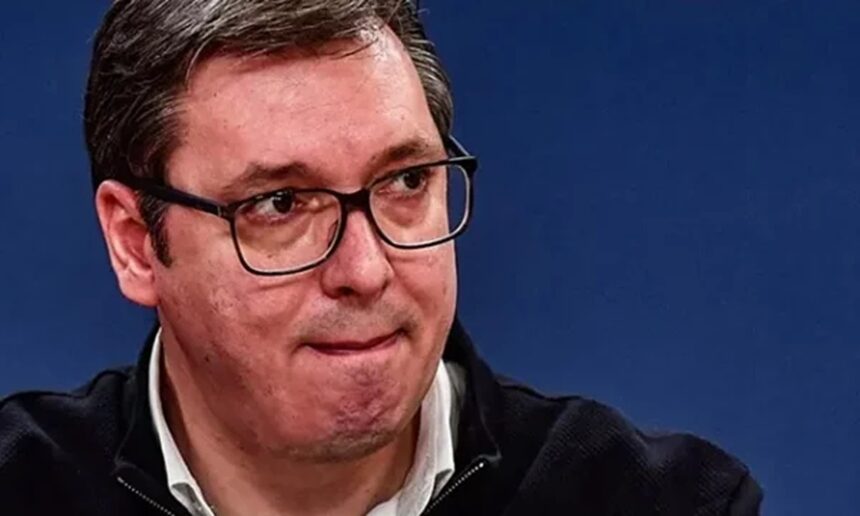
Serbian President Aleksandar Vučić has once again promised that elections are imminent, but his repeated announcements of early elections and his previous statements about resigning have left many questioning whether his latest deadline should be taken any more seriously than those that came before.
In recent days, Vučić has said that extraordinary parliamentary elections will be held in December. If that prediction proves correct, Serbia will indeed have new political leadership before the end of the year — and perhaps even a new president, although not of the country.
Following Crvena zvezda’s elimination from Champions League qualifying, club president Zvezdan Terzić, who is also Vučić’s godfather, announced that the football club would hold elections in December.
The coincidence has not gone unnoticed, particularly because Vučić has repeatedly announced that Serbia itself is heading toward early elections.
On August 16, Vučić again said that elections would be called “very, very soon,” specifying a possible timeframe of 15, 20 or 25 days. He also said the campaign would last between 45 and 60 days — a period already prescribed by Serbian law.
The problem, critics argue, is that Vučić has made similar predictions countless times without actually calling an election.
The president who keeps saying “elections”
Vučić’s repeated election announcements have gradually become a political version of the “wolf, wolf” fable: after so many warnings that failed to materialize, there is growing skepticism about whether the next one will be different.
The same pattern has appeared in his statements about his own resignation.
On June 27, during Vidovdan celebrations, Vučić told supporters that he would remain president for only “a few more weeks” before resigning. Nearly eight weeks have now passed.
He had previously mentioned resignation on May 24 while in China, saying that he might soon step down. On June 11, he said he was planning to resign within “three or four months, perhaps earlier,” and even claimed he was already packing his books at the Presidency.
By July 4, however, the timetable had changed again, with Vučić saying parliamentary elections could take place “perhaps even before” his resignation.
The latest statements have therefore reinforced the impression among critics that the resignation announcements were never accompanied by a concrete plan.
A constitutional contradiction
The editorial points to another problem in Vučić’s timeline.
If he had resigned at the end of July, as he had suggested, a presidential election would have had to be organized within 90 days. That would have placed the presidential vote before November, rather than after parliamentary elections in November.
The conflicting timelines have raised questions about whether Vučić’s public statements were ever intended as firm commitments or were instead designed to maintain political uncertainty and control the timing of the electoral process.
Vučić as president — and everything else
Since Vidovdan, Vučić has continued touring Serbia and addressing supporters at SNS gatherings. Although he has repeatedly suggested that his presidency is approaching its end, his public role has remained extensive.
The editorial sarcastically portrays him as simultaneously acting as president, prime minister, finance minister, infrastructure minister, labor and party-employment minister, health minister, sports minister, police and defense chief, head of the land registry and even an imagined equality commissioner for SNS members.
The criticism reflects a broader argument that Serbia’s political system has become excessively centered on one person and that Vučić continues to dominate areas that formally belong to other state institutions.
Universities, investment and corruption
The editorial also challenges Vučić’s recent comments about Serbia’s universities.
Vučić argued that the decline of the universities of Belgrade and Novi Sad in the Shanghai Ranking could lead to fewer investments and fewer new jobs.
But the author points to another indicator that may be relevant to investors: Serbia’s position in Transparency International’s 2025 Corruption Perceptions Index.
During Vučić’s rule, Serbia fell to 116th place among 182 countries, with a score of 33 points — described in the editorial as the country’s weakest performance in two decades.
The argument is that the government should be equally concerned about the institutional environment, corruption and rule of law when discussing Serbia’s attractiveness to investors, rather than attributing economic consequences primarily to university rankings.
For now, the only certainty appears to be that Vučić continues to announce major political changes while leaving their timing deliberately uncertain. Elections may indeed come before the end of the year — but after repeated promises, the question is no longer simply when they will be held, but whether the president’s latest timetable deserves to be believed.