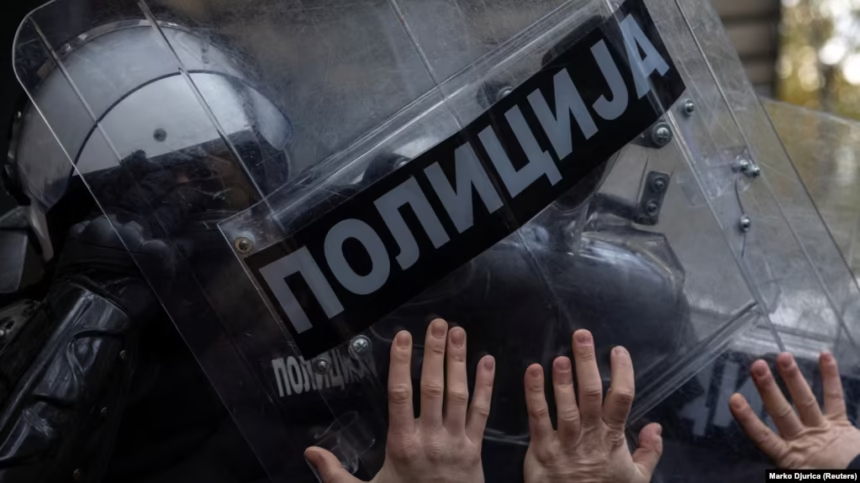
Allegations of police violence against protesters, including minors, are putting Serbia’s system of police oversight and accountability under renewed scrutiny, with lawyers and former police officers questioning whether existing mechanisms are capable of delivering independent and effective investigations.
Cases in Novi Sad and Valjevo have become emblematic of broader concerns over excessive use of force, arbitrary detention and alleged abuse during anti-government protests, while a recent report by the Council of Europe’s Group of States against Corruption (GRECO) has highlighted weaknesses in Serbia’s mechanisms for investigating complaints against police officers.
Family seeks accountability after Novi Sad detention
One of the cases concerns a 16-year-old from Odžaci who was detained with his father following an anti-government protest in Novi Sad on August 13, 2025.
The teenager’s father, Marko Starčević, alleges that his son was detained without a parent present and subsequently subjected to physical and psychological abuse, including being slapped and struck on the fingers and head while in a police vehicle and later at a police station.
The teenager was eventually taken to a children’s hospital, where doctors reportedly documented physical injuries, before he was returned to the police station and later released without charges.
“We want someone to be held accountable and to find out who beat my son,” Starčević told Radio Free Europe.
The family has filed a criminal complaint against police. According to Starčević, his son has continued to suffer psychological consequences from the incident.
Serbia’s Interior Ministry had not responded to questions about the case at the time of publication.
Ombudsman Zoran Pašalić confirmed that a procedure examining allegations of excessive use of force remains ongoing.
Valjevo case involves 28 police officers
Similar allegations emerged in Valjevo, where a protest on August 14–15, 2025, was followed by accusations of excessive police force against demonstrators and other citizens.
Lawyer Jana Aćimović Planojević, who represents 27 alleged victims, said her clients include minors who were allegedly beaten by police despite offering no resistance.
She described one case involving a 15-year-old who allegedly raised his hands and told officers that he was a minor. According to the lawyer, officers nevertheless allegedly knocked him to the ground and repeatedly kicked and struck him with batons.
She also alleged that police used force against people who were not participating in the protest, including individuals taken from taxis, betting shops and bakeries.
Police denied using excessive force during the incident and reported that dozens of officers had also been injured.
The 27 citizens represented by Aćimović Planojević filed a criminal complaint against 28 police officers, alleging ill-treatment and torture.
After lawyers argued that the initial investigation had not been sufficiently prompt or effective, they requested extraordinary oversight by the Supreme Public Prosecutor’s Office. The case was subsequently transferred to the Prosecutor’s Office for Organized Crime.
According to the lawyer, most of the alleged victims have been questioned and the proceedings remain ongoing.
The Ombudsman has also opened a separate procedure to examine whether there were shortcomings in the authorities’ handling of the allegations.
GRECO highlights weaknesses in oversight
The cases come as GRECO raises concerns about Serbia’s broader system for supervising police conduct.
In a report published on August 18, GRECO said Serbia needs to strengthen its oversight mechanisms and ensure that investigations into complaints against police are independent and transparent.
According to data cited in the report, authorities received 1,722 complaints from citizens concerning police conduct in 2024, 17 percent more than in 2023. Deficiencies in police work were confirmed in 127 cases.
GRECO, however, noted that complaints are largely handled by the police and the Interior Ministry themselves, meaning the existing procedure does not amount to genuine external oversight.
Former officer calls for structural reform
Uglješa Bokić, a journalist and former police officer, argues that Serbia currently lacks an effective system capable of deterring unlawful police conduct.
He said there is little publicly available evidence that police officers have been held accountable for excessive use of force during the wave of anti-government protests that began in November 2024.
Bokić also identified problems in the relationship between prosecutors and the Interior Ministry’s Internal Control Sector, which is responsible for investigating allegations involving police officers.
According to him, prosecutors can request evidence-gathering and witness interviews, but the system lacks an effective mechanism to compel the Internal Control Sector to act when it fails to follow instructions.
He called for a comprehensive reform of the Internal Control Sector and stronger external oversight of the Interior Ministry.
Bokić also questioned whether investigations can be fully impartial when officials with previous police backgrounds are tasked with investigating former colleagues.
GRECO said some of these issues are expected to be addressed through a new law on internal affairs. The legislation has been announced repeatedly by Serbian authorities but has not yet been adopted.
For victims and their families, the cases in Novi Sad and Valjevo have therefore become part of a broader test of Serbia’s rule of law: whether allegations of police abuse can lead to independent investigations, accountability and, ultimately, justice.