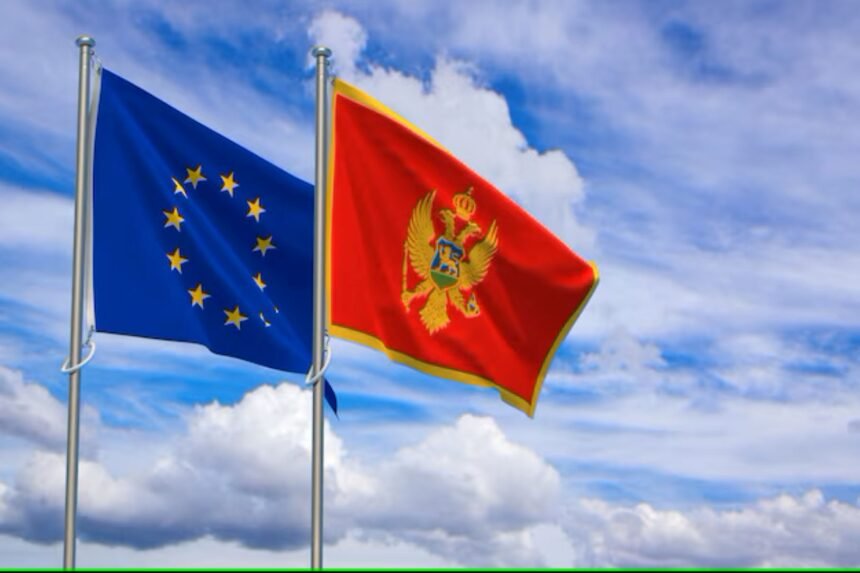
Montenegro has moved beyond the stage where its strategic direction can be determined from outside, but its continued European integration depends on strengthening weak institutions, completing judicial reforms and resisting political polarization, civil society activist and analyst Dina Bajramspahić told Pobjeda.
Bajramspahić described the latest political and media tensions between Podgorica and Belgrade as part of what she called a more than century-old pattern of pressure on Montenegro, arguing that Serbia has historically expected Montenegro to follow its political direction.
She said, however, that today’s Montenegro is more resilient and politically self-aware and that support for both independence and European Union membership has become deeply rooted across society.
“Montenegro has historically overcome the phase in which its strategic direction could be determined from outside, but it has not yet overcome the internal weakness of its institutions,” Bajramspahić said.
She argued that regional attempts to destabilize Montenegro are increasingly unlikely to overturn the country’s strategic course, although they can consume political and social energy needed for reforms.
According to Bajramspahić, the country’s EU membership objective has become broadly accepted across ethnic and political communities, while the question of statehood has also consolidated.
She cited a spring 2026 Eurobarometer survey showing that 75 percent of citizens believe Montenegro would benefit from EU membership. She also referred to research indicating that, among those who would participate in a hypothetical referendum, 75.6 percent would vote for independence.
“Twenty years after the referendum, the idea of an independent and European Montenegro has triumphed,” she said.
Bajramspahić warned that the upcoming election year could bring intensified political tensions and attempts to exploit sensitive issues to deepen polarization and weaken social cohesion.
Constitutional reforms seen as critical for EU path
She said Montenegro cannot afford to jeopardize the constitutional amendments required as part of its EU accession process.
“Any complications surrounding the adoption of the constitutional amendments would absolutely block the accession negotiations,” Bajramspahić said.
Although she criticized the quality of some proposed reforms, she argued that completing the process should remain the priority.
She said the amendments could have been more ambitious, particularly in the area of judicial reform, but warned that failing to adopt them would carry a greater cost.
“If we have to choose between two evils, it is better to improve judicial reforms after joining the EU than to remain outside the EU trying to perfect everything before membership,” she said.
The Montenegrin Parliament has already voted by 74 votes to initiate the constitutional amendment process. Bajramspahić said lawmakers now need to complete the procedure without political bargaining or calculations.
Rule of law remains a major obstacle
Despite progress on legislation, strategies, staffing and institutional modernization, Bajramspahić said Montenegro continues to face serious problems in Chapter 23, covering the judiciary and fundamental rights.
She pointed to political pressure on the judiciary, unequal treatment of politically influential individuals, lengthy judicial proceedings and concerns over the independence and impartiality of decision-making.
She also criticized what she described as declining standards for appointments within the judiciary and prosecution system, warning that a lack of experience could affect the quality and efficiency of institutions.
Digitalization of the justice system, she added, remains significantly behind schedule, with only around one-third of planned measures implemented.
Corruption is another major concern. Bajramspahić said implementation of the government’s anti-corruption strategy remains weak, with measures repeatedly carried over from one action plan to another.
She cited Eurobarometer findings showing that 81 percent of Montenegrin citizens consider corruption to be widespread, while 76 percent of companies share that assessment.
She also criticized political party financing, the use of public resources during elections and the lack of sufficient transparency and oversight, saying these areas remain inconsistent with recommendations from OSCE/ODIHR and GRECO.
Transparency and human rights remain concerns
Bajramspahić also highlighted what she described as persistent problems with transparency in public administration, pointing to thousands of lawsuits before the Administrative Court related to administrative silence and failures to respond to requests for access to public information.
She said the situation was similarly problematic in the field of human rights, citing attacks on human rights defenders, pressure on critics and independent media, inadequate protection against torture and ineffective investigations into allegations of mistreatment.
She also pointed to unresolved issues involving legal recognition of gender identity, discrimination against persons with disabilities and the protection of Roma rights.
EU sees the broader geopolitical picture
Bajramspahić believes the current phase of Montenegro’s EU accession talks is increasingly influenced by geopolitical considerations.
“There is no doubt that at this stage of the negotiations, geostrategic and political criteria dominate over technical ones,” she said, arguing that the accelerated pace of negotiations has made it harder to achieve the desired quality of reforms.
She warned, however, against assuming that Montenegro’s EU membership is guaranteed.
“Every domestic deviation from the course can serve as an excuse for any member state not to support the completion of negotiations with Montenegro,” she said.
With only four months remaining and 15 negotiating chapters still unopened or not yet closed, Bajramspahić said Montenegro faces a narrow window of opportunity.
She argued that political stability, meaningful institutional reform and the completion of constitutional changes will be essential if the country is to take advantage of what she described as a rare geopolitical opportunity for EU enlargement.
Ultimately, she said, Montenegro’s most important long-term challenge is not only completing the accession process but building a state whose institutions function effectively after membership.
“The unifying question for all our different identities is the quality of the state,” Bajramspahić said.