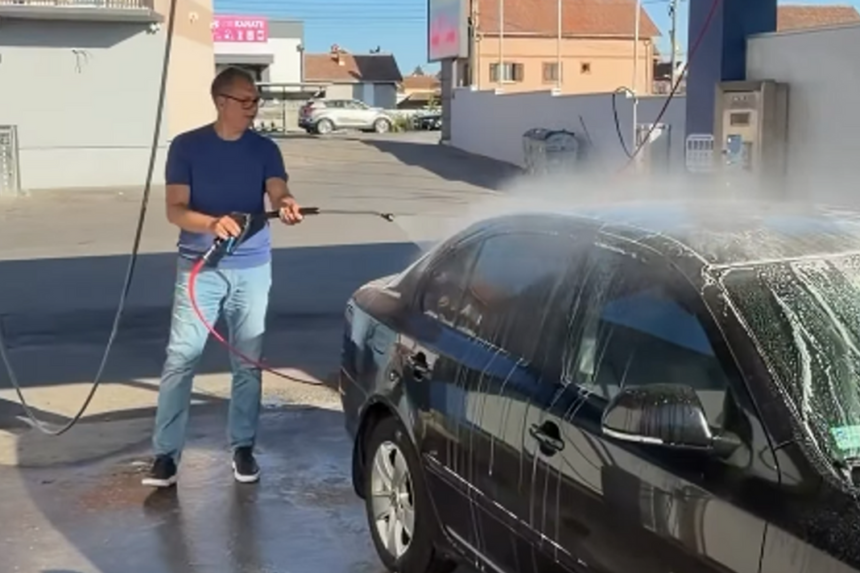
Serbian writer and columnist Marko Vidojković has mocked President Aleksandar Vučić over a newly published social media video showing him washing a car at a self-service car wash, portraying the clip as another attempt by the Serbian president to cultivate a relatable image and attract online engagement.
Writing for Danas, Vidojković sarcastically described himself as “delighted” by reports that Vučić had filmed another entertaining Instagram video, this time at a self-service car wash in a suburban area.
According to Vidojković, Vučić appeared in a blue T-shirt while driving to the location, speaking to the camera and adjusting the volume of the car radio. The columnist joked that the shirt probably cost almost as much as the Škoda being washed.
The video then shows Vučić operating the high-pressure water gun and washing the vehicle. Vidojković questioned, in his characteristically satirical style, how much of the work was actually carried out by the president, pointing to the extensive cuts and editing in the clip.
He also mocked the video’s closing exchange, in which a woman asks Vučić whether he has washed the floor mats. The president responds: “We’ll do that next time.”
Vidojković interpreted the remark as part of a broader pattern in which Vučić appears in carefully produced videos performing ordinary everyday activities.
He sarcastically suggested that the president could next film himself changing a light bulb, replacing a car tire or changing the cartridge in an electric mosquito repellent.
“Does the president know how to wash dishes?” Vidojković asked, joking that even putting dishes into a dishwasher could become the subject of another viral video.
The columnist also joked that Vučić might eventually film himself riding a horse, although he added that perhaps a bison would be more appropriate.
Vidojković’s article is explicitly satirical and reflects his longstanding criticism of Vučić and the Serbian government. Rather than reporting the car-washing video as a political event, the column uses humor and exaggeration to question the president’s extensive use of social media and staged appearances involving everyday activities.
The episode reflects a broader trend in contemporary political communication, in which leaders increasingly use social media videos to present themselves outside traditional political settings and cultivate a more personal connection with voters.
For Vučić, such videos have become a recurring feature of his public communication, while critics argue that they are carefully constructed political messaging designed to generate engagement and reinforce his image as an active and approachable leader.