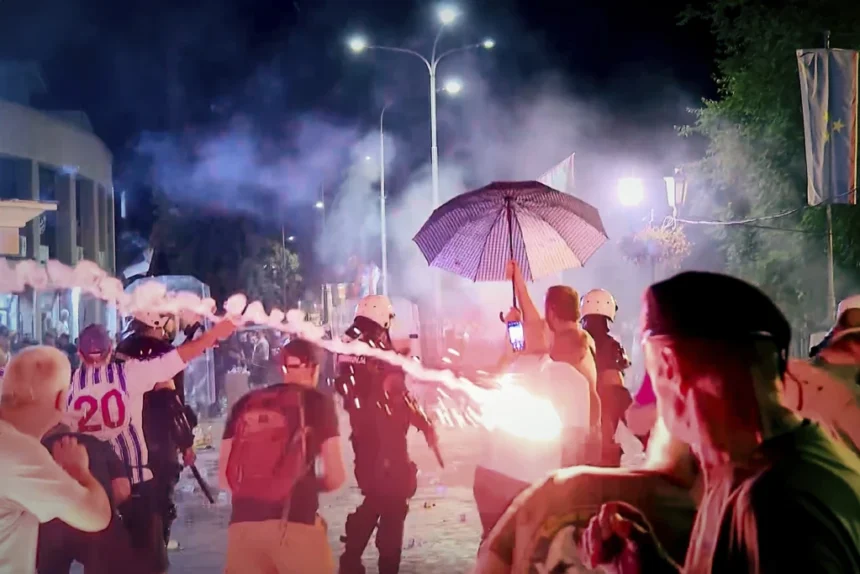
Nearly a year after coordinated attacks by regime-aligned thugs and what protesters described as a “people’s militia” during demonstrations across Serbia, the identities of many of those involved remain unknown. Critics say the authorities have effectively protected the identities of those accused of abusing and assaulting citizens who opposed the government.
In Valjevo, students publicly identified police officers accused of beating protesters. However, many officers remain listed as unidentified because they allegedly wore masks and concealed identification numbers while carrying out their duties.
Interior Minister Ivica Dačić dismissed the identification of officers as part of what he called a “brutal campaign against the police.” He also argued that the police had been “too defensive” and had suffered more than police forces in other countries.
President Aleksandar Vučić, meanwhile, said he was sorry if anyone had received “one, two or three” unnecessary blows, while placing greater emphasis on damage to property and buildings belonging to the ruling Serbian Progressive Party (SNS).
But forensic specialist Đorđe Alempijević documented at least 28 baton strikes on one of 25 people he examined and concluded that, in many cases, the use of force appeared punitive rather than aimed at controlling crowds.
Witness accounts describe even more serious incidents, including officers allegedly kicking, spitting on and humiliating protesters.
Student Tamara Jeremić recalled seeing a police officer stamping on her friend Dušan Radović, pressing his head against the pavement and spitting on him after he had been beaten.
Another student, Vladimir Đorđević, said officers mocked him while beating him, asking whether he was “still pumping” — an apparent reference to the protesters’ tactics.
Images of police violence become propaganda
Months later, there are still no clear public answers about the legal or operational basis for some of the police actions.
In Novi Sad, footage showed young men kneeling against a wall with their hands tied behind their backs, with police officers standing behind each of them. Pro-government tabloid Informer celebrated the images under the headline “Arrest, people’s militia,” while other tabloids echoed the message.
The footage emerged after an incident outside SNS offices in Novi Sad in which members of the police special unit known as the Cobras were photographed protecting themselves with chairs, with one officer holding a firearm.
The image was interpreted by protesters as evidence that “fear had changed sides.” According to the analysis, the subsequent detention of young people served as a demonstration of state power.
Police accused of standing aside as violence escalated
A similar pattern was reported in Bački Petrovac, where police were present during an exhibition about the protests but allegedly failed to intervene when groups of men began destroying photographs and harassing visitors.
According to the account, police later withdrew as additional attackers arrived, allowing protesters, war veterans and even a mother with a child to be assaulted.
Those affected filed criminal complaints alleging violent behavior at a public gathering, incitement of ethnic, religious and racial hatred, serious bodily harm and failure by police to act. The article says no response had been received from the authorities.
Two days later, residents of Bačka Palanka protested over the events in Petrovac and in support of psychologist and professor Dragan Prpa, who had been beaten during an earlier demonstration.
The situation escalated when SNS activists allegedly threw eggs and frozen water bottles at protesters. The following day, local authorities called supporters to defend the ruling party, while two organized groups of masked men reportedly arrived carrying clubs, metal bars and brass knuckles.
Witnesses alleged that Bačka Palanka municipal president Branislav Šušnica was present among masked attackers and directed the assaults. Police and gendarmerie units were accused of failing to intervene.
A similar confrontation reportedly took place in Vrbas.
From shield to “baton”
The article argues that these incidents marked a shift in the role of the police — from protecting regime supporters to becoming an instrument directly used against protesters.
The most severe example, according to the report, occurred in Valjevo, where police violence against demonstrators was followed by further pressure against activists, journalists, lawyers and others involved in challenging the authorities.
The Council of Europe’s Secretary General Alain Berset called on Serbian authorities to respect European standards, but critics argue that the government continued using pressure and force rather than accountability.
Among those targeted were election observers, journalists, artists and individuals such as Vladimir Arsenijević and Stevan Filipović. The article also cites the case of Dragan Prpa, who, in addition to being beaten during a protest, later lost his job at the Sveti Sava primary school in Bačka Palanka.
Pressure extends to lawyers and prosecutors
The pressure has also reached lawyers representing victims of police violence.
Attorney Nikola Mirković said a series of hostile television programs intensified at the same time as proceedings before Serbia’s Organized Crime Prosecutor’s Office concerning complaints filed against police officers allegedly involved in abuses.
Mirković himself was summoned as a suspect in a criminal case over an alleged attack on an official — the same type of offense for which some of his clients, including beaten students and minors, are accused.
He described the pressure as “bare” intimidation and said that it had affected not only him but also his family and the family of fellow lawyer Jana Aćimović Planojević.
The article also links the wider campaign to the burning of the car belonging to prosecutor Vukašin Vujičić, who had publicly opposed pressure on the judiciary and was handling an indictment against a group accused of intimidating protesters.
Valjevo shows signs of renewed resistance
Despite the violence and pressure, Valjevo has emerged as a notable exception.
After a commemorative protest on August 14, residents spontaneously returned to the streets two days later following the burning of the prosecutor’s vehicle. The renewed mobilization suggests that the authorities may have pushed beyond a limit even in a city that experienced some of the harshest police repression.
The broader picture remains one of escalating pressure, according to the report, but also growing resistance.
The experience of Valjevo suggests that state force can suppress protests temporarily, but it cannot necessarily eliminate public opposition. The central question is whether Serbia’s institutions will eventually hold those responsible for violence accountable — or whether the police will continue to function as an instrument of political power rather than an institution serving citizens.