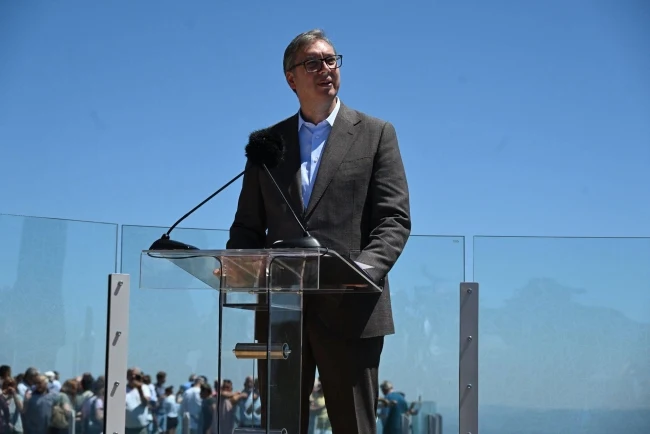
Serbian President Aleksandar Vučić said Thursday that he had sent a letter to NATO Secretary General Mark Rutte asking the alliance to prevent the opening of the main bridge over the Ibar River in North Mitrovica and urging KFOR to take action over what he described as the “persecution” of Kosovo Serbs.
“I have just sent a letter to NATO Secretary General Mark Rutte and asked KFOR, in accordance with UN Security Council Resolution 1244, to stop the persecution of Serbs, their arrests, the demolition of houses, as well as the opening of the bridge over the Ibar,” Vučić said in a video message posted on Instagram.
He also called on the international community to press Kosovo authorities to implement key provisions of the 2013 Brussels Agreement.
Vučić said he had specifically asked Rutte to oppose the opening of the bridge, arguing that such a move could create conditions for what he described as a “final confrontation” with the Serb population in northern Kosovo.
The Serbian president said Serbian Army Chief of Staff Milan Mojsilović had recently had a “very difficult conversation” with KFOR Commander Major General Özkan Ulutaş over the issue.
“We asked them not to do this because the opening of the Ibar bridge is a subject of the Brussels dialogue,” Vučić said, arguing that the situation would have been different had the EU and Western countries implemented agreements reached in April 2013.
He again criticized the failure to establish the Association/Community of Serb-Majority Municipalities, saying this was one of the reasons for the current tensions.
Vučić said Serbia would continue its diplomatic efforts and did not rule out requesting an emergency session of the UN Security Council, arguing that what he called the “persecution” of Kosovo Serbs must end.
He claimed that more than 800 ethnically motivated attacks against Serbs had occurred in Kosovo over the past five years and that 257 Serbs had been arrested and, in his words, “as a rule, severely beaten” by Kosovo police.
Kosovo authorities have repeatedly rejected Belgrade’s characterization of their actions as systematic persecution, while the issue of the Ibar bridge remains highly sensitive amid wider disputes over security, freedom of movement and the implementation of agreements reached through the EU-mediated Kosovo-Serbia dialogue.