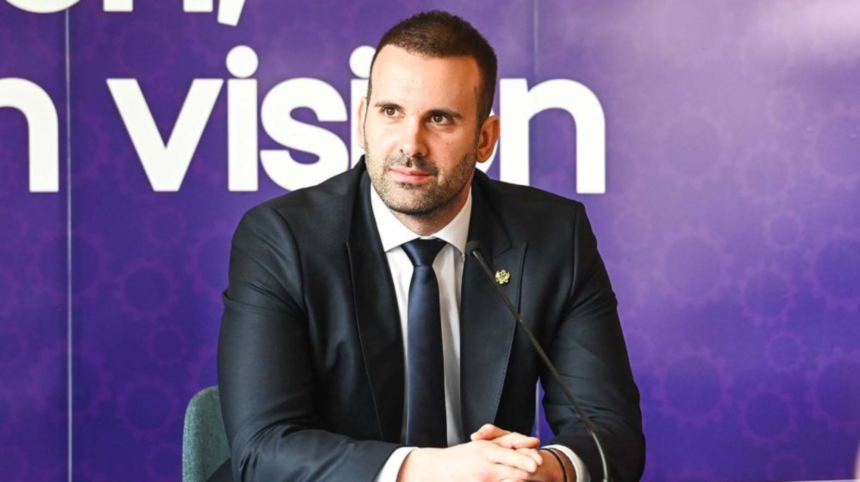
Montenegro’s Prime Minister Milojko Spajić has launched a sharp political attack on Milan Knežević, accusing him of acting in the interests of Belgrade and deliberately obstructing Montenegro’s European path.
Spajić said it was “sad to watch” a politician whom he once considered rhetorically talented and interesting now “unquestioningly carry out the tasks” of his “(non)formal boss from Belgrade,” accusing Knežević of trying to slow down Montenegro’s European integration.
Spajić also took aim at Knežević’s political sympathies in Serbia, using an ironic reference to what he described as a “trio” of similarly named figures.
“Everyone has the right to have their favorites in a neighboring country: mine are the best sportsmen and sportswomen Serbia has produced, while Mr. Knežević is delighted by the trio with similar surnames: Vučić, Vučević and Vučićević,” Spajić said.
The remark directly places Aleksandar Vučić, SNS president Miloš Vučević and media figure Dragan J. Vučićević within the political context of Spajić’s criticism of Knežević.
The accusation goes beyond an ordinary dispute between Montenegrin politicians. Spajić is effectively presenting Knežević as a political actor whose priorities are closely aligned with the power structures in Belgrade rather than with Montenegro’s stated objective of advancing toward the European Union.
That raises a broader question about Serbia’s political influence in Montenegro. If politicians in Podgorica are perceived as taking political direction from Belgrade, Montenegro’s European orientation becomes vulnerable to interference from outside its borders.
For Vučić, the accusation is particularly uncomfortable. It reinforces the long-running criticism that Belgrade seeks to preserve political leverage in Montenegro through parties and politicians who maintain close relations with Serbia’s leadership.
Knežević has publicly expressed strong support for Vučić in the past, including praising a major speech by the Serbian president and endorsing Vučić’s claims about Montenegro’s treatment of Serbs.
The relationship is therefore not simply a matter of political coincidence. There is a documented history of political affinity between Knežević and Vučić, even though Spajić’s stronger claim—that Knežević is literally carrying out instructions from a “boss in Belgrade”—remains a political accusation rather than an independently proven fact.
The involvement of Vučević is also significant. As president of the Serbian Progressive Party, he has publicly defended Vučić while responding aggressively to Spajić’s criticism of Belgrade. In a recent response, Vučević accused politicians in Podgorica of using attacks on Vučić and Serbia as a political “lifeline” and insisted that Vučić answers only to the Serbian people.
This exchange illustrates the increasingly open political confrontation between Podgorica and Belgrade.
On one side, Spajić is presenting Montenegro’s European integration as a sovereign national objective. On the other, figures close to Vučić are portraying criticism from Podgorica as an attack on Serbia and its leadership.
The result is a political battle in which Knežević is being portrayed as the link between Montenegro’s pro-Serbian political camp and the power structures of Belgrade.
The central question is therefore becoming increasingly difficult to avoid: Is Montenegro free to determine its own European future, or is Belgrade still attempting to shape that future through its political allies in Podgorica?
Spajić has clearly chosen confrontation rather than silence. By naming Vučić, Vučević and Vučićević in the same breath as Knežević, he is accusing a wider political network not merely one Montenegrin opposition figure of standing in the way of Montenegro’s European trajectory.
And if Belgrade’s political influence is indeed being used to obstruct Montenegro’s EU ambitions, then the controversy surrounding Knežević is only the visible part of a much larger regional struggle over who gets to influence Montenegro’s future.