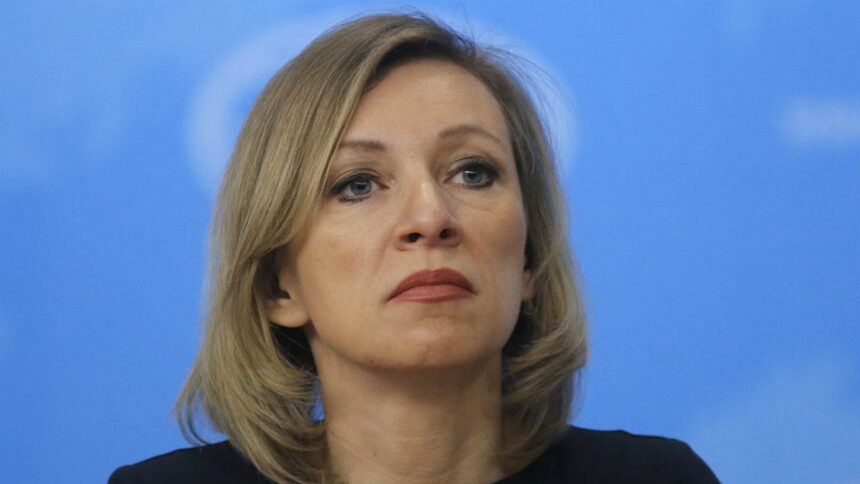
Russian Foreign Ministry spokeswoman Maria Zakharova has once again entered the Kosovo debate with a familiar message from Moscow: allegations of “systemic terror”, “ethnic oppression” and an impending “humanitarian catastrophe” allegedly facing Kosovo’s Serbian community.
Her latest statement is another example of the increasingly repetitive propaganda coming from Moscow and Belgrade, where almost every action taken by Kosovo’s institutions is presented as an attack on Serbs, while Serbia and Russia position themselves as their supposed protectors.
Zakharova claimed that the situation of Serbs in Kosovo had become “catastrophic”, alleging forced displacement, fabricated criminal cases, intimidation, disproportionate use of force and the demolition of Serbian property.
She also criticised the gradual adjustment of KFOR’s presence around the Ibar bridge and near the Visoki Dečani monastery, describing the move as “cynical and irresponsible” and calling for the international community to intervene.
But these claims deserve to be examined against the reality on the ground rather than simply repeated as fact.
Serbs in Kosovo are a constitutionally recognised community with the same fundamental rights guaranteed to all other communities in Kosovo. They have guaranteed political representation, the right to use their own language, cultural and religious rights, access to public institutions and mechanisms designed specifically to protect community interests.
Kosovo’s constitutional framework provides extensive protections for non-majority communities, including guaranteed seats in the Assembly and institutional mechanisms intended to ensure their participation in political and public life.
Yet Moscow’s narrative rarely acknowledges these realities.
Instead, Zakharova repeats a familiar formula: portray Kosovo Serbs exclusively as victims, describe Kosovo’s institutions as inherently hostile to them, and present international missions as accomplices in alleged persecution.
This narrative is not new. It has been repeatedly used by Serbian and Russian officials to create the impression that Serbs in Kosovo live without rights or institutional protection.
That does not mean that every issue affecting the Serbian community should be dismissed. Incidents, disputes over property, policing, security or individual rights must be investigated and addressed wherever they occur — regardless of ethnicity.
But there is a significant difference between raising legitimate concerns and portraying an entire community as permanently persecuted.
Zakharova’s statement crosses that line by presenting sweeping political claims as established reality, without acknowledging the constitutional protections and institutional representation available to Kosovo’s Serbian community.
The timing is also telling.
As discussions continue over the future of the Ibar bridge and KFOR’s security posture, Moscow once again frames a move towards greater freedom of movement and the reduction of barriers between the northern and southern parts of Mitrovica as a threat to Serbs.
For years, the bridge has been one of the most visible symbols of division in the city. Its eventual opening to vehicle traffic would instead represent greater connectivity and freedom of movement for residents on both sides.
A bridge connecting communities is being presented as a danger, while the political structures designed to protect those communities are conveniently ignored.
Russia has no shortage of geopolitical interests in Kosovo. Its repeated statements about an alleged “humanitarian catastrophe” should therefore be viewed within that broader political context.
The Serbian community in Kosovo deserves genuine security, equal treatment and protection of its rights — just as every other community does.
But protecting those rights does not require turning Kosovo Serbs into permanent political instruments.
The constant repetition of the same victimisation narrative does not make it true. It only makes the propaganda more familiar.
And the more Moscow repeats the claim that Serbs in Kosovo have no rights, the more important it becomes to distinguish between legitimate concerns that deserve attention and a political narrative designed to portray Kosovo as a permanent crisis.