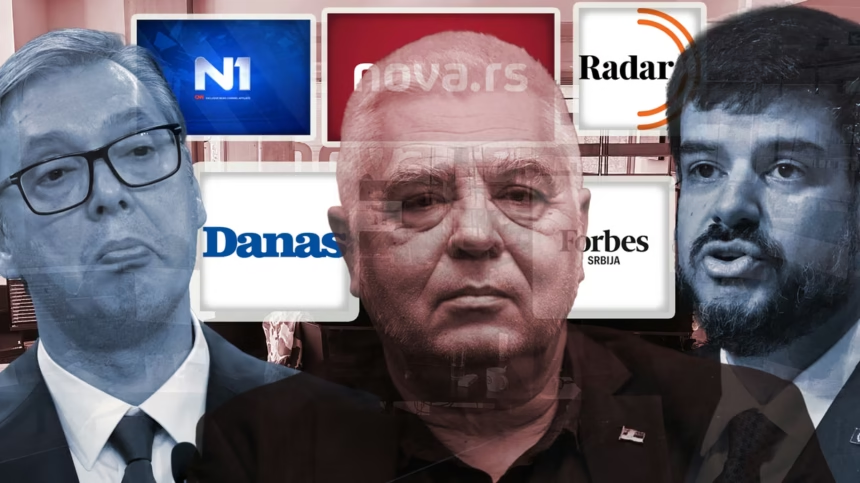
As Serbia prepares for parliamentary elections that President Aleksandar Vučić says could be held on October 18 or 25, senior government officials are increasingly signaling expectations for changes to the editorial direction of major independent media outlets linked to United Group.
Recent management changes at several Serbian media companies, including Nova, N1, Radar and Danas, have been followed by public comments from Vučić and Information Minister Boris Bratina that critics say amount to political pressure aimed at weakening independent journalism ahead of the vote.
The latest changes came after Pedro Vargas Santos David, associated with Portuguese investment company Alpac Capital, was appointed to senior management positions at several United Group media operations in Serbia. A number of existing directors were subsequently replaced.
Vučić has openly commented on the expected change in editorial policy, saying the new owner would have to “move closer to the majority of Serbia,” an apparent reference to his political supporters.
He has also accused the media previously operated by United Group of having been a political project allegedly financed by foreign intelligence services to undermine the Serbian government, without providing evidence for the claim.
“The new owner has to make money and move closer to the majority of Serbia,” Vučić said, arguing that the outlets would need a broader audience.
Bratina pressures new media management
Information Minister Boris Bratina went further, addressing an open letter directly to Pedro Vargas Santos David and calling for television channels N1 and Nova S to be registered with Serbia’s electronic media regulator, REM, rather than operating under their existing regulatory arrangements in Luxembourg.
Bratina also used the letter to attack the editorial policies of the outlets, accusing them of acting against the interests of the state and of treating government officials unfairly in their reporting.
He described the media operations as part of what he called a “criminal media project” and criticized their coverage of major tragedies in Serbia, including the 2023 mass shooting at Vladislav Ribnikar Elementary School and the collapse of the railway station canopy in Novi Sad.
Critics have accused the minister of using his position to interfere in the editorial independence of privately owned media.
Journalists warn of a campaign to silence independent outlets
Media and communications expert Igor Avžner told Nova.rs that the government’s actions suggest it expects the new ownership structure to produce changes in editorial policy.
Avžner argued that the timing was significant because the changes are taking place shortly before parliamentary elections.
He predicted that the government would seek to gradually weaken the critical character of N1, Nova S, Radar and Danas rather than impose an immediate and obvious transformation that could alienate their existing audiences.
European Federation of Journalists President Maja Sever also criticized the intervention, describing Bratina’s letter as “absolutely surreal” and warning of what she called a broader effort to silence Serbia’s remaining independent media.
Sever said the pressure was particularly concerning because it was occurring ahead of elections and involved a senior government official directly addressing the owner of private media companies.
Regulatory questions in Luxembourg
The management changes have also raised regulatory questions in Luxembourg, where the companies involved are subject to local oversight.
According to information cited by Nova.rs from the Luxembourg Independent Audiovisual Authority (ALIA), the process concerning the change of control has not yet been completed.
The Luxembourg authorities reportedly warned that changes in control of a company require prior government approval and that implementing such changes without authorization could lead to sanctions.
The developments have therefore created a dual controversy: political concerns in Serbia over the future editorial independence of major media outlets, and regulatory questions over whether the ownership and management changes have received all necessary approvals.
With parliamentary elections potentially only weeks away, the fate of N1, Nova S, Radar and Danas has become an increasingly important issue in Serbia’s political and media landscape.