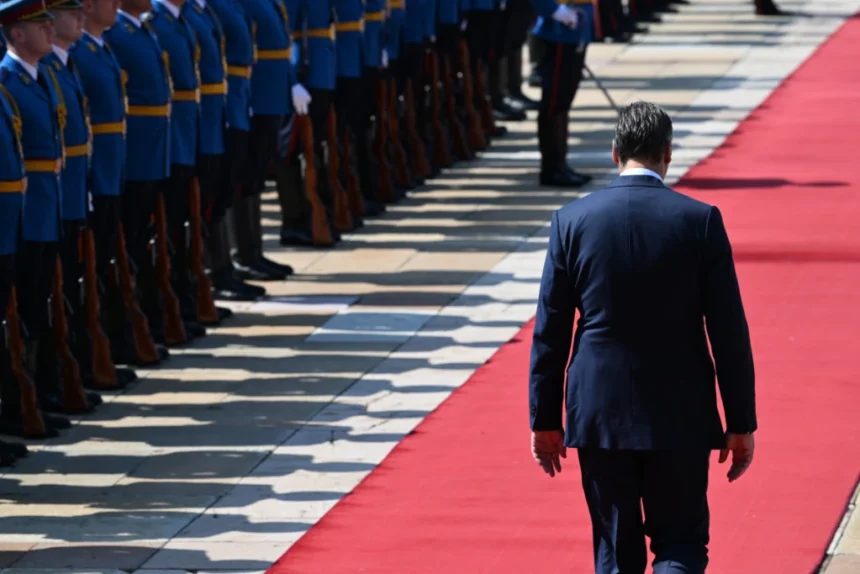
Serbian President Aleksandar Vučić is facing a political environment that is becoming increasingly difficult to control, with recent opinion polls pointing to growing support for democracy, stronger political engagement among young people and rising backing for European Union membership.
An analysis published by Radar argues that the changes underway in Serbian society could increasingly undermine the political model built around Vučić’s dominance, particularly as public dissatisfaction with corruption, living costs and the government continues to grow.
The findings are significant as Serbia prepares for parliamentary elections that Vučić has said could be held on October 18 or 25.
Rather than showing a society becoming more receptive to the strongman politics that has characterized much of Vučić’s rule, several recent surveys suggest that voters are becoming more interested in institutions, accountability and political participation.
Growing preference for democracy
According to a recent International Republican Institute (IRI) survey conducted between May 27 and June 24 among 1,502 respondents, 49 percent of Serbian citizens believe the country is moving in the wrong direction, compared with 41 percent who believe it is moving in the right direction.
The shift is particularly notable when compared with earlier years. In 2024, 56 percent of respondents considered the country’s direction positive, while 37 percent viewed it negatively. In 2022, the balance was even more favorable, with 57 percent saying Serbia was moving in the right direction and 33 percent saying the opposite.
The change coincides with several years of political unrest, mass protests and growing public scrutiny of the government.
The same IRI research identified corruption as the biggest problem facing Serbia, followed by the government and ruling party and then the cost of living.
For a political system heavily centered on one leader, those trends present a serious challenge.
Young Serbs increasingly reject the strongman model
Perhaps more important for Vučić’s long-term political position is the changing attitude of younger voters.
Research cited by Radar from the Centre for Youth Work and Policy Research (KOMS) shows that 53.9 percent of young people now consider democracy the best form of government.
By contrast, 39.6 percent believe Serbia needs a strong leader, while 45.6 percent disagree.
The figures represent a significant change from previous years and suggest that the political attitudes of a generation once widely regarded as relatively disengaged are evolving rapidly.
Young people are also demonstrating a much greater willingness to participate politically.
Nearly 90 percent of eligible young voters surveyed by KOMS said they would vote if elections were held the following week. At the same time, 84 percent said Serbia’s political system does not allow young people to meaningfully influence political processes and decisions.
Almost seven in ten said they had participated in some form of protest, while 58 percent had signed a petition or participated in a citizens’ initiative during the previous year.
That combination — deep dissatisfaction with institutions alongside high political engagement — could become increasingly important in the next election cycle.
The legacy of the Novi Sad tragedy
The transformation in public attitudes has unfolded against the backdrop of years of protests.
The mass shootings in 2023 triggered demonstrations, followed by protests over the 2023 elections, opposition to lithium mining and, later, the collapse of the canopy at Novi Sad railway station in November 2024.
The Novi Sad tragedy became a particularly powerful catalyst for student-led protests, which eventually developed into one of the most sustained challenges to Vučić’s government.
The protests have also changed the political profile of young Serbs, bringing political participation and questions of accountability to the center of public debate.
According to research cited by Radar, the events surrounding the mass shootings were already prompting serious questions about state responsibility. Crta researcher Vojislav Mihailović has argued that these events represented a turning point for many citizens who began questioning not only the government’s performance but also the kind of political system in which they wanted to live.
Corruption overtakes identity politics
Another potentially important development is the changing hierarchy of public concerns.
According to the IRI survey, corruption ranks as the most important problem for Serbian citizens, with 22 percent identifying it as their primary concern. The government and ruling party follow at nine percent, while the cost of living is cited by eight percent.
Among young people, economic pressures are even more pronounced. KOMS found that high living costs were identified as the biggest problem by 82.6 percent, followed by corruption at 76.9 percent and the lack of democracy and justice at 71.3 percent.
The figures suggest that attempts to dominate political debate through nationalist and geopolitical themes may have diminishing returns when voters are increasingly focused on everyday governance.
This presents a particular challenge to Vučić, whose political strategy has frequently relied on combining economic promises with nationalism, Kosovo-related issues and a narrative of constant external threats.
Support for EU membership is rising
The same trend is visible in attitudes toward the European Union.
According to the IRI survey, 46 percent of respondents said they would vote in favor of Serbia joining the EU in a referendum, compared with 17 percent who would vote against.
That represents a significant change from the previous year, when support and opposition were reportedly tied at 39 percent each.
Among young Serbs, support is even stronger. KOMS found that 51.3 percent favor EU membership, compared with 26.9 percent who oppose it.
For the first time in the KOMS research series, the EU has also become the preferred foreign-policy orientation among young people, with 40 percent saying Serbia should primarily align its foreign policy with the European Union.
That figure is higher than support for maintaining a balance between East and West, which stood at 32 percent.
The findings are particularly significant because Vučić has spent years presenting Serbia’s balancing strategy between Brussels and Moscow as a central feature of his foreign policy.
The limits of the Vučić model
Perhaps the most politically consequential finding concerns trust in Vučić himself.
According to Crta data cited by Radar, only around one-third of citizens currently express trust in the Serbian president, while the presidency has experienced one of the most significant declines in public confidence among state institutions in recent years.
That matters because Vučić’s political system has been unusually personalized.
The president has presented himself as the central figure capable of solving problems, defending national interests, negotiating with foreign leaders and delivering economic development.
But the same personalization creates a vulnerability: when confidence in the individual declines, the political system built around him becomes more exposed.
The contrast can be seen in the increasingly direct public complaints about corruption and political patronage. In one recent incident, a woman publicly complained to Vučić that she had allegedly been promised a job in exchange for collecting votes for the ruling Serbian Progressive Party.
Rather than the episode immediately triggering a broader institutional response, the political expectation was reportedly that Vučić himself should intervene and resolve the woman’s problem.
That dynamic illustrates one of the central weaknesses of the system: citizens are encouraged to look to the leader for solutions to problems that should ordinarily be addressed through institutions.
A changing Serbia
The broader picture emerging from the surveys is not necessarily one of an imminent political collapse.
Vučić remains Serbia’s dominant political figure, and the ruling structure retains substantial institutional, media and organizational advantages.
But the data indicate that the social foundations of his political model are changing.
Democracy is becoming more attractive. Young people are more politically active. Corruption is increasingly seen as a central national problem. Support for EU membership is rising. And confidence in the president is declining.
Those trends do not guarantee an electoral defeat for Vučić.
They do, however, suggest that maintaining political dominance may become progressively more difficult if the government cannot address the underlying causes of public dissatisfaction.
The coming parliamentary elections could therefore become an important test of whether Serbia’s political system is still primarily organized around one leader — or whether a broader demand for institutional accountability and democratic competition is beginning to take hold.
For Vučić, the most serious challenge may not be a single opposition party or protest movement.
It may be time itself.