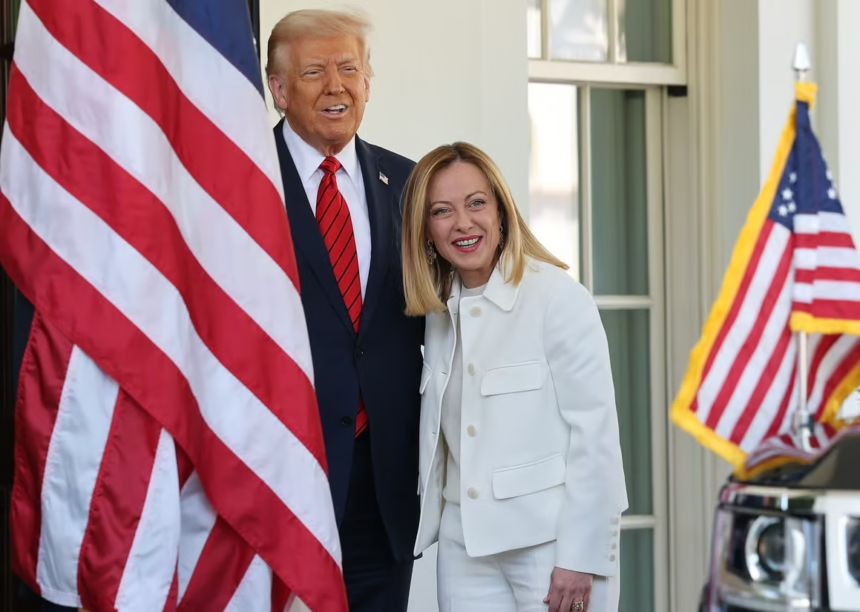
Italian Prime Minister Giorgia Meloni has acknowledged that her relationship with U.S. President Donald Trump has proved more complicated than she initially expected, while insisting that Italy’s foreign policy cannot be based on personal ties with the American president.
In an interview with The New York Times published Friday, Meloni said she had believed that her political convergence with Trump on issues such as immigration would make cooperation easier.
“It’s clear that with Donald Trump, I thought things would be easier,” Meloni said. “Things turned out differently.”
Meloni and Trump have generally maintained close relations, particularly over their shared positions on immigration and other conservative political issues. However, differences have emerged in recent months, including over Trump’s criticism of Pope Leo XIV and broader disagreements affecting relations between Washington and European capitals.
Meloni said she had not spoken with Trump for several weeks after becoming one of the first European leaders to publicly respond to the U.S. president. She described Trump’s criticism of the pope as a red line.
“I continue to believe that the unity of the West is something very important. I do not base Italian strategy on my personal relationships,” she said.
Asked whether she expected to speak with Trump after the summer holidays, Meloni replied: “Well, we’ll see.”
Meloni calls for a stronger role for Italy
Beyond her relationship with Trump, Meloni used the interview to argue that Italy should adopt a more assertive role in international affairs.
She rejected what she described as the idea of a “subservient Italy” and said the country should have greater influence over decisions shaping Europe and the wider international system.
“I don’t like the idea of a subservient Italy, an Italy that sees itself as inferior to others,” Meloni said. Italy, she argued, must “sit at the table of those who determine the direction.”
She also criticized Italy’s traditional position within Europe, saying Rome should stop acting as a “spare wheel for France and Germany” and instead pursue a stronger independent role.
The remarks reflect Meloni’s effort to balance Italy’s close relationship with Washington with its position as a major European Union member and NATO ally.
From personal ties to strategic interests
Meloni’s comments also suggest that her government is seeking to distinguish Italy’s long-term strategic interests from the personal relationship she has developed with Trump.
While the Italian prime minister has often been viewed as one of Trump’s more reliable partners in Europe, her remarks indicate that ideological and political alignment does not eliminate disagreements between Rome and Washington.
“I think what brought me here, to her office in Palazzo Chigi, was the courage to stand on the uncomfortable side of history,” Meloni said.
“To choose to go against the current,” she added.
Meloni also emphasized the importance of stability, describing it not as an end in itself but as the foundation for further action.
“Stability is not a point of arrival, but a starting point,” she said.
Her comments come as Italy seeks greater influence within Europe while navigating increasingly complex relations between the United States and its European allies. For Meloni, the challenge is to preserve strong transatlantic ties without allowing Italy’s foreign policy to become dependent on the personal relationship between two leaders.