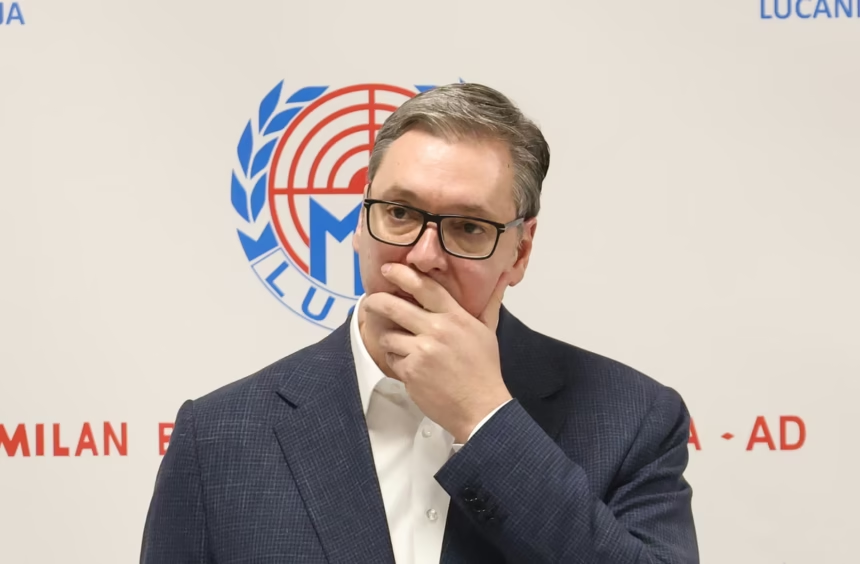
British newspaper The Times has published a critical assessment of Serbian President Aleksandar Vučić, portraying his long-standing strategy of balancing between Moscow and Brussels as increasingly difficult to sustain amid growing public dissatisfaction and the rise of the student protest movement.
In an extensive report, The Times describes Vučić as a political “chameleon” who has repeatedly adapted his positioning between Russia and the European Union while maintaining a highly centralized political system at home.
The newspaper argues that the Serbian president’s political formula is now facing its most serious challenge since he came to power, as corruption, the rising cost of living and distrust in institutions have fueled a student-led protest movement that has become more popular than Vučić himself in some opinion polls.
The report opens with Vučić’s recent visit to the southwestern Serbian town of Nova Varoš, where residents approached him with requests concerning jobs and local infrastructure.
The scene, according to The Times, reflected a political culture in which citizens are encouraged to appeal directly to the president for solutions to personal and local problems rather than rely on functioning institutions.
The newspaper links this dynamic to the broader concentration of political power around Vučić, arguing that his public image has long been built around the idea that he personally resolves problems that institutions have failed to address.
A balancing strategy under pressure
According to The Times, Vučić’s political survival has depended heavily on his ability to maintain relationships with both Russia and the West.
For years, Western governments have largely tolerated his increasingly authoritarian domestic politics because of Serbia’s strategic importance, its position in the Balkans and the hope that Belgrade could eventually move closer to the European Union.
The newspaper argues, however, that patience in both Brussels and Moscow may be running thin.
While Serbia has maintained close political and energy ties with Russia and has refused to join Western sanctions against Moscow, Vučić has simultaneously presented himself to European governments as a pragmatic partner committed to Serbia’s eventual EU membership.
The Times describes this strategy as a carefully maintained “chameleon routine” that allowed Vučić to extract political and economic advantages from both sides.
But the report argues that the strategy is becoming harder to sustain as Serbia’s domestic political environment changes.
Political analyst Nikola Burazer told the newspaper that Serbia’s political system has developed into an authoritarian model specifically designed to remain acceptable to the European Union.
Students emerge as a political force
The most significant challenge to Vučić, according to The Times, is coming not from traditional opposition parties but from Serbia’s student movement.
The protests began after the deadly collapse of the Novi Sad railway station canopy in November 2024 and developed into one of the largest sustained movements against the government in recent Serbian history.
The newspaper describes the students as potentially the strongest political force in the country.
According to a June survey by the Center for Research, Transparency and Accountability (CRTA), 59 percent of respondents supported the student protests, while only 36 percent said they trusted Vučić.
Among decided voters, 45 percent said they would vote for a proposed Students’ List, compared with 36 percent who said they would support Vučić’s Serbian Progressive Party (SNS).
That development is particularly significant because, as The Times notes, no opposition political party has managed to surpass Vučić’s political machine in polling during his 12 years at the center of Serbian political power.
The newspaper presents the figures as evidence that the student movement has broken through a political barrier that traditional opposition parties have repeatedly failed to overcome.
Vladan Đokić emerges as a potential challenger
The Times also focuses on University of Belgrade Rector Vladan Đokić, portraying him as one of the most prominent public figures associated with support for the student movement.
The newspaper describes Đokić as almost the opposite of Vučić: a restrained academic figure who has nevertheless become a target of intense political attacks.
According to the report, Đokić has faced a prolonged campaign of government-linked criticism, with Vučić himself accusing him of being a “parasite” and “terrorist.”
Đokić has also faced criminal complaints and questioning by police, although he told The Times that the cases against him remain unresolved.
His public profile increased further after police entered university premises earlier this year amid an investigation following the fall of a student from a university building.
After the police operation, Đokić addressed supporters gathered outside and declared that the government was attacking the university not because it had done something wrong, but because it had stood with the students.
The episode helped establish him as a possible political figure for the movement.
Asked about the possibility of becoming a presidential candidate, Đokić said it was “something I never dreamed of.”
From nationalist politician to Western “stabilocrat”
The newspaper also revisits Vučić’s political past.
Before becoming one of the West’s preferred interlocutors in the Balkans, Vučić was a senior figure in the Serbian Radical Party and served as information minister during the Kosovo war, when Serbia imposed severe restrictions on independent media.
The Times recalls his inflammatory wartime rhetoric, including his 1995 statement in the Serbian parliament that if one Serb were killed, 100 Muslims would be killed in response.
The newspaper argues that Vučić later transformed his political image, leaving the Radicals and becoming one of the founders of the Serbian Progressive Party, which formally embraced Serbia’s path toward EU membership.
Western diplomats subsequently embraced him as a “stabilocrat” — a leader viewed as capable of containing regional tensions and maintaining political stability.
But The Times argues that the model has increasingly failed to deliver the democratic reforms expected by the EU.
Expo and allegations of political favoritism
The report also examines Serbia’s preparations for Expo 2027, describing the project as one of Vučić’s flagship initiatives.
The newspaper raises questions about the transparency of contracts and subcontractors involved in the construction project, noting that legal changes have exempted Expo-related procurement from some public procurement rules.
It alleges that companies connected to Serbia’s political elite have benefited financially from the project, while the identities of some recipients of funds have been classified.
These allegations add to broader concerns about corruption and the concentration of economic power around the ruling establishment.
Growing distance between voters and Vučić
Perhaps the most consequential finding in The Times report is that the political environment on which Vučić built his dominance may be changing.
The newspaper points to growing concern over corruption, living costs and the functioning of democratic institutions, while younger Serbians appear increasingly willing to engage directly in politics.
The student movement has mobilized large numbers of young people and transformed dissatisfaction into sustained political pressure.
At the same time, Vučić continues to rely heavily on a highly personalized political model in which the president remains the central figure in solving problems, controlling the political narrative and determining the timing of elections.
The Times suggests that this model may be reaching its limits.
For years, Vučić benefited from presenting himself simultaneously as Serbia’s indispensable leader, a defender of national interests and a pragmatic partner of the West.
But the rise of the student movement has created a new political reality: for the first time in years, an organized movement outside the established party system is attracting greater support than the president himself.
The challenge for Vučić is therefore no longer simply how to balance Moscow and Brussels. It is whether he can preserve a political system built around his personal authority as Serbian society increasingly demands accountability, institutional reform and a greater role for democratic politics.