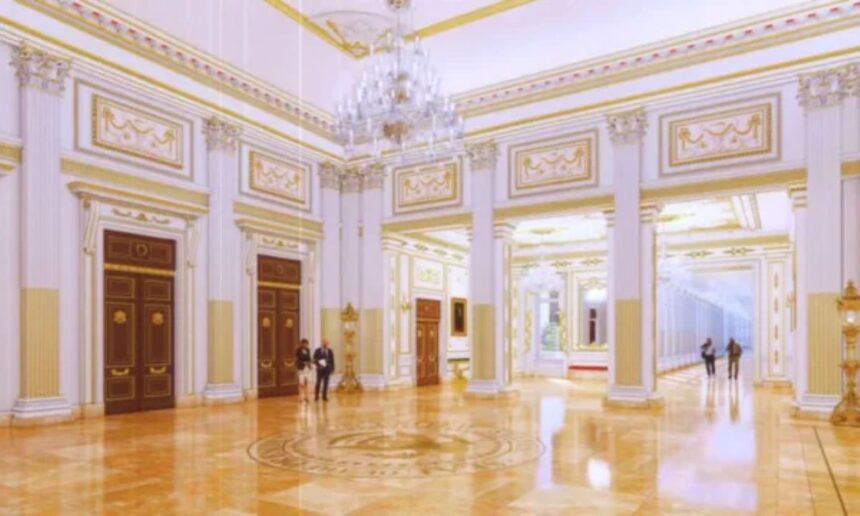
The U.S. Supreme Court has temporarily cleared the way for President Donald Trump to continue construction of a large ballroom at the White House, suspending a lower-court order that would have required work to stop at midnight Friday.
The order issued Friday afternoon does not determine whether the project itself is lawful. Two lower courts have previously ruled that Trump was proceeding unlawfully because Congress had not authorized the construction. Instead, the Supreme Court’s action gives the justices additional time to consider Trump’s request to indefinitely suspend those rulings.
The construction project has advanced rapidly. According to a filing submitted by the Trump administration to the Supreme Court, a workforce of about 250 people has been working 20 hours a day, seven days a week. The administration said the ballroom complex is approximately 65% complete overall.
Chief Justice John Roberts issued Friday’s administrative order in his capacity as the justice responsible for emergency matters arising from the U.S. Court of Appeals for the District of Columbia Circuit. The order did not set a new deadline, meaning construction can continue until the Supreme Court issues another ruling.
Because the matter was handled as an administrative stay by Roberts, the order contained no explanation, vote count or dissenting opinion. Roberts is expected to refer the case to all nine Supreme Court justices.
Trump’s signature White House construction project
Since returning to office last year, Trump, a former real estate developer, has pursued a series of changes to Washington that reflect his personal preferences. The ballroom project has emerged as the centerpiece of that effort.
Last year, Trump ordered the demolition of the former East Wing of the White House to make room for the new events facility, a move that drew opposition from lawmakers and preservationists from both parties.
“This will be the largest military complex, in combination with the ballroom, anywhere in the world. There will be nothing like it,” Trump said in August while discussing the project.
People familiar with Trump’s thinking have described the ballroom and other construction initiatives as central to the president’s desired legacy. Trump has also suggested that those opposing the project are “very disloyal to our country.”
Preservation group challenges project
The National Trust for Historic Preservation, one of the leading U.S. organizations dedicated to protecting historic sites, filed a lawsuit against the project in December.
The organization subsequently persuaded a federal judge in Washington to order Trump to halt construction of the ballroom until Congress authorized the project.
Judge Richard Leon allowed workers to continue building a highly sophisticated bunker beneath the proposed ballroom, citing the administration’s argument at the time that the two facilities were separate.
As construction progressed, however, Trump and senior officials increasingly argued that the entire structure was necessary for national security, pointing to assassination attempts against the president in recent years.
Trump unsuccessfully asked the D.C. Circuit Court of Appeals to overturn Leon’s ruling. In early August, the appeals court upheld the decision in a 2-1 ruling and ordered construction to stop beginning August 21.
“The question of whether or not a large ballroom should be built is for Congress to decide and is not a matter for the executive branch to resolve unilaterally,” the appeals court said.
The court also concluded that the National Trust had demonstrated that Congress had not granted the executive branch unlimited authority to “drastically redesign, reshape, and rebuild” the White House to suit the wishes of an individual president.
Trump asks Supreme Court to intervene
Days after the appeals court ruling, Trump asked the Supreme Court to intervene.
U.S. Solicitor General D. John Sauer argued that the ballroom was necessary because of previous threats to the president’s life, national security requirements and architectural considerations.
“The President of the United States is not a tenant, but the sole elected head of the Executive Branch,” Sauer wrote, arguing that Congress had authorized the president to renovate, secure and protect the White House and its surrounding grounds, as previous presidents had been permitted to do.
Sauer described Judge Leon’s decision as an improper expansion of judicial authority.
The Supreme Court’s latest action does not resolve the underlying dispute over the project. It temporarily allows construction to continue while the justices consider the administration’s request and the broader legal question of whether the executive branch has the authority to proceed without explicit congressional approval.