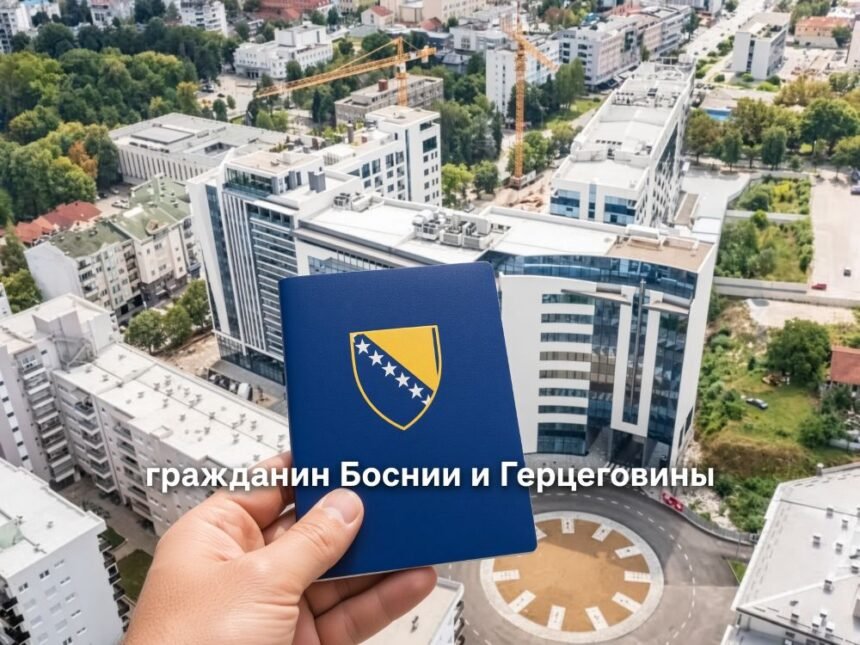
Bosnia and Herzegovina is moving to tighten rules governing the granting of citizenship to foreigners deemed to be of “special interest” to the country, amid growing questions over whether some applicants have delivered the economic, sporting or other benefits cited in their citizenship recommendations.
The issue has come under renewed scrutiny following the case of Russian businessman Mikhail Litovchenko, who was granted Bosnian citizenship in August 2024 after being designated a person of special interest who could bring economic benefits to the country.
Nearly two years later, companies linked to Litovchenko have recorded losses, one has changed ownership, while another has had its bank accounts blocked, according to business records reviewed by Radio Free Europe.
Litovchenko is among roughly 40 foreign nationals who have received Bosnian citizenship since the beginning of 2023 through the special-interest mechanism. The law allows foreigners to obtain citizenship on this basis without meeting all of the requirements imposed under the regular naturalization procedure.
However, Bosnia currently has no clear mechanism for determining whether the business plans and investments cited in citizenship recommendations were actually fulfilled, or which institution should be responsible for monitoring them.
The Ministry of Civil Affairs is now seeking to tighten the rules, warning that recommendations have in some cases been issued too easily and with insufficient justification.
Questions over Litovchenko’s businesses
Litovchenko founded Tourist Innovations several months before receiving Bosnian citizenship. The company later changed its name and headquarters and now operates as Softio in Pale.
Registered as a computer-programming company, Softio has one employee and recorded a loss of around €20,000 in 2025, according to CompanyWall data.
At the time he applied for citizenship, Litovchenko was also associated with Sarajevo-based Express Consulting, which he acquired in 2022. He remained its owner until June 2025, when ownership changed. Business records now show that the company’s accounts are blocked.
Radio Free Europe was unable to reach Litovchenko for comment. Most telephone numbers associated with his companies were no longer operational, while questions sent by email went unanswered.
His citizenship recommendation was issued by the Chamber of Commerce of Republika Srpska. The chamber did not respond to questions about the basis for the recommendation or the information it had regarding his business plans.
Before obtaining Bosnian citizenship, Litovchenko was also known to conduct business in neighboring Croatia, where two companies currently linked to him have recorded losses in recent years.
One of them, Business Solution, based in Zagreb, was taken over in March 2025. Until then, it had been managed by Russian national Anna Alferova, who herself obtained Bosnian citizenship in May 2025 as a person considered to be of special interest in the field of sport.
Her application was recommended by the Biathlon Federation of Bosnia and Herzegovina, which had begun operating only three months before her citizenship was granted. The federation had not responded to questions about the basis for its recommendation.
A broader Russian connection
Litovchenko is not the only Russian national to receive Bosnian citizenship through the special-interest mechanism.
Since the beginning of Russia’s full-scale invasion of Ukraine in 2022, five Russian citizens have received Bosnian citizenship under the accelerated procedure for people considered to provide a special benefit to the country, while another application remains pending.
Among them are Ljudmila and Evgenij Budilov, who received citizenship in September and October last year after being presented as potentially beneficial to Bosnia’s economy.
Ljudmila Budilova is the owner and director of Eva Genesis in Banja Luka. Court registry data show that the company was established in March 2025 with founding capital equivalent to one convertible mark.
The company attracted attention after Telegram deputy CEO Ilya Perekopskii applied for Bosnian citizenship earlier this year. The Chamber of Commerce of Republika Srpska said it intended to acquire a stake in Eva Genesis and use the company for investments in digital marketing, information technology and the fashion industry.
The chamber has also been involved in recommending other Russian applicants.
In Republika Srpska, 50 Russian citizens have established companies over the past four years, according to data provided to Radio Free Europe by the Agency for Intermediary, IT and Financial Services. The companies are generally small businesses involved in areas such as business consulting, computer programming, IT services, trade and construction.
Among them is IREQ, a company registered this year in Banja Luka for the trade of machinery and equipment and owned by Aleksandar Gennadievich Zamakhin.
Zamakhin was previously associated with FAM Robotics, a company sanctioned by the United States over links to Russia’s military and industrial sectors.
The Republika Srpska government supported his application for Bosnian citizenship, saying he intended to transfer business operations to the entity and invest there. The Council of Ministers has not yet issued a final decision, and Zamakhin did not respond to a request for an interview.
Another company in the entity was established by Russian national Andrei Beker, who has been linked to allegations concerning the training of Moldovans to provoke unrest in Moldova. Ukrainian website Mirotvorets has also identified Beker as an alleged member of the Russian Wagner mercenary group.
Who recommends citizenship applicants?
Since the beginning of 2023, 43 foreigners have received Bosnian citizenship under the special-interest mechanism, while the Ministry of Civil Affairs has received 56 applications.
The recipients have included businesspeople and athletes from Russia, Turkey, Serbia and Croatia.
Recommendations can be submitted by relevant ministries, the Foreign Trade Chamber of Bosnia and Herzegovina, entity governments, the Brčko District government, entity chambers of commerce, the Olympic Committee of Bosnia and Herzegovina and registered sports federations.
These recommendations form part of the documentation reviewed by the Ministry of Civil Affairs, while the final decision is made by the Council of Ministers.
Mirsad Jašarspahić, president of the Chamber of Commerce of the Federation of Bosnia and Herzegovina, told Radio Free Europe that recommendations take into account economic indicators, business plans, existing and announced investments and contacts within the business community.
He stressed that chambers of commerce do not nominate people for citizenship but provide recommendations for individuals who have already applied.
Bosnia moves to tighten the rules
Bosnia’s citizenship law provides for regular naturalization of foreigners who, among other requirements, must have held permanent residence in the country for at least three years and satisfy additional conditions.
A separate mechanism applies to people considered to be of special benefit to Bosnia because of their expected contribution to the economy, sport, culture or science.
This mechanism allows applicants to bypass some of the requirements of regular naturalization, including the three-year permanent-residence requirement and, in some cases, the requirement to renounce their existing citizenship.
The procedure is currently regulated by a 2009 rulebook. The Ministry of Civil Affairs has drafted a replacement aimed at making the process more restrictive and precise.
According to the ministry’s explanation, some applicants have received recommendations too easily, with brief or incomplete justifications, including cases in which there was insufficient evidence that the applicants were actually of special benefit to Bosnia.
The proposed rules would narrow the list of institutions able to nominate individuals and remove the Foreign Trade Chamber and entity chambers of commerce from the process.
The new rules would also clarify security checks, with the ministry expected to obtain information from Bosnia’s Service for Foreigners’ Affairs and Intelligence-Security Agency.
The proposed rulebook was discussed by the Council of Ministers on July 30 but failed to receive the required support in the first round of voting.
EU concerns extend beyond Bosnia
The issue is not unique to Bosnia and Herzegovina.
Serbia also allows citizenship to be granted to people considered to be of special interest to the country. According to the European Commission, more than 200 Russian citizens had received Serbian citizenship under such provisions since 2022.
The European Commission has urged Serbia not to use accelerated citizenship procedures for nationals of countries considered security risks to the EU and has called for adequate security screening.
Radio Free Europe reported that in the first half of this year, the Serbian government granted citizenship to Russian nationals at roughly four times the rate of citizenship granted to all other foreign nationals combined. Some of the Russians were reportedly subject to international sanctions.
Montenegro also has provisions allowing citizenship to be granted when authorities determine that doing so is in the country’s interest. That framework was used for the country’s economic citizenship program, launched in 2019 and discontinued at the end of 2022 following repeated European Commission warnings over security and migration risks.
According to the Montenegrin Investment Agency, 807 citizenships were granted before the program was abolished, primarily to nationals of Russia and China.
The developments in Bosnia are therefore part of a broader regional debate over accelerated naturalization, foreign investment and the security risks associated with granting citizenship to foreign nationals without the safeguards required under standard procedures.
The Bosnian government’s proposed reforms are intended to address those concerns by strengthening oversight and ensuring that claims of economic or other benefits are supported by verifiable evidence rather than broad promises made during the citizenship process.