Twenty-seven years after the end of the war in Kosovo, the fate of 1,579 people remains unresolved, leaving thousands of family members trapped between hope, uncertainty and the absence of justice.
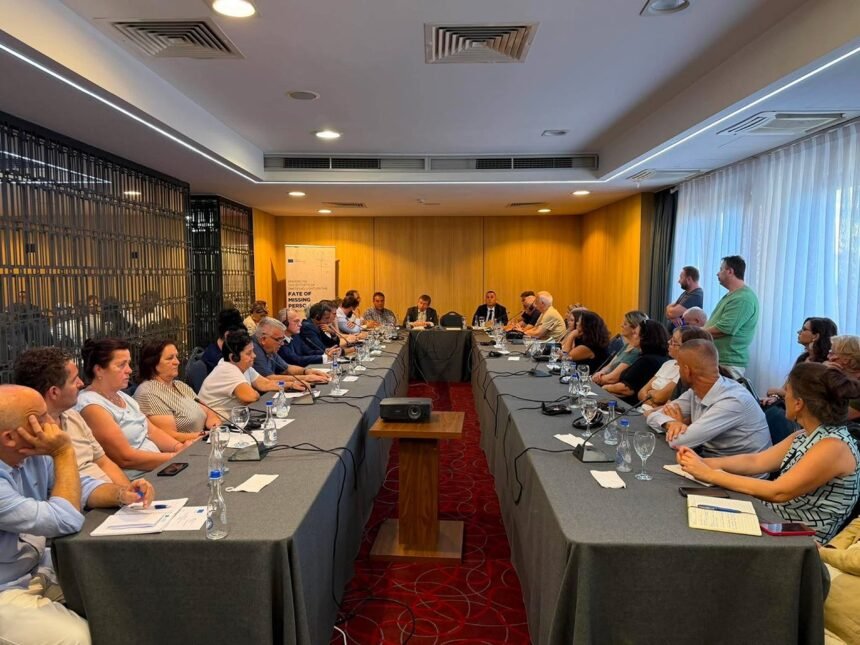
On the International Day of the Victims of Enforced Disappearances, representatives of Kosovo’s institutions, international organisations, human rights groups and families of missing persons renewed calls for greater institutional responsibility, transparency and cooperation to establish what happened to those who disappeared during the war and to ensure that those responsible are held accountable.
The issue was discussed at a public event organised by the Humanitarian Law Center Kosovo and the Resource Center for Missing Persons, bringing together representatives of institutions involved in the search, identification and investigation of missing persons.
A question of justice, not statistics
Bekim Blakaj of the Humanitarian Law Center Kosovo stressed that the International Day of the Victims of Enforced Disappearances should not be reduced to an occasion for remembrance.
According to him, the unresolved fate of missing persons represents an ongoing obligation for institutions to act, provide information and establish the truth.
“Many families in Kosovo continue to live in uncertainty and in a state of waiting,” Blakaj said, emphasising that the issue must be understood not only as a humanitarian matter but also as a question of the right to truth and justice.
He called for stronger institutional engagement to identify potential burial sites, recover and identify human remains, establish the circumstances surrounding the disappearances and bring those responsible before justice.
Blakaj also said that meetings such as this provide families with an opportunity to receive information directly from competent institutions and to ask questions about the progress of investigations.
Families still waiting for the truth
For the families of the missing, the passage of time has not diminished the importance of finding answers.
Boguslaw Gertruda, Acting Head of the European Union Office in Kosovo, said the commemoration was an opportunity not only to remember the missing and stand in solidarity with their families, but also to ensure that the legacy of the war is not erased or distorted over time.
He highlighted the role of civil society organisations in documenting the past and preserving the stories of victims.
“They are guardians of the truth, storytellers of untold stories and voices ensuring that the events of the past are neither forgotten nor distorted,” Gertruda said.
Christoph Fuchs, Switzerland’s Chargé d’Affaires a.i., described the issue of missing persons as one of the most painful legacies of the Kosovo conflict.
More than two decades after the war, he noted, 1,579 people remain missing.
Behind that number, he said, are individual lives, families and stories that remain unresolved.
“For family members, this is not simply a number or a historical issue. It is personal. It concerns a loved one whose fate remains unknown,” Fuchs said.
He stressed that the passing of time does not remove the families’ right to know what happened to their relatives.
New human remains discovered in northern Kosovo
While thousands of cases remain unresolved, authorities continue to search for possible burial sites.
Florim Elshani of the Kosovo Police’s Directorate for War Crimes said that the Missing Persons Search Sector has recently been focused on the Zubin Potok area, including the villages of Cirkulja, Jabukë, Kalludër and Zhagull.
According to Elshani, searches at three locations produced positive findings, resulting in the recovery of a minimum of human remains belonging to 11 individuals.
The remains were transferred to the Institute of Forensic Medicine for further examination.
Preliminary assessments by forensic anthropology experts determined that the remains were human and of forensic interest, meaning that they could be connected to the 1999 conflict and require further forensic and DNA analysis.
The identification process will depend on detailed examinations and comparisons with available DNA samples.
Forensic investigations continue
Ditor Haliti of the Institute of Forensic Medicine said that excavation and exhumation work began on July 28 at a location in Kalludër e Vogël.
While the police investigation continued, two additional locations were identified and subsequently addressed by the relevant teams.
Haliti said the Institute of Forensic Medicine has played a central role in the excavation and exhumation process, working together with EULEX and its forensic medicine team operating within the institute.
The recovery of remains is only the first stage of a lengthy process. Once remains are recovered, forensic specialists must determine their identity and establish whether they correspond to any of the individuals officially registered as missing.
The right to know
Ibrahim Makolli of the Resource Center for Missing Persons said that commemorations such as the International Day of the Missing provide an opportunity to assess what has been achieved and, more importantly, determine what must still be done.
Twenty-seven years after the end of the war, more than 1,500 people remain missing.
For their families, the central demand remains unchanged: access to all available information that could help establish the fate of their loved ones.
Makolli stressed that the right of families to know is clearly recognised under international standards, but argued that families do not always receive sufficient information about the progress of investigations and searches.
This lack of information, he said, has contributed to frustration and, in some cases, a loss of confidence in the process.
He identified three interconnected responsibilities: the families’ right to know, the obligations of Kosovo’s institutions and the role of international institutions involved in the search for missing persons.
A case that cannot be closed while the truth remains unknown
The unresolved cases of Kosovo’s missing persons remain one of the most enduring consequences of the 1999 war.
For the families, the issue is not confined to history or statistics. Every unresolved case represents a person whose fate remains unknown and a family without the certainty needed to grieve.
The discovery of human remains in northern Kosovo demonstrates that investigations can still produce new evidence, even decades after the conflict.
But recovery alone is not enough.
The remains must be identified, the circumstances of the disappearances established and the broader chain of responsibility investigated.
Until that happens, the question of the missing remains unfinished.
Twenty-seven years later, families are still waiting for answers — and for justice to accompany the truth.