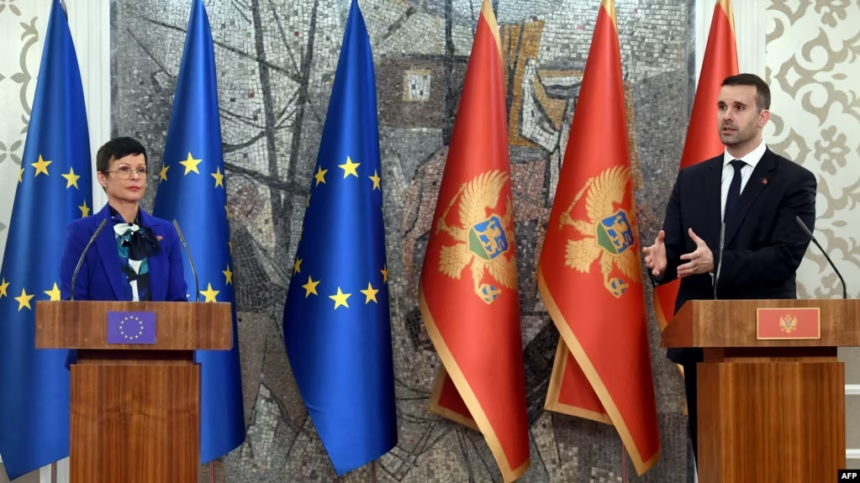
The European Commission has warned that any interference in Montenegro’s accession process is “unacceptable,” as Podgorica raises concerns over possible hybrid activities aimed at destabilizing the country and undermining its path toward EU membership.
“We remain in close contact with the Montenegrin authorities and continue to carefully monitor developments in order to support the country’s stability and its path toward EU membership,” a European Commission spokesperson said in a written response to Radio Free Europe.
The statement follows remarks by Montenegrin Prime Minister Milojko Spajić on August 27, when he said the government had received what he described as “serious operational security information” indicating that the expected closure of additional EU accession chapters could be accompanied by coordinated hybrid activities involving officials from at least two countries in the region.
According to Spajić, the alleged activities are intended to destabilize Montenegro and could receive support from certain political actors and parts of the domestic media landscape.
Spajić did not identify the two countries he was referring to and did not publicly provide evidence supporting his claims.
EU offers support against hybrid threats
The European Union has reaffirmed its support for Montenegro in strengthening its resilience against hybrid threats, including activities that could undermine the country’s EU accession process.
The European Commission said its assistance focuses on strengthening democratic institutions, media resilience and media literacy, as well as cybersecurity capabilities.
The warning comes as Montenegro remains the leading candidate among EU aspirants in the accession process. Podgorica has provisionally closed more than half of the negotiating chapters and aims to complete the negotiations by the end of 2026, with the goal of becoming an EU member in 2028.
Tensions with Serbia intensify
The Commission’s warning also comes amid growing tensions between Montenegro and Serbia.
Belgrade recently banned several Montenegrin journalists from entering Serbia after Serbian President Aleksandar Vučić announced reciprocal measures following Podgorica’s decision to bar Informer editor-in-chief Dragan Vučićević, a figure closely associated with the Serbian authorities.
Montenegro also imposed a six-month restriction on the rebroadcasting of Serbia-based Informer TV at the end of May.
Montenegrin authorities have accused some political structures in Belgrade of being unwilling to accept Montenegro as a sovereign state, further straining relations between the two neighboring countries.
Croatia remains another challenge
At the same time, unresolved issues between Montenegro and Croatia could complicate Podgorica’s efforts to conclude accession negotiations.
Croatia, as an EU member, has the ability to block progress in the accession process, making bilateral relations particularly important for Montenegro.
Tensions were further aggravated after Montenegrin Parliament Speaker Andrija Mandić expressed condolences following the death of former Bosnian Serb military commander Ratko Mladić, who died in The Hague on August 27 while serving a life sentence for genocide and other war crimes.
The episode drew criticism from Croatia and added another sensitive issue to Montenegro’s already complex regional and European agenda.
With Podgorica seeking to complete its EU negotiations this year, Brussels’ warning underscores the strategic importance of protecting Montenegro’s accession process from political pressure, hybrid threats and bilateral disputes.