A legislative initiative has been introduced in the United States House of Representatives, calling on the Pentagon and the State Department to conduct a detailed review of the military, security, and intelligence cooperation between Balkan countries and Russia, China, the United States, and NATO.
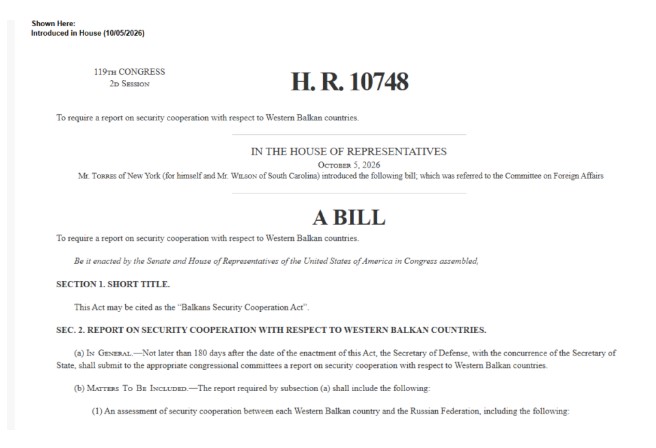
The proposed legislation, titled the Balkan Security Cooperation Act, was introduced on October 5 by Congressmen Ritchie Torres of New York and Joe Wilson of South Carolina. The bill, filed under the designation H.R. 10748, was referred to the House Committee on Foreign Affairs.
Under the proposal, the U.S. Secretary of Defense, with the approval of the Secretary of State, would be required to submit a comprehensive report to Congress on the security relationships of countries in the region with Russia, China, the United States, and NATO within 180 days of the law’s potential enactment.
The proposal covers Bosnia and Herzegovina, Serbia, Croatia, Montenegro, Kosovo, Albania, North Macedonia, and Slovenia.
The Pentagon would be required to provide a list of Russian and Chinese weapons systems, military equipment, and technology worth at least $1 million per item that countries in the region have purchased or received since 2012.
U.S. institutions would also have to document military exercises, security force training, signed agreements, and any intelligence cooperation with Moscow and Beijing.
A separate section of the report would assess the implications of such cooperation for the security interests of the United States, NATO, and countries bordering those included in the analysis.
The proposed legislation specifically highlights the Russian-Serbian Humanitarian Centre in Niš. The Pentagon would be required to assess the centre’s operations, including its potential influence and coordination with Russian intelligence agencies.
The centre in Niš has attracted the attention of Western security institutions for years because of questions surrounding the nature of its activities and its relationship with Russian state structures.
The proposed legislation is not limited to Russian and Chinese influence.
It would also require the collection of data on U.S. military equipment delivered to countries in the region since 2012, joint military exercises, security agreements, and intelligence cooperation with the United States.
Each country’s cooperation with NATO would be examined separately, including its activities under the Partnership for Peace programme.
The bill stipulates that the report must be submitted in an unclassified, publicly available format, with the option of including a separate classified annex containing sensitive information.
The proposal is currently moving through the legislative process. Its introduction does not mean that Congress has passed the legislation or that the Pentagon has already been formally required to prepare the report.