
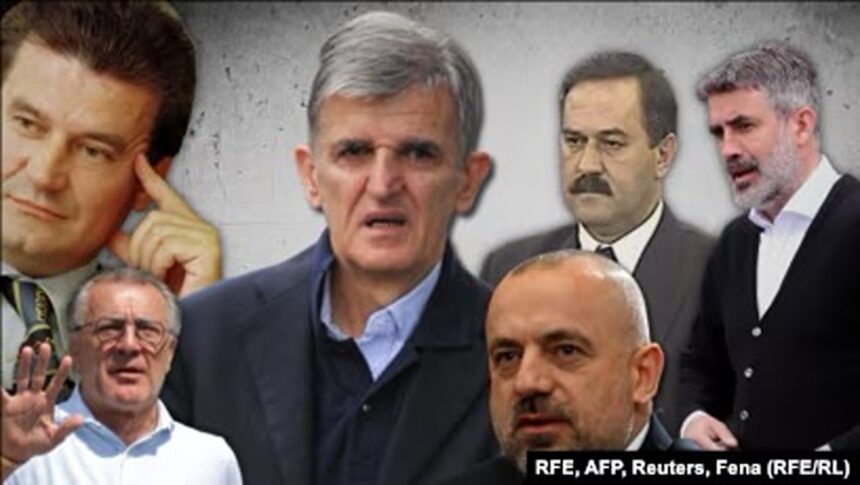
Extradition agreements were signed to prevent the abuse of dual citizenship and the practice of fleeing to neighbouring countries to evade justice.
In practice, however, they often fail to achieve this purpose.
Although most Western Balkan countries have bilateral extradition agreements, Svetozar Marović, the former president of the State Union of Serbia and Montenegro, is one of many individuals who have exploited porous borders and dual citizenship to avoid serving prison sentences or standing trial in their home countries.
Marović has been a free man since October 10, after the statute of limitations expired on his sentence in Montenegro for corruption.
He fled to Serbia after the court ruling was handed down in 2016.
Until the sentence became time-barred, Belgrade refused to extradite him, despite having an agreement with Podgorica on the mutual extradition of citizens accused of organized crime, corruption, and other serious criminal offences.
Vesna Rakić Vodinelić, a retired law professor from Belgrade, told Radio Free Europe (RFE/RL) that political ties have a significant influence on decisions to reject extradition requests from neighbouring countries.
According to her, Marović should have been extradited.
Beyond individuals who have evaded justice in neighbouring countries, the Western Balkans has also become a refuge for people wanted or convicted in countries around the world, from Romania to Thailand.
Convicted War Criminals and “Political Asylum Seekers” in Serbia
Bilateral agreements, which Western Balkan countries began signing mainly around 2010, allow for the extradition of their own citizens under specific conditions relating to organized crime and corruption.
However, these agreements do not apply to criminal offences committed before the agreements were signed. In the case of Serbia and Bosnia and Herzegovina, they also do not cover war crimes.
Despite an international arrest warrant, Novak Đukić, a former general of the Army of Republika Srpska who fled to Serbia in 2014 shortly before a court verdict was issued in Bosnia and Herzegovina, continues to live freely in Belgrade.
He was sentenced in Sarajevo to 20 years in prison for war crimes, specifically for the killing of 71 civilians in the area known as Kapija, in Tuzla.
Belgrade refuses to extradite him because Đukić also holds Serbian citizenship, and Serbia does not extradite its own citizens.
Former members of the Army and Police of Republika Srpska, Tomislav Kovač, Mirko Vručinić, and Duško Kornjača, also hold dual citizenship.
They are among several individuals wanted by the justice system of Bosnia and Herzegovina for war crimes who continue to live freely in Serbia.
Three years after taking responsibility for the armed attack on Kosovo Police in Banjska, Milan Radoičić also remains at liberty in Serbia.
Although Kosovo has issued five arrest warrants against him in recent years, and the United States and the United Kingdom have sanctioned him over alleged links to international organized crime, he attended an election rally on October 9 organized by the ruling party of Aleksandar Vučić.
Other individuals facing indictments by Kosovo’s justice system for various criminal offences, including war crimes, also live freely in Serbia.
Some remain active in public life, writing and promoting books, engaging in politics, and appearing in the media.
Although Pristina has issued arrest warrants against them, Serbia refuses to extradite them, meaning most are tried in absentia in Kosovo.
Belgrade does not recognize Kosovo’s independence and has no extradition agreement with it.
Cooperation between the two sides falls under the responsibility of the European Union Rule of Law Mission in Kosovo (EULEX).
Over the past decade, Serbian citizenship, asylum, or other forms of protection have also been granted to citizens of Romania, Bulgaria, Thailand, and other countries who are wanted by their national judicial authorities.
One such individual is Bulgarian businessman Tsvetan Vasilev, who is accused in his home country of involvement in 144 cases of embezzlement.
He fled to Serbia in 2014 and was granted political asylum seven years later.
Political asylum was also granted to Romanian businessman and former MP Sebastian Ghiță, who fled to Serbia in 2016 after several investigations were launched against him, including inquiries into suspected corruption.
Serbian authorities justified granting him asylum by citing the possibility that he could face persecution because of his political beliefs.
In 2019, the Serbian government also granted citizenship to former Thai Prime Minister Yingluck Shinawatra, who had been sentenced to five years in prison in Thailand for corruption.
“These are wealthy people, so it seems to me that corruption played a role in decisions concerning the extradition of citizens from these countries,” Rakić Vodinelić said.
Chinese citizen Cui Guanghai, whose extradition the United States is seeking on charges of espionage and the smuggling of military technology, disappeared from house arrest in Belgrade in 2025. He had been detained under an international arrest warrant issued at the request of the United States.
At the time, FBI Director Kash Patel told the U.S. Congress that Serbia was returning Chinese nationals accused of crimes to China rather than extraditing them to the United States.
In 2022, former Ukrainian intelligence official Andriy Naumov was also arrested in Serbia.
Belgrade rejected Ukraine’s request for his extradition in connection with an investigation into alleged abuse of official position.
Naumov was tried in Serbia and, in 2025, sentenced to one year in prison for a separate offence: money laundering.
The Mamić Brothers: Bosnia and Herzegovina’s Most Notorious Fugitives
One of the best-known individuals who has fled justice and is living in Bosnia and Herzegovina is Zdravko Mamić, the former executive vice-president of Croatian football club Dinamo Zagreb.
In 2018, Mamić was found guilty of embezzling money from the club and sentenced to six and a half years in prison.
Before the verdict was handed down, he fled to Bosnia and Herzegovina, whose citizenship he had previously obtained on the basis of his ancestry.
Bosnian authorities rejected Croatia’s request for his extradition.
His brother, Zoran Mamić, a former footballer and coach, similarly avoided serving his sentence. He was sentenced in Croatia to four years and eight months in prison for embezzling money from Dinamo Zagreb.
He now works for Sarajevo Football Club as an adviser to the club’s owner.
In 2010, Miroslav Kutle also fled from Croatia to Bosnia and Herzegovina. He had been convicted of three offences involving the abuse of authority in business activities.
He also holds Bosnian citizenship through his ancestry and continues to live freely in the country, where he has built a business empire.
At the end of September, the statute of limitations expired on the final case in which he was wanted by Croatian justice.
Jozo Ćurković, former director of the Salonit company near Split, fled to Bosnia and Herzegovina in 2004 before being indicted for economic crime and abuse of power.
Because he holds dual citizenship, he has never been extradited to Croatia.
In 2022, a court in Split sentenced him in absentia to three years in prison.
Other individuals wanted by Croatian authorities have also found refuge in Bosnia and Herzegovina.
Branimir Glavaš, who was convicted in 2009 of crimes against Serb civilians during the war in Osijek, used his dual citizenship to flee to western Herzegovina before the verdict was delivered.
He spent more than five years in Bosnian prisons after Bosnia and Herzegovina agreed to enforce his sentence.
However, he was released in 2015 after Croatia’s Constitutional Court overturned the conviction and ordered a retrial.
In 2025, Slovenian citizen Mladen Samaržija was arrested in the southern Bosnian town of Prozor under an Interpol arrest warrant.
Slovenian authorities wanted him, among other reasons, on suspicion of leading a drug-smuggling network.
However, the Court of Bosnia and Herzegovina rejected the extradition request because no bilateral extradition agreement exists between the two countries.
Slovenia subsequently transferred the case to the Bosnian authorities, where it is currently under investigation.
Who Is “Hiding” in Montenegro and Kosovo?
Radomir Laban has avoided serving a prison sentence in Serbia since 2011 and has been a judge of the Constitutional Court of Kosovo since 2018.
Laban was convicted as a member of the so-called “customs mafia,” a group suspected of bribery-related offences.
His name has been on Interpol’s wanted list since 2014.
His integrity has been questioned in Kosovo.
Former President Vjosa Osmani described him as a threat to national security in 2025, while the then Minister of Justice raised suspicions that he had collaborated with Serbia’s intelligence service.
The Constitutional Court of Kosovo previously told Radio Free Europe that a judge can be dismissed during their term “only for committing a serious criminal offence or for gross negligence in the performance of their duties,” following a proposal supported by two-thirds of the court’s judges.
The best-known case in Montenegro is that of former Thai Prime Minister Thaksin Shinawatra, who spent 15 years in exile before being arrested in Thailand in 2023, following convictions for several criminal offences.
During that period, he obtained Montenegrin citizenship in 2009 as an honorary citizen, despite being wanted by Interpol.
Former Montenegrin President Milo Đukanović stated at the time that Shinawatra could not be extradited to Thailand because Montenegro’s Constitution prohibited the extradition of its own citizens to other countries.
After returning to Thailand, Shinawatra served his sentence and was released on parole in May 2026. He was pardoned in June.
In October 2026, he submitted an application for amnesty, seeking to have all legal proceedings terminated and all charges against him dismissed.