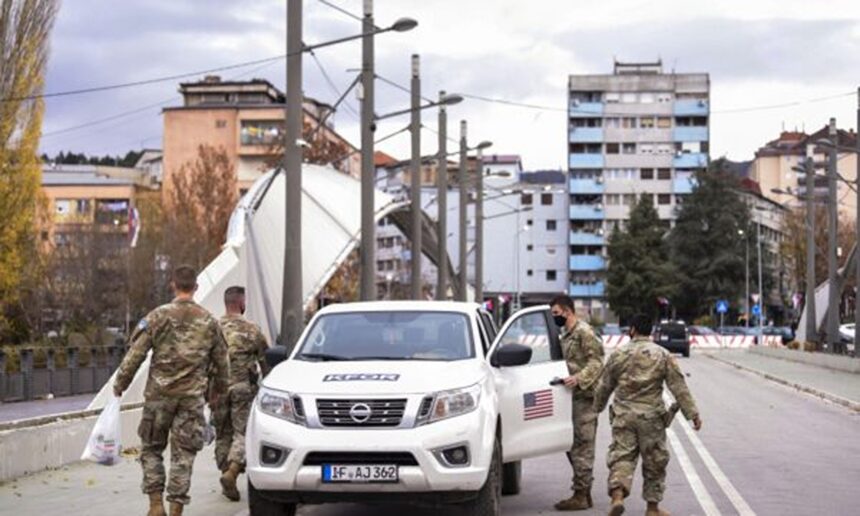
NATO has confirmed that the gradual reduction of KFOR’s permanent presence at the Iber Bridge in Mitrovica is underway, but says the process will depend on security conditions and that no operational timeline can be disclosed.
The adjustment is part of NATO’s broader effort to optimize KFOR’s deployment in Kosovo following an improvement in the overall security situation. NATO announced in June that KFOR’s posture would be gradually adjusted over the following year, while maintaining its core mission of ensuring a safe and secure environment and freedom of movement.
In a response a NATO official said the transition away from KFOR’s permanent position on the bridge is being carried out gradually and in close coordination with the Kosovo Police, EULEX and other relevant stakeholders.
“The transition from KFOR’s permanent presence at the Ibar Bridge is based on certain conditions,” the NATO official said, adding that the Alliance cannot provide operational details or a specific timeline.
The move should not be interpreted as a NATO withdrawal from northern Kosovo.
KFOR has stressed that it will maintain a visible presence in both North and South Mitrovica, as well as throughout northern Kosovo. NATO has also made clear that the optimization process can be reversed if developments on the ground threaten lasting security or regional stability.
The permanent KFOR presence at the main Ibar Bridge began to be reduced on August 10, as part of the broader restructuring of the mission. The process is being coordinated with Kosovo institutions, the Kosovo Police, EULEX and other international actors.
KFOR does not decide whether the bridge opens
NATO has also underlined an important distinction: KFOR is responsible for security, not for deciding the political or administrative status of the bridge.
According to the NATO position, decisions on whether the bridge should be opened to vehicle traffic fall to the relevant institutions in Kosovo and the European Union—not to KFOR.
Even after the permanent position is removed, KFOR personnel will remain in the surrounding areas and retain the ability to respond to security developments under its UN mandate.
NATO’s current position is therefore clear: the permanent checkpoint may be changing, but NATO is not leaving northern Kosovo.
The adjustment reflects what NATO describes as improved security conditions and the increasing capabilities of Kosovo’s security institutions, while preserving the Alliance’s ability to respond if the situation deteriorates. KFOR continues to operate under UN Security Council Resolution 1244 and coordinates closely with the Kosovo Police and EULEX in their respective roles.
As for the reported cancellation of a meeting between KFOR Commander Major General Özkan Ulutaş and Prime Minister Albin Kurti, NATO declined to provide details, citing its policy regarding schedules and meetings of NATO officials and commanders of NATO-led missions.